Friday, January 14, 2022

Taking Them Out


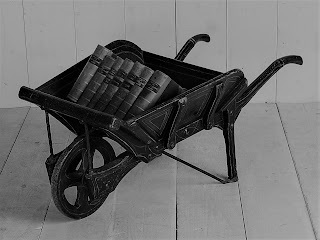
"On a fair estimate, the dictionary is the book above all books. All the other books are in it: it is only a matter of taking them out."

- Anatole France, from On Life and Letters, 2nd Series


What's the answer? Still don't know. The question I was asking myself last night wasn't as simple as this, but for simplicity's sake here it is:

When did I stop using a dictionary? 

The next question of course has to be when did I start? Can't answer that one either. 

Might as well start there:

My First Dictionary

Dictionaries would seem to have always just been there, like capers or a flyswatter; never noticed until needed. The only dictionary I remember in the house in which I grew up was a small thing, with red vinyl covers repaired with tape. It was thumb-indexed* and had tiny illustrations that I loved even before I could read. Did I ever actually use that book? I don't remember. Must have done, wanting other options, but when? Looking online I found all sorts of advice to parents and teachers about introducing children to the use of a dictionary. The consensus -- to the extent that there is consensus online on any subject -- would seem to be that kids should be "looking up words" as early as the second and third grade. Was I? Maybe. I don't remember much of anything about elementary school other than the names of my teachers and that they were uniformly nice ladies of a certain age. I know I was reading by the third grade and writing. I know this because I wrote and illustrated stories for my third grade teacher, Mrs. Stinson and I remember vividly that she read one of my stories, about cats flying hang-gliders, to the class. I was terribly proud. That's pretty much all I remember about third grade. (It seems that even in retrospect children are a bit self-involved, doesn't it? Me anyway.) Surely by then I was "looking up words"?

At some point someone taught me the particulars of using a dictionary properly, though that must have been later than the third grade? Don't think anyone explains "etymology" or "derivation" to third graders. Those pronunciation keys still give me fits. Never really mastered those. Alternate spellings and multiple definitions also confused me as I remember. I think it must have been in the fifth or sixth grade that I had a lengthy and doubtlessly annoying confrontation over certain adjectives ending in "ful." I found this idea delightful but was sorely disappointed to learn could not properly be applied to any noun I fancied such as "cup," or "whale." I turned to the dictionary for support and was sore disappointed. I do have a vague memory from the same period of learning the function of various reference materials in addition to the dictionary: thesaurus, atlas, encyclopedia, the index card file in a library. (Does anything like this still happen?)

The One(s) I Kept

Not the first dictionary I bought, but the first one I felt quite smug about owning was a 1932 printing of the Oxford Universal Dictionary. (I believe "Aeroplane" is listed in the "New Words." Not to be rushed was Oxford in those days.) I still have it. It is a single volume the size of  sofa cushion. I actually bought and painted a low table on which to keep it. (My illustrated New Century Dictionary in two volumes lives underneath the Oxford.) A recent survey of my references books includes two more Oxford dictionaries, a matching thesaurus, the Clement Wood Rhyming Dictionary, A Roget's Thesaurus "in dictionary form" and a reproduction of the standard edition as Roget designed it, Bartlett's Familiar Quotations from the 1950s before they started adding in quotes from Kermit the Frog and taking out Walter Savage Landor, A Strunk & White, an old Fowler's, and various odds and sundries of quotation, history, and usage. 

And yes, I own a faithful and rather pricey reproduction of Samuel Johnson's A Dictionary of the English Language, as well as two books of selections therefrom and various titles about. Taking Johnson's Dictionary up to have another look actually prompted the questions with which I began. 

Seven years of very hard thought and considerable, sometimes very difficult labor, went into making this landmark in our language. Begun in poverty, both personal and of previous examples in English, with a commission from the booksellers (i. e. publishers,) Johnson finally published in 1755, just as poor as he started in all but reputation. It is now most famous for the author's sometime acerbic definitions such as:

"lexico'grapher. A writer of dictionaries; a harmless drudge, that busies himself in tracing the original, and detailing the signification of words."

and:

"load. (3) As much drink as one can bear."

or:

"viz. (This word is videlicet, written with a contraction.) To wit; that is. A barbarous form of an unnecessary word."

Johnson's Dictionary also set a standard not only in its size and comprehension, but in tracing the origin of words in the literature and providing the best examples of usage from same. He did not just improve upon the earlier English spellers and "word books," he systematized the language, provided a standard for all subsequent reference, and boldly asserted the full equality of English to any classical or continental language. An heroic task that earned him many accolades, including the degree he hadn't the money to pursue earlier in life when his father's business went bust. Thus it was Sam became Doctor Johnson. It's an inspiring story. There are others, not unlike.

I've read a good book about Noah Webster's efforts to produce his An American Dictionary of the English Language (1828), and a fascinating biography of Peter Mark Roget (1779 - 1869). The intellectual heavy-lifting required to make these standard reference works is frankly hard to imagine now, considering the available resources from which they all had to work. Of precedent was there nearly none, or nothing much good to them. It indeed took a kind of genius even to conceive these works and unimaginable devotion and diligence to see them through to publication and fame. So what do we miss in not using these books anymore?

Clement Wood (1888 - 1950) was evidently a better socialist than he was a poet. We remember him now if at all for for his complete or unabridged rhyming dictionary, a favorite of the late Stephen Sondheim. Wood's book presented not just word lists, but a system explaining how rhyme works, a way of training the eye and the ear to find and even anticipate rhyme. Likewise Roget in the original classified words under a whole apparatus of relationship that offered not just an inventory of alternatives and opposites but a way of thinking about words in relation. Bartlett's Familiar Quotations has been through eighteen editions since the first in 1855 and until recently it's organization and purpose was not just to gather quotations, but to familiarize the user with the greatest writers in English, promote the habit and facilitate the use of familiar literature in the everyday life of it's readers. Fowler's Dictionary of Modern English Usage, Strunk & White, the list of once standard reference works is if not long, certainly venerable, in part because the form of each was as useful as the content. All were intended to teach, and specifically to teach the best ways in which to practice the use of English and to pursue the information necessary so to do. 

And there are the lessons lost in this new age of miraculous convenience, of Rhyme Zone and Thesaurus dot com, calculator apps and Wikipedia. I use all of these now more than my reference books. (No better than I ought to be, remember?) I do not mean to suggest that we are not all of us better off thanks to these new resources and technologies. What is lost is the habit and practice of thinking about these matters in ways that only books seem able or inclined to teach us. Does one really need quotations from Dryden to understand the meaning of a word, or Fowler's sometimes witty if autocratic rules to decide between that and which? Obviously not. We do not need any of us Johnson's Dictionary now. Doesn't mean we might not want something of what it can still teach us.

Anatole France's noble tribute to the dictionary seems to me still true, all other books are still in it. Let us hope we don't forget the means of fetching them out.

*In case anyone does not now remember the term, these were those little alphabetized tabs with the tactilely satisfying notches cut into the pages, for ease of turning to the required letter.

Sunday, January 9, 2022

Other than Boswell


There's a reason we still read Boswell. Many reasons, come to that, but I mean in preference to all the other biographers of Samuel Johnson. Johnson died 1784. Boswell wasn't even the first out the gate. By the time he published in 1791 there had already been two very important entries. Sir John Hawkins published the first formal biography four years earlier and Hester Thrale Piozzi's Anecdotes of the Late Samuel Johnson was out by 1786. A whole raft of other writers and literary personalities were busy about the business of memorializing Johnson as well. Hawkins knew Johnson longer. Mrs. Piozzi knew him better. Both were more important to the Dr. personally than Boswell. Hawkins was at Johnson's deathbed. Piozzi made him a home and broke his heart. Compared to Hawkins', Boswell's book is a ramshackle affair, more tent than stately tomb (compared to Mrs. Thrale though, Bowell is a structural engineer.) I have both Hawkins and Piozzi in my library. I'm glad of both. Neither was much of a writer in the end, and neither's a patch on Bozzy. What both his primary rivals lacked was not love for their subject. It is delight they lack. Boswell delights in Johnson. Johnson, despite his profound pessimism and constitutional melancholy, delights in Boswell's youth and absurdity. We share in their delight and I think therein their immortality.

The thing about Boswell's Samuel Johnson is that for all his size, tics, repetitions, and bellicosity, should you go with Boswell to the Doctor's end you will either think yourself something for having gone so far, or you will want more. And there is more to be had for sure, not just in Johnson's own books but in more books about him, of which at a guess I should think there are more than any English writer save Shakespeare. 

Boswell's rivals are not really my concern just here (More on them both I hope on another day.) I am thinking instead of the modern biographers, from just the last century and this. Every generation since Boswell has contributed something to the ever growing heap of Johnson studies. G. Birbeck Hill's two volumes of miscellanies in 1897 set the standard at the start, but since then the specialists have reigned and any number have contributed popular and interesting books on some of the particulars. In 1955 Columbia professor James L. Clifford published Young Sam Johnson, using all the material Boswell didn't have to describe Johnson's beginnings.  (Clifford followed his first with a second volume, Dictionary Johnson: The Middle Years of Samuel Johnson. Both are wonderfully readable and informative still, specially as they describe Johnson before Boswell. Boswell's Presumptuous Task: The Making of the Life of Samuel Johnson (2001), by Adam Sisman is one such I mean to reread. Likewise Henry Hitchings' Defining the World: The Extraordinary Story of Doctor Johnson's Dictionary (2005.) There have been specialized books on everything from Johnson's politics to his prayers. In my experience most of these have sadly been academic in exactly the sense assumed correctly to make them unattractive to the general reader, meaning me. 

Can't really call either Paul Fussell's Samuel Johnson and the Life of Writing (1986) or Richard Holmes' Dr. Johnson & Mr. Savage (1994) full biographies. Fussell's brilliant little book is more a critical celebration of Johnson as an important 18th Century author of much more than just his landmark dictionary. Fussell was already a favorite of mine. This book is my favorite of his. Holmes is the much esteemed biographer of Coleridge and Shelley. His Johnson book is more an attempt to explore and possibly explain the unlikely early friendship of the younger Johnson and the poet, playwright, and murderer, Richard Savage, about whom Johnson himself wrote one of his most famous short biographies. That Holmes does not solve this puzzle doesn't make the book any the less fascinating. 

Far and away the least satisfying biographies since Boswell are the two most recent. Jeffrey Meyers is one of those professional biographers whose subjects seems to matter less than the regularity of his output. He's written books not only on F. Scott Fitzgerald and Edgar Alan Poe, but also Gary Cooper and Bogart. (Not a good sign. Think of someone writing cookbooks on subjects ranging from Szechuan noodles, to Jello salads, Mennonite charcuterie, and French pastry. I don't say the recipes will all be bad, but neither should one assume much depth of knowledge -- or flavor.) I've tried a couple of Meyers' books and each was I suspect the equal of all the others. His biography of Johnson, subtitled "The Struggle," might just as well have been titled, Samuel in His Smalls, so preoccupied is Meyers with the possibility that Johnson was a bossy bottom and rather liked it rough. Coulda been. Even if so, not quite the master-key Meyers seems to think.

The other recent major biography was something of a sequel. In 1999 Professor Peter Martin, previously known as a specialist in historical gardens, published a life of Boswell. Even with the wealth of new Boswell material since the last midcentury, there still haven't been nearly so many biographies of the Junior Partner in Johnson & Boswell. Martin's biography of Johnson followed in 2008. He supplemented his biographies with a new volume of Selected Works for each. Of the anthologies I make my usual complaint that our ancestors usually did this sort of thing much better; with fewer notes, less bulk, and better print, however small. I bought both anthologies and kept the later. As for Martin's Doctor, he is perhaps the grimmest in recent memory and, like Meyers' dark portrait, sexually tormented in not specially interesting ways. Neither of Martin's biographies is a bad book, but his Doctor is more of a boor (and a boar) than he need have been. There are better options.

The respected critic Joseph Wood Krutch, better known as a naturalist and biographer of Henry David Thoreau, wrote a very good Johnson in 1944. Popular historian Christopher Hibbert wrote a readable and comparratively brief biography in 1973. (I still own both.) Of the major modern biographies the two best -- in my opinion -- are John Wain's from 1974 and W. Jackson Bate's from 1977. I realize that both are now nearly fifty years old, but both are by excellent writers and literary critics who wrote sympathetically and realistically about Johnson as both a man and an author. Wain won the James Tait Black Memorial Prize -- the most prestigeous award in the UK for biography -- for his life of Johnson. After Boswell, his is my favorite. Wain was a novelist and poet of the "Angry Young Man" generation in Britian, as well as a critic. His prose is superior to the rest and his politics and psychology unencumbered by the obvious and not always welcome agendas of other writers on the subject. Walter Jackson Bate was a Harvard professor and his biography of Johnson deservedly won the Pulitzer Prize for nonfiction. Both gentlemen wrote critical studies of our author independent of their full biographies. Both produced substantial, rational, and readable books.

Reading modern literary biography can be a discouraging business simply because ironically, unlike other historic and artistic figures, much of what's written about writers isn't written for readers but, it seems, for other writers and students of writing. Nothing wrong with that, but not what one wants to read on a winter's night. Reading a biography of Benjamin Franklin there's no similar assumption that I want to become a printer, study electricity, help to write the US Constitution, or be an ambassador to France.  Leonardo Di Vinci makes for a different list but his biography can be read without the urge to take up painting or flying. Biographies of composers, philosophers, and mathematicians can make for some confusion for the common reader (again, me,) but books about writers are the worst -- or rather they can be. Biographers using the same tools as their subjects I suppose and so the temptation to technical discussions and too close attention to the shavings on the floor at the expense of the artist working is an all too common experience. Like really good science writing, literary biography isn't just a matter of accurate study or great scholarship. Whatever their contributions to their respective fields, Oliver Sacks and Edward O. Wilson were also blessed with the rare gift of communicating complex knowledge in clear English prose. Not every serious student of literature can make that claim.

Two things will be obvious to anyone who has  tried to read any of the massy lives of major writers published in the past thirty years. First, that the age of the great editors seems to have passed. How else explain publishers printing door-stops on poets dead by twenty five, or indulging an unhealthy interest the daily dietary details of a playwright who may or may not have had Irritable Bowel Syndrome? Secondly, the distinction between academic and popular publishing has grown so porous now as to make the distinction meaningless, or at least harder to judge as a bookstore shopper. When I started selling books, academic books looked reassuringly, recognizably dull: two or three color, matte covers, discouraging subtitles of a ridiculous length, back jackets giving the authors CV and nearly nothing about the book in hand. Not a bad thing, as it saved a deal of disappointment. Buyer beware. Now even the stodgiest stodge arrives tarted up in vivid graphics and for all the world looking like something to be read for pleasure rather than profit. (Still, a random page or two in the middle can show if a book is meant for an armchair or a lecture hall.)

Maybe I ought to state what to me seems obvious (you needn't agree and we can still be friends): what makes a good literary biography is what makes a good biography, and a good book -- good writing. Doesn't matter if the biographer has mastered Samuel Johnson't every Latin pun or studied the baptismal records of Hester Thrale's dead children, or found what he or she thinks is a tooth from the skull of Johnson's favorite cat Hodge. None of that research will matter if it can't to be presented in decent English prose. For all his pompous, even prolix style, Johnson wrote the King's English, and so should anyone writing about him. Boswell, bless him, tried to do likewise, and considering that one of the best established classics of English literature is a biography of Samuel Johnson, the prospective modern biographer of same should take pause. 

I would add that what also is not needed, at least by me, is speculative and  fashionable psychology that would make a great, sad man into little better than a case study in unfortunate symptoms and possible perversions. Maybe his chains weren't metaphors. Fair enough, but remember why someone like me might be reading a new book about a long dead man named Samuel Johnson, considering that we've all probably read better before. 

Tuesday, January 4, 2022

My Best Boswell


"It is strange that there should be so little reading in the world, and so much writing."

-- from The Life of Samuel Johnson, Volume IV, pg. 513, by James Boswell


I own four editions of James Boswell's Life of Samuel Johnson. Just the other day I put the number at three. I was off by one. Then I remembered that somewhere here I still have what can only be described as the remains of a two volume Everyman's Library from I think the 1950s. There are bits of the dust wrappers for each but the books themselves even when I bought them were in a sorry state and volume one -- it's always just volume one, isn't it? -- was defaced by the usual idiot notes and underlinings. (People who write in books! Pencil may just be forgivable I suppose, but ink? And even the smell of a "highlighter" makes me nauseous. This is the used bookseller in me, yes, but also as a reader of books largely owned by other people before me I feel I must say this flat out: I can count on just my two hands every interesting annotation I've ever read. If you write in your books then yes I am talking to you. You've done no one any favors, my dear, including you. Buy a pack of Post-It and a sturdy notebook, you animal. If you must, buy cheap paperbacks and throw them away when you are done. Corrections to the text can be useful, even amusing, if rare. I should very much, however painful, like to see Johnson's annotations in the books he mangled to make his dictionary. Otherwise? I've owned books owned before me by professors, journalists, actors, and even a respectable writer or two, and do you know what? What wasn't obvious was insipid or mean or pompous or illegible, and sometimes all at the same time. Nearly no one looks good in just their notes, folks. Once went to value the books of a reputable Shakespearean scholar, a much respected teacher of literature. Know what he wrote next to Ophelia's mad speech? "Flower image," and then he underlined that and the individual flowers! Didn't know where to look for blushing. Spare us all the embarrassment; if this is you, please see to it now that when you die your books are burned. It'll be a kindness really, to your memory and to your heirs. In short, if you cannot read without ink or remember without painting the pages of a book, you've no business owning any book worth keeping.)

It is the practice of many readers to note, in the margin of their books, the most important passages, the strongest arguments, or the brightest sentiments. Thus they load their minds with superfluous attention, repress the vehemence of curiosity by useless deliberation, and by frequent interruption break the current of narration or the chain of reason, and at last close the volume, and forget the passages and marks together." -- Samuel Johnson, Idler #74, September 15th, 1759

The three versions of Boswell that I remembered better are an Oxford Standard Authors in one bulky volume, a really beautiful big three volume club edition from the thirties, with sparse illustration and lovely wide white margins, and my favorite: Boswell's Life of Johnson, in six small volumes, edited by Augustine Birrell, from Archibald Constable and Co., LTD., published in 1904. Each volume is about four and a half inches by seven and no more than three hundred pages. Just the right size for carrying around. The print, particularly in the notes is painfully small, but clear. This set is my favorite and among my favorites generally, one of the books I most love. 

I was working as a buyer in a used bookshop when I found it. I hadn't bought the box of books it was in. It was lost in a jumble of other old and largely useless things. It was a dirty, ugly little lump, broken and battered and foul smelling. A previous owner had cut some thick plastic for covers to each volume. This had decayed and become sticky, and stinky with age. In fact all six books were stuck together when I found them. Most of the hinges were broken or breaking, and some were repaired with cellophane tape, now so dry that when the books were opened the strips crumbled and fluttered out like dragonfly-wings. I would never have paid a penny for the set, but the bookstore's owner had already marked it at $20.00 and I paid that and bought it for the editor's sake. Augustine Birrell (1850 - 1933), author of Obiter Dicta and other charming essays, was a largely unlucky politician -- Chief Secretary for Ireland -- and a gentleman of letters in the very best sense. For his sake, I decided to try to save these books. 

I managed to detach the volumes from one another and discarded the plastic jackets. I cleaned each volume as best I could. I erased the unreadable pencil notes and underlining. I pulled and picked out all of the tape. I unbent the dog-ears and I glued the broken hinges and I pressed each bowed volume as flat as I could make them under a considerable weight for a considerable time. I glued down the loose labels, even though they can't really be read, and I aired the lot in a dark dry room for some days before I even tried to read them. When I had done the best I could by them, these six little books, though far from handsome, looked about as respectable as they could be made to look. This then was the edition I read first in my thirties, then again in my forties, and read now in my fifties. It feels right in my hand and easier to read than any of my others, despite the small print. These books were made when even cheap books were better made than most new books are now. And I like Birrell's notes, and the letters he occasionally elbowed into the text, such as Johnson's last little letters to his dying mother. (An example I wish had been followed since.)

Edwardians being dreadful snobs almost to the man, they always seem to assume that the reader has at least "small Latin and less Greek," as well as French and Italian (!) but that isn't such an issue in the age of the Internet. True, more modern editions have uniformly better notes, but often too many. Birrell's introduction is all of eighteen short pages long and nearly as delightful as his longer essay on Johnson in his Selected Essays. More, Birrell is neither a bore nor a man with any point to prove. His only intent is to share his enthusiasm. (Imagine that from a professor, and who else writes introductions to books like Boswell's, nowadays!) He may not have been the most garrulous editor -- his own notes are few, fun, and far between -- but best of all he is no fool. He trusts his reader and the value of his text. In this he is not unlike the biographer himself, or his subject.

                                                                        ***

In Lichfield, Staffordshire there is a statue* of James Boswell with what, from certain angles looks to be a cabbage on his head. It's not. It's just a hat. Still, this would not have been the first suggestion that the 9th Laird of Auchinleck was himself a bit of a cabbage. His contemporaries seem to have found the little Scot more than a little absurd; nosey, pretentious, touchy, and even a bit dim. Subsequent generations of critics were not much kinder. An exception was critic Walter Raleigh (Victorian professor not Elizabethan pirate) who stated plainly that "the idle paradox that presents him in the likeness of a lucky dunce was never tenable by serious criticism..." In this estimation though Raleigh was singularly rare. Until the middle of the 20th Century and the publication of his rediscovered journals and papers, Boswell's achievement mystified most critics. How could such a little man have written such a great book? In his famous essay on Johnson, Thomas Babington Macaulay offered the following description of this pre-eminent biographer, Boswell: "That he was a coxcomb and a bore, weak, vain, pushing, curious, garrulous, was obvious to all who were acquainted with him." A generation later, critic Leslie Stephen was not much kinder: "His absurd vanity, and the greedy craving for notoriety at any cost, would have made Boswell the most offensive of mortals, had not his unfeigned good-humour disarmed enmity. Nobody could help laughing, or be inclined to take offence at his harmless absurdities." To give both their due, Stephen is also quick to point out that Boswell was always just as quick to laugh at himself, surely among the highest virtues in a man, a writer, and a friend?

Boswell's archives, including extensive journals and hundreds of letters were actually discovered packed away in trunks by his descendants and left in a hayloft in an Irish castle, of all places. Eventually donated by an American millionaire to Yale University, the publication of Boswell journals and manuscripts transformed his critical reputation. Turns out he was a far more thoughtful writer and a far greater artist than was previously assumed. He was both more flawed and more lovable than perhaps anyone but his friend Johnson ever understood.  His journals have in fact now been declared classics of English literature in their own right.

There is a frankness in Boswell that can still be startling to modern readers. Both his sex life and his ambition were revealed in new and naked detail in the journals, but so was the hard work he put into books, his real affection for his  friends, and his genuine if sometimes neglectful love of family. His Life of Samuel Johnson is in it's own way a surprisingly frank document, as well as a remarkable exercise in wholesale preservation -- Boswell never met with a scrap of paper from his subject's hand that he didn't treasure -- and justly celebrated as the supreme record of Johnson's conversation. But the biography can also sometimes be a most unflattering, hence very modern portrait. (See Johnson eating.) More though, in his great work, Boswell records nearly his own every idiocy, dumb question and many of his personal embarrassments. If in his journals this honesty rises to another level, what with all the whoring and climbing, etc., in even his Life of Samuel Johnson it is meant to feel like he's held little back. (Actually, Boswell was very careful of Johnson's innumerable vulnerabilities, and quick to find fault in Johnson's critics, and his own rivals, chief among whom Boswell numbers Johnson's much beloved Mrs. Thrale and Sir John Hawkins, Johnson's earlier friend, literary executor, and first biographer.) It would seem the very thing his contemporaries found most annoying in Boswell, his pushing personality and his persistence, proved his greatest virtue as a biographer. His style, which they could not see at all, is in his all but ever presence on the page -- a choice made much in advance of his time and still imitated down to at least the "New Journalism" of writers like Didion and Tom Wolfe, and many a nonfiction writer since. Boswell's story, his education, is the frame of his portrait of Johnson. It is Boswell who makes Johnson modern.

Hugh Kingsmill, himself biographer, journalist, and something of a wit, in 1940 produced Johnson Without Boswell. It is The Life basically with all the Boswell out of it. No harsher criticism than that, one would think. And yet Kingsmill admits himself there would hardly be enough Johnson to make such a book without Boswell. In some ways, all the modern scholarship and the publication of Boswell's papers have nearly and neatly reversed the earlier critical opinion, and now for many if not most readers, Johnson only exists to the extent that Boswell keeps him alive. Neither man deserves this. It is one of the least attractive undertakings of modern criticism, this business of knocking down and building up and then knocking down in turn. Boswell himself had no doubt of who was the greater man and writer. We needn't take him at his word, anymore than we must accept Johnson's gloomy spiritual inventories as the best estimate of his own character. Johnson did a great thing in his dictionary, as Boswell did with his biography. Johnson also wrote more and better than almost any man in his time, encouraged the best from his friends, valued the best of his predecessors, and promoted what he hoped would last in his own and other's languages. Would we now know Johnson without his Boswell? Not nearly so well if at all, and more, we might not know how to love him. As to Boswell, Johnson loved him and now we can too as few enough did before us, and as I do best in six shabby little, much repaired volumes from more than a century ago.

Call it all a rescue, a record of admiration, conversation, and the preservation of a friendship. Call it a reclamation, if not from obscurity then from old boxes and dim shelves and the dusty studies of dusty old men, and from the exclusive attentions of scholars and antiquarians. Call it an old friend in a rusty, brown suit, well met.

Boswell met Johnson in a bookstore, you know. Best way, really.


*The sculptor, Percy Hetherington Fitzgerald (1834-1925), was actually quite the fellow: a painter, biographer, journalist and regular contributor to Dickens' magazine Household Words. Fitzgerald's bust of his editor and friend can be seen in the Pump Room, Bath, and his delightfully curvy statue of Samuel Johnson in the Strand, London.

Monday, January 3, 2022

Dear Reader


 "... remember that what has once been done may be done again."

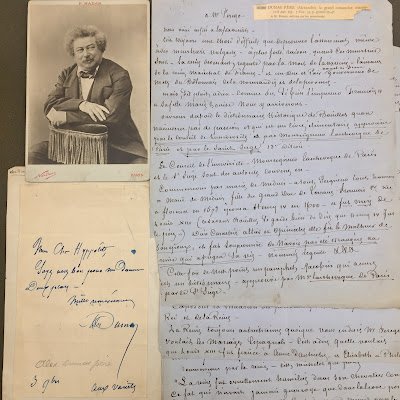
The Count of Monte Cristo, Chapter 16, Alexandre Dumas


"Dear reader" -- is there any more pleasant address in a novel, any honorific sweeter? And yet. A brief survey of online writing instruction -- pedantry for the self published -- tells us that this sort of thing is called an "authorial intrusion." Well, that isn't scornful at all, is it? Like virginal heroines, thwarted suitors, stolen inheritances, omnipotent narrators, and spontaneous combustion, the phrase has fallen largely out of fashion, but the device is not unknown in the work of modern writers. What is Vonnegut's style without direct address to the reader? How else to explain the popularity and celebrity of personal essayists like David Sedaris and Sarah Vowell? Margaret Atwood employed the actual phrase once, unironically if in the third person, to describe how the writer is born of the reader, "... the 'real' reader, the Dear Reader for whom every writer writes." (C. Bronte's rather blunt, "Reader, I married him." is so satisfying in part, I think, for being a little rude.) 

When reading Fielding or Hugo or Dickens or any of the great 18th or 19th Century novelists, I am convinced that I am the reader addressed. Me. Dear me. Thanks. Job done, novelist. I don't hold with the theories of readership that insist we change the book by reading it, or that every reader reads a different book, etc. Rhetorically valid, but how helpful really? Why egotize the reader at the expense of the writer? Why make the bottom top? (Instinctive answer? The urge to master what we study. Degrees must be justified, podiums make for pomposities, and who could be more important to a scholar than the writers he studies? Ask his mother.) I loath audience participation in the theater. No, I don't want to help you sail the boat. I am never eager for an invitation to join the cook in the kitchen. No. Gourmand not gourmet. A smile, a nod, a wink. As a reader I don't feel much need to be otherwise flattered. Really. It's sweet you noticed. Everybody likes a confidence so long as we're already listening. I like you too. If I didn't I would already be dancing with somebody else. And no, I don't want to write the book with you.

So who -- other then those self-appointed online editors -- doesn't like a nod from the host?  I suspect that this may be yet another instance of an older style jarring a bit on modern sensibilities, along with words like "perspicacity" and "wherefore," semicolons, and long dependent clauses. 

Obviously I like all that stuff. Yes, I enjoy a clear broth, but find a rich stew just as much to my taste, and I prefer the older recipes for both. Why? Comfort? Perhaps I am past the age when I can digest too many discordant and bitter things. At least say I prefer these in smaller servings. If I am to sit long at the table, there is only so much I am willing to take in of foams and smoke, grit and tricks and mysterious proteins. I'm hardly a meat and potatoes sort of reader, but a nice sauce helps, side-dishes and wine, dessert and a trusted chef. To them that would dine always off a modern menu, what can I say? As a dear friend, himself a published novelist, is always quick to remind me, there is no point in arguing taste. Quite right. Thus The Count of Monte Cristo as the first selection for my Big Fat Book Club. Felt like a good bet.

Reading The Count of Monte Cristo, there aren't actually that many authorial intrusions. One has to read pretty closely to find the kind of direct address to the reader one would expect as a matter of course in, say, Dumas' friend Victor Hugo. Here for example is I think Dumas talking to me: "Oh, tell me over and over again, never tire of telling me that I have made you happy," though even here he isn't really, as a character says that for him. Dumas' vocabulary, while sometimes antique is more often just as straightforward as anyone could want. Melodrama then? The man certainly loved a dramatic scene, a shocking reveal, a timely murder, poison, revenge, virtue threatened. But he was masterful when it came to plots and twists. No one better.

So, what then? I ask this because if I am being honest there was a precipitous falling away of my fellow readers after our first meeting. Despite the initial enthusiasm expressed when my first selection for Brad's Big Fat Book Club was announced, many who hadn't started did and then did no go on. To be expected, no matter the club or the selection. People do get busy. There were the holidays to consider as well. Not my first book club. Still, there was a... what? Vehemence, shall we call it? to more than one withdrawal from the group. No one was impolite, but there were some abrupt announcements that The Count of Monte Cristo, on reflection was not for X, Y, or Z. "Not for me," said one. "Can't do it, sorry," said another. 

Length would not seem to have been the reason. I mean, right there in the name of the club. In the end I guess, Alexandre Dumas was just not to everyone's taste. As host, I can only accept that many left for whatever reason and be grateful for them what stayed. Three longish months we had. I enjoyed every meeting, every minute. On we go then to the next.

So why am I still flogging such a large and very dead horse? (Ugly 19th century metaphor for which I apologize.) I finally had an actual (well, virtual) conversation with someone who bowed out quick. Didn't want to pester people. Out? not a problem. Thanks for trying, sincerely. This person contacted me again, with yet another apology for not sticking around. We'd already been through the polite exchange of regrets three months ago. I was fine with that being the end of it. Seems it wasn't, quite. More polite apologies and then a confession: Dear Reader could not see the point. Why? Short conversation even shorter? Dear Reader did not see Dear Reader anywhere in the thing, nor any prospect of finding same.

I betray no confidence in paraphrasing the Dear Reader's response. (I was given permission.) And it makes perfect sense. It had not occurred to me, I admit. I understand the fatigue of repeatedly, consistently reading books about people unlike one's self. I for example have long-since resolved to never read another novel about a male academic's or a novelist's troubled marriage. I do not care to know the struggle. Likewise I do not feel the slightest embarrassment in never reading any novel told in the voice of a dog, cat, or any domestic animal. (Will I read a book told in the voice of, say an Australian Sugar Glider? I don't know that I would even should such a book exist, but the odds are still better than they would be for another chatty Golden Retriever or a cat who solves mysteries.) And yes, this is not for me just a question of been there done that. It's also true that I do not see myself therein. More importantly for me personally? I do not see anyone in, for example even a classic like White Fang or John William's Stoner, about whom I now give a walking, running, or seated damn. I mention these classics because while I once was a twelve year old boy and also once read everything I could find of John Williams', I would not now find purchase in either. I do not need to see myself in the books I read, but neither am I interested in stories about people -- or pets -- about whom even genius could not now make me care.

The fate of Edmond Dantes is still interesting to me my third or fourth time through because I can in fact see something of myself however unlikely in a French sailor sewing himself into a shroud, in a middle-aged man disappointed by love, in the perfect fantasy of resourceful revenge. More, I can still flatter myself that Dumas' "Dear Reader" is me. If someone else can not -- I get it now. It's not the language, the plot, the people, or the period. Our empathies, like our sympathies are entirely our own and as I assumed before, none of my business really. 

That said, you really must read Boswell's Life of Samuel Johnson. 


Saturday, December 25, 2021

Soonest Mended


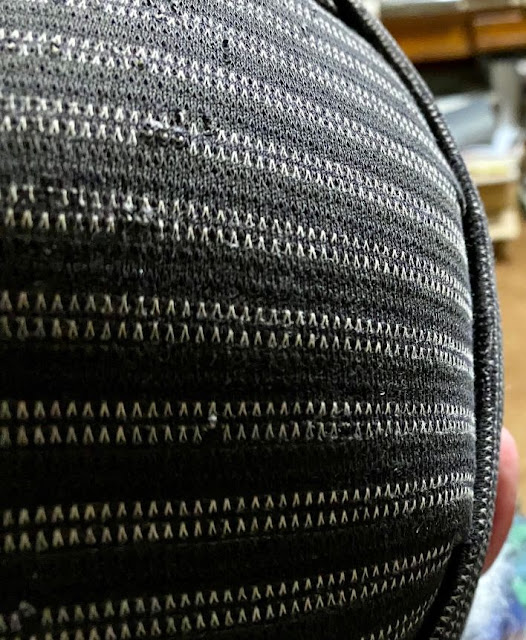
My best gift this year? The beloved husband mended my favorite stocking cap. (His favorite gift this year, by the way? Not the fancy new "dental care system," aka electric toothbrush I bought him, but the vintage plastic lunchbox and matching thermos my mother sent him. He's been wanting one of those.) He didn't give me the cap, you understand. I bought it from a vendor at the Castro Street Fair in San Francisco some time in the nineteen-eighties. In fact, I bought half a dozen different such hats from that talented lady. "Martha Made It/San Francisco," the tag says. I still have three of these. Lost the rest at Christmas parties or they fell out of coat pockets or were inadvertently left under under theater seats. Don't know. Miss the missing ones still. Of the three surviving hats, this is my favorite. It is black with white pinstripes and I wear it like a skullcap with the brim rolled. (A friend calls these my "house turbans" which is not inaccurate, though I do wear them in the streets as well. Slattern.) The rolled edge at the back has frayed away and was threatening to unravel after it came last out of the wash. The beloved husband noticed this and all unprompted stitched up up for me. The stitching was the gift, though he would not think to call it that. I do. He is quicker than I to mend things and often without saying. His mother taught him to sew, as my mother taught me.

We were taught to sew, at least so far as to fix a hole in the heel of a sock, put a button back on, or hem a pillowcase as just a useful thing to know. Backstitch, running, and basting, in my case, nothing artful or fancy, but still, better than helplessness. Helplessness is natural in small children and it seems still all too common in most grown men. As in so many things including cooking, talking to service providers and repair persons, and keeping his temper, the beloved husband has the better of me, and much the more sure and lighter touch. I have less patience generally and the quicker temper, typically enough. Rather a shock I should think, anyone meeting us for the first time that in some things I'm the more stereotypical male. I am all too easily frustrated, particularly in practical matters, and fat peasant fingers on me, better suited to ditch-digging than to making invisibles stitches. He has hands like a pianist.

We were both lucky in our mothers. Not every mother asks much of her sons in domestic matters. Perhaps better say in my generation and before, sons were not taught a tenth of what their mothers knew, not even something so simple and necessary as sewing on a button. Would that more of us had been taught more, or had listened. That sounds smug, but trust me when I tell you I did not listen much myself. Amazing I learned the little I did, but then in my case the woman in question was and is formidable in her way. Wouldn't know it to look at her. Helplessness was not an option in her sons. 

That men do not listen to women generally is I think still broadly true. The evidence of this is everywhere. (Note Angela Merkel in every photo from every g20 conference, to pick just the one obvious example. Patience of a saint, that woman. Imagine sitting next to Putin for a decade, or worse! Enjoy your retirement, Chancellor.)

Few of the domestic sciences have a more storied history in literature than needlework, and less respect in the wider, man-spreading world.  For three years Penelope works and reworks that wretched shroud before Odysseus finally wanders home and hardly a word of praise does she get for it -- or anything even from Homer but the requisite admiration of her fidelity. (I'll bet that when she was done that winding sheet was exquisite as Austen's prose.) Women's work, to use an antique and condescending tag, never gets its due, except of course from other women. Of all the somewhat scant displays in the Jane Austen House museum, none is now more treasured that the coverlet Jane sewed and signed in stitching, now I think of it. I looked it up.  In a letter to her sister Cassandra, of what was Jane Austen proudest? Writing Sense and Sensibility? No. Of that she worries it might prove, "too clever."  Instead it is her needlework of which she boasts, "I am proud to say I am the neatest worker in the party." Note that she was writing to her sister. If she was going to brag, who better to? And yet it is the quilt not the novel that in the author's opinion recommends her even to Cassandra.

Mother tells me she never minded sewing. The domestic chore my mother likes least is ironing. Remember that in her youth this was a far more cumbersome business than now; what with starch-bottles, water for sprinkling, hot irons and cold. It was hard work. Yet it was not the onerous nature the task itself so much as all the time spent -- and entirely too much of that in ironing her older brother's shirts. For much of the time described he was a college student and then a seminarian. He required clean white shirts and sometimes more than one a day. That side of the family always ran hot and tended to damp and my uncle, even as a young man was  a substantial, if unathletic figure. In those days, it would have occurred to no one other than my mother that the man might have ironed his own damned shirts.

When the day came that I left my father's house for good and all, my mother made sure that I knew how feed myself, clean my own clothes and linens, and that should the need arise I might iron my own shirt. No woman would ever have to "do for" me as she had done for three generations of men and boys. By then of course we both knew just how right she was, no woman ever would, but the principle was sound. In my abbreviated college career I instructed half a dozen boys in operating the washing machines, explained to at least one that a fitted sheet was not "part of" the mattress, taught a grown man how and when to turn a fried egg, and explained to another what shoe-polish was for and how it worked. I remember a conversation with someone I barely knew about why one end of the ironing-board was rounded. 

I'd like to think that the rigidity of gender in my mother's generation has relaxed and that the assumptions that condemned my mother to all those steamy hours flattening my uncle's collars and pressing the generous spaces between his many shirt-buttons will never come again. Nonetheless I've known more than one mother of my own generation -- and after -- whose adult sons still bring them dirty laundry as if it were a gift, adult men who have never made a meal more complicated than a sandwich, and at least one fellow with an advanced degree who not all that long ago found he had no idea how to operate the iron in his hotel room. He needed a shirt pressed for the conference he was in town to address. (Evidently no one had ever taught him how to pack a suitcase either.) No idea how an iron worked. His solution? He ordered a new shirt online and had it delivered to the front desk. (Hard not to think that whatever the actual subject of his lecture, it might better have been Unexamined White Male Privilege and the Gig Economy or something like, but not a point I raised.) However evidently slow the progress of my sex, I am proud to say my mother did her part raise her boys from helplessness and sexist assumptions. 

Among my personal treasures in a quilt-scrap worked by my grandmother and adapted by my mother as a framed background for a collage of photos of my mother's youngest, meaning me. It is a lovely thing, not because I'm in it and all the more so for representing the kind and artful attentions of the most important women in my life. Not an un-troubling example I'll admit as it is about me ultimately. Again, typical now I think about it.

Now that gifts are very much again in mind, I am thinking of intangibles too, of what lasts, what does and doesn't get passed down through the generations. And I am thinking of mended things. When I was young I was surrounded by mended things: pots, pans, clothes, engines, animals, people.

Women mended all sorts, but men did too. Theirs were the vehicles and engines, windows and doors, pumps and stone walls and fallen fences. Every summer a man with a round stone came to my grandmother's house, just up the road from ours. I do not know his name. He was a knife-grinder and he brought with him a stone wheel that sat in a wooden frame. He operated the wheel with a peddle, not unlike my grandma's Singer sewing machine but also not unlike, his wheel, something from the Middle Ages. It might have been a battle-axe or a broadsword sharpened on that wheel. As it was he sharpened kitchen knives, and hatchets, saws, scythes, and hoes. He carried whetstones of various sizes and meant to varied purposes. He was when last seen already very old.  I saw him only the once, if I actually saw him at all. I remember him vividly, but as with so many memories of early childhood, he may have been one of my grandmother's stories that I've adopted as my own. Memory is in part appropriation too, or theft to put it more bluntly.

I'm sure that I don't remember the tinkers, but I know they still came in the summers too, offering to fix things, and to lay new blacktop on driveways. They were not trusted to finish what they started and were not to be employed by any of mine. Their reputation, and our prejudice outlasted their presence, and people back home still describe things as being "not worth a tinker's dam."

I do remember standing with my father in a room that smelled of boots and resin and old wood watching a man mend horse tack and saddlery. I remember he held a length of leather in his mouth while he talked. I marveled at that. I'd seen men all my life talk around the plug in their cheek or with a bobbing cigarette stuck to their lip, but never before had I seen someone stretching leather with one end anchored in his teeth. I wondered at the strength of his teeth, thinking they must be very like a horse's to do that. I was reminded of this while watching an excellent new movie recently and have to wonder, again, how much I actually remember and what I've borrowed from the movie? (Made by a woman, by the way.)

Of course I've seen a horse shoed more than once and thought the moment in no way special.

My grandmother's last gentleman-friend made brooms and raised bees. I knew more than one man who worked wood on a lathe or caned chairs. I've seen many practical things made as well as mended.

Mostly though I preferred the company of women even then because they had actual conversations about more interesting things; like people I might know, rather than dogs or vehicles.  What they worked on while they talked was better too, and smelled better too, like food and flowers rather than carburetors and, again, dogs. And women talked indoors. Always better, indoors than out; cooler in the summers and warmer in the winters, and nobody spat. And in their homes, everywhere around me was the evidence of working needles and sewn things: quilts and crochet, doilies and table linens, no curtains but what were measured and made at home, dresses, doll-clothes, sock-monkeys, fascinating, detailed, and artful things. I say that now, but no one then thought of these things as "artisanal" or "folk art" or in anyway superior to store-bought things. "Old timey" was already the phrase for much of this then -- a phrase I still find lovely -- but not yet so unusual as to be sold in boutiques and to tourists of which where I grew up there were none in those days. Quaint was not yet a craze or collectible. The bourgeois women I met later through their children all seemed obsessed at the time with something called "authentic colonial." Being then a junior pedant, I thought this a weird preoccupation as my hometown not founded until more than a decade after the Constitutional Convention. "Authentic colonial" in Western Pennsylvania would be better represented by three legged stools in rough, unvarnished wood and general Augean filth, I should think, but who wants that in one's breakfast nook? So far as I could tell, what these ladies meant by the term, and what they called antique in general were spindle-legged, straight-backed chairs on which no one was allowed to sit, polished spinning wheels no one used, and over-sized copper pots hung above their gas ranges. There was as yet no wider market, or at least none that any of us had heard tell, for anything so practical as a quilt or so old fashioned as a sampler. Fo my grandmothers' generation things were made when they couldn't or needn't be bought. Some things were beautiful, some weren't but even when the look of the thing was not the point there was often craft and great skill in the stitching of it. Barely noticed much of it. In those far off days piles and pounds of the stuff could be had at a rummage sale for a song. Antique shops then were for blue and white china and Queen Anne bureaus and "colonial" whatnots. What did I know? Looking back, I knew no more than that interesting old women lived in old houses full of interesting old things.

 All of which sounds terribly charming and folksy now, doesn't it? That is very much my fault.

I am reminded of Michael Pollan, journalist, food-activist, and ayahuasca enthusiast. Admirable writer, admirable fellow in his way, but also representative of a generation nearly my own and a class still pretty alien to mine that seems intent on a Rousseauian reclamation of simplicity, of fading rustic skills, the locally sourced, and bitter greens. The best part of this movement has reproduced lost apples, fought the insanity of single-use plastics, and proved objectively that we are a danger to ourselves and to life in general. The less attractive aspect of all this enthusiasm for "authenticity," the bit that sticks is the assumption of infinite leisure. How comes it that anyone has time to raise chickens in the city? 

I heard Pollan on a panel in some online something. He was blithely telling an audience of bourgeois white women that home-canning was really the way to go; the product so superior in every way to tinned peaches or frozen peas, healthier, better for the planet, etc., etc. Delighted smiles all around and applause. SO true. So very true. 

What no one on that panel pointed out was that the only reason my grandmother, who canned all her long life, had the time to read a book or watch her Wheel of Fortune was because she'd lived to see affordable tinned peaches and frozen peas. The reason she was able to live respectably as a widow for forty years was because she was able to find respectable work that didn't break her back and cripple her hands. No one mentioned that the hideous vinyl flooring in her kitchen meant she needn't scrub and polish the "authentic" wood floors underneath. 

In my experience the dignity of work is most often mentioned by those that needn't hold a brush or a broom, raise anything other than their voices, people who've never needed to mend anything, make a meal they weren't pleased to eat, or teach a child to work for anything better than the lesson of it. 

The word abandoned by the modern disciples of Rousseau is "savage." Ugly word, too often used to demean other human beings, but a good word to remember when discussing this reclaimed nobility in humble things and tasks. The lives of my people, of most people, poor people were and are savage. Poverty is savage. The physical requirements of daily survival the world over remain savage. It is not character or genetics that the word "savage" describes. It is the state of people's hands, the pain in their knees, the work required to raise and preserve their food. Life is savage. Want is savage. Necessity is savage, not people. 

Are we all really so far from savagery now that the little things people did and do to make sweetness where they could find it, beauty in practical objects, comfort against the cold or the equatorial heat, that these things they made for want of better are valued now for their authenticity, collected and appraised for their delightful simplicity, aesthetically pleasing despite the sweat they represent? Yes, a quilt can be art. I will grant you, but I would remind the collector that it was made from scraps because scraps were what were to be had. People carved because they had a sharp knife and just time enough of an evening to add detail to something needed. 

I am no better than the people whose new enthusiasm for old things and simplicity I disdain. My house -- and yes, I have a house -- is full to the rafters with things, many of them old as I grow more so every day. I've no more need of most of the things I possess than of a third ear. I collect canes and carved staffs, books and ornaments and weathered toys. I eat fruit out of season and meat when I want it. I recognize the luxury in which I live, undreamt of by my ancestors no more than two generations back. I see the value in these things, I invest value in them exactly as the rich might and do. I reckon only that I needn't learn the superior taste of a home-canned tomato because I ate them at one time because that was what we had. I know the work involved, and the cost, because I saw it. That's all. It makes me angry to think a man might lecture women about how little it costs to can a peach. Does he know? What was the state of his grandmother's hands? How hard did his father's heart work to feed him? Absolutes and abstractions are a privilege -- and there at last is a newly dirty word I feel comfortable using as such myself. I am myself privileged in using words just this way. I have the time. I was taught the value of that.

Mended things may be the best gifts. Twelve little stitches made with affection and strong nylon thread can save a hat more than a quarter of a century old. Don't know that sewing can save the world, or even the past. For that I think we need less canning, fewer seminars and instructional videos and online "package-openings," and maybe more labor unions, income and inheritance taxes, fewer dilettante in space, more billionaires in fear of eternal Hell, and more bankers in jail.

I am minded now this Christmas day of another quote about mending things. "Least said, soonest mended," as Betsey Trotwood says -- having spent a long, hilarious, and most confusing paragraph explaining in the third person the loss of all her money. Again it seems I have met with a wise woman and failed to listen or learn my lesson.  "'Which was injudicious, Trot,' said my Aunt, 'but well meant.'" Best that can be said of me, mostly, and of this. 

And now I should go and give my good husband a kiss for mending my cap.