Showing posts with label sonnets. Show all posts
Friday, July 22, 2016
Daily Dose
From The Poems of Sir Philip Sidney, edited by William A. Ringler
SONNET #71
Who will in fairest book of nature know
How virtue may best lodg'd in beauty be,
Let him but learn of love to read in thee,
Stella, those fair lines which true goodness show.
There shall he find all vices' overthrow,
Not by rude force, but sweetest sovereignty
Of reason, from whose light those night-birds fly;
That inward sun in thine eyes shineth so.
And, not content to be perfection's heir
Thyself, dost strive all minds that way to move,
Who mark in thee what is in thee most fair.
So while thy beauty draws thy heart to love,
As fast thy virtue bends that love to good:
But "Ah," Desire still cries, "Give me some food!"
Labels:
Daily Dose,
Philip Sidney,
poetry,
Quotations,
sonnets,
Titian
Friday, March 11, 2016
Daily Dose
From The Collected Poetical Works of Algernon Charles Swinburne
TO DR. JOHN BROWN
BEYOND the north wind lay the land of old
Where men dwelt blithe and blameless, clothed and fed
With joy’s bright raiment and with love’s sweet bread,
The whitest flock of earth’s maternal fold.
None there might wear about his brows enrolled
A light of lovelier fame than rings your head,
Whose lovesome love of children and the dead
All men give thanks for: I far off behold
A dear dead hand that links us, and a light
The blithest and benignest of the night,
The night of death’s sweet sleep, wherein may be
A star to show your spirit in present sight
Some happier island in the Elysian sea
Where Rab may lick the hand of Marjorie.
From Sonnets
Thursday, March 10, 2016
Daily Dose
from The Collected Poetical Works of Algernon Charles Swinburne
BEN JONSON
BROAD-BASED, broad-fronted, bounteous, multiform,
With many a valley impleached with ivy and vine,
Wherein the springs of all the streams run wine,
And many a crag full-faced against the storm,
The mountain where thy Muse’s feet made warm
Those lawns that revelled with her dance divine
Shines yet with fire as it was wont to shine
From tossing torches round the dance aswarm.
Nor less, high-stationed on the grey grave heights,
High-thoughted seers with heaven’s heart-kindling lights
Hold converse: and the herd of meaner things
Knows or by fiery scourge or fiery shaft
When wrath on thy broad brows has risen, and laughed,
Darkening thy soul with shadow of thunderous wings.
From Sonnets
Labels:
Algernon Charles Swinburne,
Ben Jonson,
Daily Dose,
poetry,
Quotations,
sonnets
Wednesday, March 9, 2016
Daily Dose
From The Collected Poetical Works of Algernon Charles Swinburne
ON LAMB'S SPECIMENS OF ENGLISH DRAMATIC POETS
I.
IF ALL the flowers of all the fields on earth
By wonder-working summer were made one,
Its fragrance were not sweeter in the sun,
Its treasure-house of leaves were not more worth
Than those wherefrom thy light of musing mirth
Shone, till each leaf whereon thy pen would run
Breathed life, and all its breath was benison.
Beloved beyond all names of English birth,
More dear than mightier memories; gentlest name
That ever clothed itself with flower-sweet fame,
Or linked itself with loftiest names of old
By right and might of loving; I, that am
Less than the least of those within thy fold,
Give only thanks for them to thee, Charles Lamb.
II.
So many a year had borne its own bright bees
And slain them since thy honey-bees were hived,
John Day, in cells of flower-sweet verse contrived
So well with craft of moulding melodies,
Thy soul perchance in amaranth fields at ease
Thought not to hear the sound on earth revived
Of summer music from the spring derived
When thy song sucked the flower of flowering trees
But thine was not the chance of every day:
Time, after many a darkling hour, grew sunny,
And light between the clouds ere sunset swam,
Laughing, and kissed their darkness all away,
When, touched and tasted and approved, thy honey
Took subtler sweetness from the lips of Lamb.
From Sonnets
Friday, December 25, 2015
I Haste Me to Bed
I like pillows -- a lot. I don't mean those pretty, fussy things some women arrange across an otherwise inviting bed; all brocade and trims, big, uncomfortable buttons, tassels and whatnot. Throw pillows, is it? Meant to be thrown. I don't like bolsters and and ovals and odd shapes. No. I like bed pillows. I like big pillows. I like firm pillows and soft, fluffy ones. I like a lot of 'em. My beloved husband, A. sleeps on just two, rather flat pillows. I sleep on a wedge, from thin to thick against the headboard. Helps me breath, I like to think, but that may or may not be true. Mostly though, what I like best is sitting up in bed, in winter, with a comforter across my legs and with a great pile of pillows behind me and around me. How I like to watch TV. My favorite place to read.
Different folks have different ideas of a holiday, I suppose. Mine is sitting in bed all day with a book. Christmas morning of course we're up at a reasonable hour, just the beloved husband and me, to open presents and call the relations. We watch something or other on the television, and at some point he starts our supper. The rest of the day, I sit in bed and read. It's bliss.
The holidays have always been something of a trial for us. He worked in the Postal Service -- bulk mail -- for thirty five years. I've worked retail nearly my whole, adult life. The year I moved in with the man 32 years ago, we spent just that first Christmas apart. I went home to the family. Never happened again. (At the time, they did not altogether approve.) Ever since we've spent Christmas together.
For many years we had friends over. There were elaborate dinners, a proper tree, drifts of gifts. Some of the friends we knew died. We moved away. For a long time now, there's been just us. If asked, I might say we missed those Christmases, but I don't know that I do now. I miss my friends. I miss my family. I don't know that I miss the rest. As I said, we've usually been run a bit ragged by the time December 25th actually rolled 'round. Usually I've had to work the next day anyway. To just be home, together, quiet, that's what I like best.
A book, in bed, with pillows.
It's a lazy sort of tradition, for me anyway. But what it feels like is rest. Not always easy to say what that is, other than a proper night's sleep. That isn't what I mean though. There may well have been a nap, somewhere along the day. I won't deny it. What I like though, once my family obligations have been met, is to not to think my own thought, or worry my worries for a whole day. Because nearly everyone we know is far away, I make a fool of myself every year, rushing around from Thanksgiving to Christmas, making calendars, buying things, trying to get packages mailed, etc. All the usual nonsense. Work at the bookstore likewise gets a bit hectic at the holidays. I enjoy that, but it does wear me down by the time Christmas comes, "Weary with toil", as Shakespeare's Sonnet 27 puts it. What's wanted then is a day in bed. Pillows.
What I read doesn't much matter, honestly. The reading does, but not the matter. I returned to Tom Jones at last. I read into the second volume of the Alexandre Dumas I'd set down. I read, as incongruous as it sounds for occasion, quite a bit of Primo Levi. I dipped and dozed and let my eye roam across my nightstand. It was almost the point not to read too far or too fast in any one thing. I wasn't reading for sense, you understand, or even entertainment as such. I was reading for rest.
There's something wonderfully luxurious about reading this way, something quite decadent in being propped up in bed all day like some ancient Pasha, sampling prose the way a Sultan might call for his harem. I'd no more thought of doing anything else unless and until our meal was ready or the house caught fire.
Didn't owe nobody nothing.
Not true, actually. At some point I had to at least offer help in the kitchen, but we don't do anything elaborate at Christmas as we do at Thanksgiving. Sooner or later I knew I'd come down here to my desk and do... something.
for a few happy hours however, it was just me in bed: books, pillows, a comforter across my legs, and just such company as I like best.
Merry Christmas. Hope you all got what you wanted too.
Sunday, October 4, 2015
Daily Dose
From The Sonnets, by William Shakespeare
Sonnet #73
That time of year thou mayst in me behold,
When yellow leaves, or none, or few do hang
Upon those boughs which shake against the cold,
Bare ruined choirs where late the sweet birds sang.
In me thou seest the twilight of such day
As after sunset fadeth in the west,
Which by and by black night doth take away,
Death's second self that seals up all in rest.
In me thou seest the glowing of such fire
That on the ashes of his youth doth lie
As the death-bed whereon it must expire,
Consumed with that which it was nourished by.
This thou perceiv'st, which makes thy love more strong,
To love that well which thou must leave ere long.
Labels:
autumn,
Daily Dose,
poetry,
Quotations,
seasons,
sonnets,
William Shakespeare
Sunday, May 3, 2015
Daily Dose
From The Poems of Christina Rossetti
SONNETS ARE FULL OF LOVE
Sonnets are full of love, and this my tome
Has many sonnets: so here now shall be
One sonnet more, a love sonnet, from me
To her whose heart is my heart’s quiet home,
To my first Love, my Mother, on whose knee
I learnt love-lore that is not troublesome;
Whose service is my special dignity,
And she my loadstar while I go and come
And so because you love me, and because
I love you, Mother, I have woven a wreath
Of rhymes wherewith to crown your honored name:
In you not fourscore years can dim the flame
Of love, whose blessed glow transcends the laws
Of time and change and mortal life and death.
Labels:
Christina Rossetti,
Daily Dose,
motherhood,
mothers,
Mothers' Day,
poetry,
Quotations,
sonnets
Monday, September 8, 2014
Daily Dose
SONNET ON THE SONNET
To see the moment holds a madrigal,
To find some cloistered place, some hermitage
For free devices, some deliberate cage
Wherein to keep wild thoughts like birds in thrall;
To eat sweet honey and to taste black gall,
To fight with form, to wrestle and to rage,
Till at the last upon the conquered page
The shadows of created Beauty fall.
This is the sonnet, this is all delight
Of every flower that blows in every Spring,
And all desire of every desert place;
This is the joy that fills a cloudy night
When bursting from her misty following,
A perfect moon wins to an empty space.
-- Alfred Douglas
To see the moment holds a madrigal,
To find some cloistered place, some hermitage
For free devices, some deliberate cage
Wherein to keep wild thoughts like birds in thrall;
To eat sweet honey and to taste black gall,
To fight with form, to wrestle and to rage,
Till at the last upon the conquered page
The shadows of created Beauty fall.
This is the sonnet, this is all delight
Of every flower that blows in every Spring,
And all desire of every desert place;
This is the joy that fills a cloudy night
When bursting from her misty following,
A perfect moon wins to an empty space.
-- Alfred Douglas
Labels:
Alfred Douglas,
Daily Dose,
poetry,
Quotations,
sonnets
Saturday, November 30, 2013
Daily Dose
From The Sonnets, by William Shakespeare
THAT
"That poor retention could not so much hold"
From CXXII
THAT
"That poor retention could not so much hold"
From CXXII
Labels:
books,
Daily Dose,
memory,
poetry,
Quotations,
sonnets,
William Shakespeare
Sunday, November 3, 2013
Vacation Unpacking
Home and back. As I do now every autumn, I went home for two weeks to see the old people in Pennsylvania. And every year, I pack a stack of used books, because, honey, while home may be here the heart is, there ain't a bookstore for miles. Here then this year's vacation books.
It's usually mass market paperbacks for the trip. Otherwise, I almost never buy, let alone read, in this this format. I like old books better, books I often can't find but in hardcovers (or, as here, in paperback EBM reprints.) Old books tend to be better made books. My books go in and out of my old leather bag every day, get stowed in a crowded cubbyhole at the desk, often bristle with Post-It notes and scraps of paper. True, they travel only from table to sofa, from home to work and work to home, mostly, not from pillar to post, but as I usually mean to keep them, I try to be kind. Old fashioned "pocket books" like the ones I pack on trips I only buy when I can leave them behind me, in airports or the trash. Some of the less battered paperbacks may have another chance as donations to the permanent garage sale my parents put out in the warm weather, to pay for their heart medications when their medicare coverage falls into what my mother calls, "the don't die hole." I don't really like the size of pocket books, or the paper they're made of, or the cheap way they're made. I don't like the impermanence of paperbacks. Of course, the very things I don't like about paperbacks makes them ideal for travel.
Years past, I've taken thick paperback classics, Russians mostly, or late Dickens and the like, thinking I'd make a proper reading-project of my two weeks back home. Almost never happens, what with getting to the Golden Corral in time for the Early Bird on steak-night and what have you. (This trip unhappily included time spent in waiting rooms, and hospital rooms and the like. All that worrisome business turned out well enough in the end, thank you, but I can think of few places on earth less congenial for reading serious books. Who can concentrate in such an atmosphere?) What usually happens is that instead of reading all those big, important books I've brought with me, has been that I read whatever pulp or mysteries I find in Dad's garage-sale, and just a bit of poetry before bed.
That in mind, I packed three Christie thrillers this time, none of which feature either Marple or Poirot. That way I could be pretty sure I hadn't read these before. In recent years I've found a lot of unfamiliar titles without either star detective. Moreover, the old girl seems to relax a bit when she doesn't have to write for her big names; there's a willingness to shift focus, to to explore a bit more away from country houses and the like. (Poirot specially can make the outcome seem pretty inevitable sometimes.) On recent trips, I've read at least one Christie, and usually wanted more. So this time, I was ready.
Murder Is Easy was a delight. A classic bit of Christie twist in an old girl who suspects foul play in the village chatting up a stranger on the train and then turning up in a headline shortly thereafter herself. Hit and run. Her reluctant interlocutor turns detective to see if she wasn't right after all. She was. Good fun.
Murder at Hazelmoor starts with a bit of Spiritualist table-rapping, and, of course, a murder. Trust Christie to come down on the side of devilishly clever reasoning rather than hocus pocus to solve the thing. And -- I didn't guess the villain!
Of the last of my three Christies, The Mysterious Mr. Quin, frankly, the less said the better. Not so much a novel as a series of linked mysteries, all with the same rather lazy-minded narrator and all resolved with irksome and unconvincing efficiency by the appearance of the ever increasingly metaphorical Mr. Quin, this is Christie trying without success to broaden the significance of her puzzles and make them -- what? more literary, somehow? infused with a more spiritual mystery? Whatever she was about, this does not work. I've already learned that with a few well-made exceptions, Christie isn't at her best in a short form. Add to this the shock of this most sure-footed materialist uncharacteristically wandering afield at the end into (ick) allegory, and this, you may trust me, is a Christie to skip.
I'd a lovely old leather-bound copy of The Sonnets, from J. M. Dent, circa MCMV, to do for my poetry. I hadn't read these straight through since forever. Last year's ancient paperback of English Literature: The Seventeenth Century, edited by one Everett Mordecai Clark, and originally published by Charles Scribners' Sons in 1929, proved one of my happiest finds in recent memory. I've kept that one. Reading nearly through The Sonnets every night before bed proved every bit as surprising and satisfying in it's way. The standards, in their proper setting, proved to be like welcome and familiar songs in an otherwise unfamiliar set, and the narrative of the two parts, with all repetitions, quite fresh to me now. Best investment I made this year.
The one that I'd already started reading before I left, and that I haven't finished yet, was The Life of John Sterling, by Thomas Carlyle. I had this copy printed up for me on the Espresso Book Machine. The volume from my complete hardcover set of Carlyle in which I'd started the book was frankly too fragile to take traveling across country. (Seems I've found yet another use for the EBM! Travel editions!) Like most modern readers of Carlyle's only biography of a contemporary, I was reading this book for the biographer rather than the subject. This seems easily the Great Man's gentlest book -- though even here, the old boy can't help himself from being the most cantankerous brute. He wants to memorialize his talented young friend -- a poet and playwright of admittedly unmet promise who died tragically young -- but Carlyle could do nothing without thunderous disapproval of all human frailty, even when he tried to be kind. A grand old monster, was poor, pity-less Tom. Fascinating monster, Carlyle. I wanted something of his with me this trip as I'm reading fairly deeply in him and his biography by Froude just now anyway and don't want to a) stop or b) try carrying heavy Victorian volumes with me on the "aeroplane." Despite being a bit too much of muchness for a vacation, I'm glad I had it with me; now and then a body needs some chewy, really flavorful prose.
The Stephen Fry contained his first two novels, which I'd always meant to read but never had. The first, The Liar, was very much the bright boy's portmanteau: chapters from a spy thriller, a coming of age romance, elements which are now familiar to any reader of Fry's first memoir, with Wodehouse and Waugh and what-all besides. It was a delight, front to back. I already knew that Fry is a brilliant entertainer and a crackerjack writer. He is firmly established in my affections by virtue of being a remarkable comedian, actor, director, and one of that uniquely British tribe of in-house BBC intellectuals. He's written an entertaining and very sensible book about poetry. For whatever reason, I've avoided his fiction 'til now, largely I think for fear it would prove inferior to his other efforts. I needn't have denied myself the pleasure.
Which is not to say I like the other novel in this "traveler's" paperback, because I didn't. The writing was just as good, and if anything the structure and plot of his sophomore effort was superior in every way to his first. But, I didn't finish The Hippopotamus -- nearly, but, no. The central character was a a Kingsley Amis type, the artist as boar; straight, drinky, and more than a bit of a dick. I know this is meant to be forgivable, even ultimately endearing, and very much of a tradition, and it's not as if Fry didn't do the thing justice, he did, but I'm tired of dick in literature. Okay, that's not quite true in every sense, but in this it is. After a hundred pages I had to admit I wished the protagonist dead and the book over, so I gave it up. True, there was quickly much saving camp, and some truly funny satire, but... perhaps I was tired of the fun. Who knows? Anyway, it remained unfinished, and on I went.
My other unfinished novel this trip was Statues in a Garden, by Isabel Colegate, but only because I lost the book somewhere. Presumably I left it in some waiting room, or it fell out of my pocket somewhere or something. A pity, because 60 pages in , I was enjoying it. Colegate is the author of The Shooting Party, among other excellent things. (That one was made into a very good movie with, as I remember it, James Mason as a country squire in one very good, and very brief scene featuring John Gielgud as a militant if mild antivivisectionist singly and rather sadly protesting the eponymous hunt.) When I got back to my library, I discovered that I did indeed already own a nice hardcover copy of the novel I lost, so I'm reading the rest just now.
Colegate is a cool, careful writer, an historical novelist who works almost within reach of living memory, mostly. She is one of those English novelists of a certain age rightly preoccupied with the passing of Empire, and a kind of innocence. It's an obvious a subject, I suppose, The Fall. Worked pretty well since Genesis. But the reader would be mistaken to confuse Colgate with those professional nostalgists of the pre-war glory, the kind of darling hacks who make us Americans go all moony over great houses, and loyal servants and cliches served on silver salvers. Colgate is a very serious writer, and for all her convincing charm and eye for historical detail, she's not much interested in the past as a missed garden party. She can write completely convincing Edwardian scenes, but just when it all begins to feel a bit too untroubled and lovely, she will invariably shift the temper and the tone, and often also the point of view, and shake the reader from his hammock. It's actually quite a subtle sort of dislocation, and her novels never break the spell of historical verisimilitude, but she does periodically draw the reader up short in the most unanticipated and bracing way, reminding us that what she is about is both writing thoughtful, modern fiction and a kind of social retrospection only really possible at the distance where she stands.
J. G. Farrell's unfinished last book, The Hill Station, was no effort at all and ran smoothly, if not all that interestingly right up to it's unfortunate and abrupt end. I know his reputation for the "Empire Trilogy", but I admit I haven't tackled that and thought this book might be an easier way to have a peep into the author's work without taking on the big book. As it stands, this seems an entirely conventional piece of post-colonial fiction and admirable as that, if hardly a shock to any reader familiar with the standing flood of both British, Indian and "commonwealth" novelists who've addressed the same subject now for thirty years or more. Clearly, if I'm to know Farrell, I shall one day have to buckle down and take on The Siege at Krishnapur.
Finally, I took up an early Murdoch I'd never read, The Sandcastle, only finishing it as the plane landed in Seattle. It's been years since I read a Murdoch novel, and I was reminded how easy it is, at least with her earlier books, to simply read her as a rather eccentric practitioner of the English comic novel, forgetting that the old darling was, after all, a philosopher. She will remind one though, often as not in one of those ponderous patches of unlikely dialogue -- usually, weirdly meant to be part of the lovemaking, and even pillow-talk between her invariably mismatched lovers. Here we have an unhappily married old stick, a school master with political ambitions, taking up with a pixy who paints portraits. In support of the main plot there are the expected Murdoch players: the wise and slightly wicked old cynic, various weedy academics, a clumsy sort of Labour Party Lothario, a completely convincing, thoroughly, wonderfully weird child or two, and, a Murdoch must, an abandoned son of god, this time in the person of a stuttering art master. It all works most wonderfully well, of course and reminds me why the late Dame Iris is one of the only important English novelists of my lifetime who can still be read and reread with real surprise. There's invariably something off on. More importantly, she writes descriptive scenes of startlingly vivid reality -- as here, for example, a little girl's walk through the fields with her imaginary dog, or another when the lovers' car-ride through the countryside goes comically, and menacingly awry. Nearly as important, at least to me, is the very strong sense I always have, reading Murdoch, that her sympathies are nearly universal; that she actually tries in her fiction to practice what she's actually preaching; that love lends us a dignity close to grace, even if sex, among other things, makes fools of us all. (I must just say though, She does always betray a kind of touching innocence about the way almost everyone other than the lady herself probably ever talked anyone into bed. Good for you, Iris. Gives the bookish hope, does that.)
I'm reminded that Murdoch has every gift of a great novelist: invention, sympathy, humor, a great dramatic gift, depth of feeling and thought. All her novels also have all the flaws of the mid-century modern -- as opposed to either classic or modernist fiction: a wobbly command of narrative interest, a sameness of psychology that assumes a world almost exclusively populated by the educated, middle classes, and an almost crippling preoccupation with sex as a vehicle for the development of character and ideas. Even if posterity should find her no better than the best of her time and kind, well, what better can be said of any artist other than the very greatest? There's an honorable immortality in that. Without any qualification beyond a sustained acquaintance and affection, I would say she's the equal of any novelist in my lifetime, and certainly better than her nearest literary predecessors, I should think, and here Huxley and the novels of Sartre come first to mind. It's true I suppose that she wrote no single work likely to transcend the body of her work, but she also wrote very little that was much inferior to her best.
It was reading Murdoch again that proved my happiest hours away, though this time it was all well worth the packing for once.
Sunday, May 19, 2013
Daily Dose
From Sonnets, by William Shakespeare
SONNET 71
No longer mourn for me when I am dead
Than you shall hear the surly sullen bell
Give warning to the world that I am fled
From this vile world, with vilest worms to dwell;
Nay, if you read this line, remember not
The hand that writ it, for I love you so
That I in your sweet thoughts would be forgot,
If thinking on me then you should make you woe.
O if (I say) you look upon this verse,
When I, perhaps, compounded am with clay,
Do not so much as my poor name rehearse,
But let your love even with my life decay;
Lest the wise world should look into your moan,
And mock you with me after I am gone.
SONNET 71
No longer mourn for me when I am dead
Than you shall hear the surly sullen bell
Give warning to the world that I am fled
From this vile world, with vilest worms to dwell;
Nay, if you read this line, remember not
The hand that writ it, for I love you so
That I in your sweet thoughts would be forgot,
If thinking on me then you should make you woe.
O if (I say) you look upon this verse,
When I, perhaps, compounded am with clay,
Do not so much as my poor name rehearse,
But let your love even with my life decay;
Lest the wise world should look into your moan,
And mock you with me after I am gone.
Labels:
Daily Dose,
death,
mourning,
poetry,
sonnets,
William Shakespeare
Friday, May 3, 2013
Sunday, September 30, 2012
Daily Dose
ALACK
"Alack, what poverty my Muse brings forth"
From Sonnet 103
Labels:
Daily Dose,
poetry,
Quotations,
sonnets,
William Shakespeare,
writing
Tuesday, March 6, 2012
Daily Dose
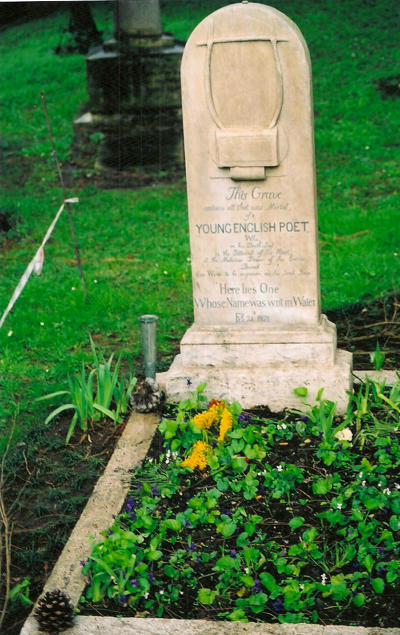
TO THE MEMORY OF JOHN KEATS
The world, its hopes, and fears, have pass'd away;
No more its trifling thou shalt feel or see;
Thy hopes are ripening in a brighter day,
While these left buds thy monument shall be.
When Rancour's aims have past in nought away,
Enlarging specks discern'd in more than thee,
And beauties 'minishing which few display,—
When these are past, true child of Poesy,
Thou shalt survive — Ah, while a being dwells,
With soul, in Nature's joys, to warm like thine,
With eye to view her fascinating spells,
And dream entranced o'er each form divine,
Thy worth, Enthusiast, shall be cherish'd here,—
Thy name with him shall linger, and be dear.
Labels:
Daily Dose,
John Clare,
John Keats,
poetry,
Quotations,
sonnets
Monday, February 6, 2012
Friday, December 31, 2010
Nothing Novel, Nothing Strange

My Samuel Johnson is not handsome. I might say my Boswell's Life of Samuel Johnson, LL.D., to be clearer. Six homely little volumes, rescued from the oblivion to which they were well on their way when I found them, I bought them for myself and decided to see if I couldn't repair them just enough to be read. I'd meant to read the book again anyway, thinking that what I'd read before had either been incomplete or an abridgment, anyway something I'd never got through, for all that. Couldn't say why. I owned some monstrous Modern Library thing, the print so small and the book so big as to make reading it anywhere but in bed under a strong light impractical. When I met with this set, I was working in a different bookstore, a rather quiet used shop, and these sad little books came across the desk, scattered through a few boxes from some dear old soul's estate. I put them aside as I found them, each little book looking worse than the last, thinking the set might be worth something, even in such disgraceful shape, if complete. (It's not, by the way, even in good condition.) Eventually, I found all six. Four of the six were cracked and at least two were completely gone at the hinges. All six were filthy with dust and damage. The owner, at some point, looking I like to think to save an old favorite, had wrapped each one in a hard cellophane that had gone tacky with age, so that the stray volumes were stuck either to each other or to some other unfortunate book. Having paid just a few dollars for the set, I made a project of restoring the books as best I could.
The edition appealed to me because of it's editor, Augustine Birrell, an Edwardian essayist I like, and because of the perfect proportions of the books; neither too small to be read, nor too big to be put in a coat pocket. Took me a few hours, working on them in just my spare time at the store, to see what I had. The tops of the books were black with soot, though this came away easily enough with a thorough dusting. The worst of the work was when I had to carefully disengaged each book from it's sticky homemade wrapper, first by slitting the cellophane along the spine with a knife, and then peeling away the dry bits down to the pasted edges folded inside the books. Here and there the cellophane had stuck to the covers and had to be shaved off using a razor and some lighter-fluid. Only when the last bits of ancient amber tape and primitive plastic came away, could I assess the real damage. The labels on the spines were all more or less intact, but had faded to a near nullity, and the spines themselves had all gone brown with age. The green cloth covers were all discolored and dimpled to varying degrees, the worst this way being the third volume, which had bowed from the moisture slowly collecting under the wrapper. One of two had flecks of white paint, and at least one volume had a circle of candle-wax on the back cover. I took off whatever dirt would come away. I glued the hinges with plain white glue. I stacked all six under some heavy dictionaries and let them heal for a day or two. The glue made the hinges stiff, but, as I'd already observed, the stitching inside the spines was sound, so if I open each book quite carefully, I'm alright after the first few pages. Well worth doing, as I've found in the years, and readings, since. The result of my twenty dollar investment, and my entirely amateur efforts at restoration could ultimately not have better pleased me. This, I now think, is my favorite book, just as it is, ugly as it is, and all six, precious volumes, more mine in a way, than any others I own.I am tonight reading this best of books, in this, my favorite edition, yet again. As the old year dies, and the New Year rises, I find myself unusually restless, and in need of good, boisterous company. I know no better among my books. I can fall into good company in any of the six volumes, at almost any page. Even in the first number, so often criticized, and justly no doubt, for what James Boswell did not know of his friend's life before they met, there is Boswell himself, and him I like. Not everyone does, but I do. I like his nervousness, and his rush, I like his chattering recitation of fact, his sympathy and his antiquated tact. For a man much criticized first for his indiscretion and intrusiveness, and then by later scholars for his prudish recasting of quotation and events, I still like his charming belief in every anecdote of the infant, intellectual Hercules, and his sincere devotion to the reputation of his mentor and friend. Some of Boswell's contemporaries, and rivals for his subject's affections, found him annoying and obsequious, and not a few considered him unworthy of the task he undertook well before his great friend died, to preserve Johnson's conversation and character for future generations, yet none proved Boswell's equal in this, just as no one since, scholar or not, has written a better book about Johnson, or a book better kept next to those that Johnson wrote. The Victorians, and none more influential than Macaulay, dismissed Boswell as a species of idiot savant, lucky in the company he kept, but no kind of writer and of a character no gentleman might like. (I love Macaulay, even in his essay on Boswell and Johnson, as Macaulay was great critic, and in his way a stylist near the equal of any critic after Johnson, excepting Hazlitt. I'm not really bothered then that Macaulay was wrong about Boswell, or anything else, much.) Later still, when Boswell's journals finally saw the light, his reputation seemed to triumph, even at the expense of the person who made his name. In the past few decades, Johnson has come up again, the Yale Edition, and the tercentenary of his birth restoring much of the luster that might otherwise have dimmed in the modern era, with scholars like Donald Greene correcting long-standing misinterpretations of his politics, and biographers like Peter Martin writing excellent and well informed new books.

But it's Boswell I go back to.
This New Year's Eve, the husband has a head-cold. I gave it him, no doubt, and have kept some symptoms for myself, by way of keeping him company. We don't go out to parties anyway, but this year we saw the New Year in watching the celebrations in New York. One of the great advantages of living on the West Coast of the United States, we've discovered, is that we may have a kiss at midnight, by EST, watch the fireworks go off nearly everywhere but here, and then be about our business for the night. In the case of dear A., just tonight, this meant taking his dose of cough-syrup like a good man by nine-thirty and then settling into his pillows without a murmur, and for me, yet another night curled in the guest-room with my books. I'd vowed, most solemnly, to read the night and the year away in quiet contentment; reading something new, and edifying, for the New Year. But what I read in this way did not satisfy. I did not need new ideas, or gentle music. What I wanted was a bit of excitement it seemed, though even the murders I had waiting for me seemed surprisingly dull. I tried book after book, each, it seemed, further and further from my original intention. I could not settle, even with so many good options already at my elbow, until I was up and standing on a foot-stool to fetch my Boswell down from the top of the case. I was not really happy then until I'd stepped into a conversation and heard the familiar roar:
"JOHNSON (much agitated) : 'What! a vow? -- O no, sir, a vow is a horrible thing, it is a snare for sin. The man who cannot go to heaven without a vow, may go --'"
And Boswell aside right after, "Here standing erect, in the middle of his library, and rolling grand, his pause was a truly curious compound of the solemn with the ludicrous; he half whistled in his usual way, when pleasant, and he paused as if checked by religious awe. Methought he would have added -- to Hell -- but was restrained. I humoured the dilemma."
That was what was wanted; "nothing novel, nothing strange," but good old friends, conversation, and company, after all. And so, another year begun in the same old way, and all the better for that.
These old friends of mine, all six ugly little books of them, will simply have to last me another year.
Monday, April 26, 2010
Daily Dose
THE ANNIVERSARY.
" ALL kings, and all their favourites,
All glory of honours, beauties, wits,
The sun it self, which makes time, as they pass,
Is elder by a year now than it was
When thou and I first one another saw.
All other things to their destruction draw,
Only our love hath no decay ;
This no to-morrow hath, nor yesterday ;
Running it never runs from us away,
But truly keeps his first, last, everlasting day.
Two graves must hide thine and my corse ;
If one might, death were no divorce.
Alas ! as well as other princes, we
—Who prince enough in one another be—
Must leave at last in death these eyes and ears,
Oft fed with true oaths, and with sweet salt tears ;
But souls where nothing dwells but love
—All other thoughts being inmates—then shall prove
This or a love increasèd there above,
When bodies to their graves, souls from their graves remove.
And then we shall be throughly blest ;
But now no more than all the rest."
Labels:
Daily Dose,
John Donne,
National Poetry Month,
poetry,
Quotations,
sonnets
Sunday, April 25, 2010
Busy Old Fool
A commonplace, first in my family and later among my friends, is that I was always old. At least until my beard turned white, it was among the most frequent, and weirdly flattering things said of me that I had always been "at least middle-aged." Now that I am, I know of course that that wasn't true at all. Middle-age, as I'm only now learning, is that stage in life when one comes to recognize one's limitations as irreversible, yet, presumably before old age, at least for those healthy enough to see it through gracefully, has taught the full wisdom of accepting what one doesn't know and what might never be. Indignation, of a rather mild kind, still rises in me at such a suggestion, and enthusiasm, if less likely to ignite and harder to keep alight, still warms at least most of my evenings' reading.
What I do not have now, I see, is that impatience to know something, anything new, that made me read so widely if not well, and that allowed me when I was a boy to be bored without stopping. That is what I think I now miss most. Taking up, for example, a huge new novel on a war in which I never had much interest, I could only manage, even with the best intentions, and in part at least as a duty to the awards committee on which I've agreed to spend another year, perhaps one hundred pages before I flung the thing away. What was I doing, I found myself asking no one but myself tonight, reading this catalogue of criminal stupidity, jungle-rot and futility, when I might instead be reading something, anything else from my nightstand? I can't just this minute imagine that there is anything about this particular war, a war within my memory, that I would wish to know that I don't already, certainly not from the perspective of yet another American veteran. Now that's just an idiotic thing to admit, I know, but so, I suspect, must any middle-aged, civilian reader, born before the end of Napoleon's era, have felt, had they had no unfulfilled curiosity about the siege of Moscow, when confronted by yet another foot soldier's memoirs. No amount of precise, not to say fetishistic detail of uniform, weather, rations and the condition of a soldier's feet, no recreation of maneuvers, however exacting, and no discussion of the politics within the army, could save such a book for such a reader. Perhaps only a Leo Tolstoy, writing well after the death of nearly everyone involved, and to a purpose greater than accurate reportage, could make a masterpiece out of such familiar suffering and carnage. And if this novel's not a masterpiece, or even anything much that's new to me, why am I reading it?
This book, this new book is a novel of a war I already know, a war I remember, a war about which I've already read enough if not too much, or at least too much of this. If I was already reluctantly reading this novel, and already willing to concede that even I could see how good and earnest it author's intentions were, nevertheless tonight I was finally convinced, and forced to admit, that it is indeed not a novel likely to someday find a place next to Tolstoy, or even be ranked as being by the James Jones of the Vietnam Conflict, and so... to Hell with it. This may not then be a bad novel -- and there have certainly been enough people whose opinion I respect who have encouraged me to think it a good book and worth reading -- but nevertheless, I simply do not want to read another word of the damned thing tonight.
And that, my friends, is a middle-aged man's confession. I can work up neither the indignation nor the enthusiasm to read another word. Maybe there is something in this new book I don't know and need to, or at least some story I would be the better for having read. Maybe I'll pick it up off the floor tomorrow and decide to give it another hundred pages to convince me, and maybe I won't.
Tonight though, before bed, I'm going to be reading Donne's Songs and Sonnets, again. War be damned.
Labels:
committees,
John Donne,
Leo Tolstoy,
New Books,
novelists,
PNBA,
poetry,
reading,
sonnets,
Vietnam
Daily Dose
WHAT MEANT THE POETS IN INVECTIVE VERSE
"What meant the Poets in invective verse,
To sing Medea's shame, and Scylla's pride,
Calypso's charms, by which so many died?
Only for this their vices they rehearse,
That curious wits which in this world converse,
May shun the dangers and enticing shoes,
of such false Sirens, those home-breeding foes,
That from their eyes their venom do disperse.
So soon kills not the Basilisk with sight,
The Viper's tooth is not so venomous,
The Adder's tongue not half so dangerous,
As they that bear the shadow of delight,
Who chain blind youths in trammels of their hair,
Till waste bring woe, and sorrow hast despair."
Labels:
Daily Dose,
National Poetry Month,
poetry,
Quotations,
Robert Greene,
sonnets
Saturday, April 24, 2010
Daily Dose
FULL WELL I KNOW
"Full well I know — my friends — ye look on me
A living specter of my Father dead —
Had I not bourne his name, had I not fed
On him, as one leaf trembling on a tree,
A woeful waste had been my minstrelsy —
Yet have I sung of maidens newly wed
And I have wished that hearts too sharply bled
Should throb with less of pain, and heave more free
By my endeavor. Still alone I sit
Counting each thought as miser counts a penny,
Wishing to spend my pennyworth of wit
On antic wheel of fortune like a zany:
You love me for my sire, to you unknown,
Revere me for his sake, and love me for my own."
Labels:
Daily Dose,
Hartley Coleridge,
National Poetry Month,
poetry,
Quotations,
sonnets
Subscribe to:
Posts (Atom)


.jpg)