Showing posts with label reference books. Show all posts
Monday, September 30, 2013
Atlas Holds Steady
Let me just say, I am not the map guy. Whatever the chromosome that makes a man love a map, I don't have. I am not "the navigator" on road-trips, in fact, I don't even much like road-trips. (I am not much of a traveller, come to that. If I could fall asleep in my own bed and wake up next morning wherever it is I was going, that would be perfect.)
I can appreciate that maps are beautiful objects, some of 'em, even most of them, but I do not share the aesthetic rapture that seems to put the light in some folks' eyes whenever they see brightly detailed geography laid out on a scientifically accurate grid. (Had a friend, years ago, of a specially deliberative character, who spent the better part of a year deciding just exactly what would best suit the empty white walls of her new home. She pondered and she shopped and she considered many, many options, from art to clocks, before she bought herself one great big map. I had to agree, it looked good when she had it framed and finally put it up. Nevertheless, I was pretty mystified by the whole process of decorating a room so carefully as all that and then deciding on something so... colorful and frankly cold. I mean, just how often would she need to locate Vladivostok before bedtime, bless her?)
Atlases I understand a bit better, as they are reference books, and I have the greatest respect for good reference. An atlas, I confess, I've never owned. I just have never needed to know the distance between Paris and Versailles. Perhaps I'm too trusting, but I just assume that Carlyle worked all that out for me before he sent the Sans-culottes down the road (or was it up? No matter.) I like the idea of an atlas. I like the traditionally over-sized importance of them, as books. I've rarely consulted one, or looked through one, unless someone else, a customer or coworker usually, asked me to.
I have however happily sold atlases in every bookstore, new and used, where I've worked. As reference books go, it has always been the atlases that seem to inspire the greatest admiration in the purchaser. Someone setting about the business of buying an atlas usually has had something of the same heady anticipation with which people shop the travel guides, in combination with the full seriousness of the investor in real estate. The people who tend to buy atlases, even the simplest student atlas, or an annual road atlas, tend to be the kind of bookstore people one looks forward to serving. They usually know what they want, roughly, yet are open to suggestion and eager to get "the best." They come in prepared to pay a fair price, but are always delighted to find a bargain. They are book people.
I had thought the Internet would kill the atlas almost before it killed any other standard reference work, but I now think I was wrong about that. In our house, I don't know that we would ever find our way to the multiplex now, let alone a doctor's appointment in a new clinic, without the lovely ladies at the other end of OnStar. (We like that turn by turn security.) The lovers of maps and atlases however, much as they might while away their evenings peering into their neighbor's backyard on Google Maps, seem to still want the full, weighty, totality of an atlas and the pleasurable puzzle of refolding a map. As I've said, I don't have whatever that is, myself. It may be an evolutionary advantage already being met by other means, new technologies and new digital interactions. I wouldn't know. It does hoever seem to be something lots of people, and not all of them grandparents, would seem inclined to pass on.
An atlas is, it seems, still a gift.
Labels:
atlas,
bookselling,
internet,
publishing,
reference books,
Thomas Carlyle
Sunday, May 26, 2013
Daily Dose
From The Lost Beauties of the English Language, by Charles Mackay
OTHER
"Other languages are dainty in the materials of their increment; but English is, like man himself, omnivorous. Nothing comes amiss to the hungry palate."
From The Introduction
OTHER
"Other languages are dainty in the materials of their increment; but English is, like man himself, omnivorous. Nothing comes amiss to the hungry palate."
From The Introduction
Labels:
Charles Mackay,
Daily Dose,
language,
Quotations,
reference books
Tuesday, May 31, 2011
Daily Dose
IDIOMS
"Idioms are words or phrases which those of us with a native English tongue take for granted, as we have grown up to recognize their meaning. That despite the words being used having absolutely nothing to do with the context of a conversation we are having."
From the Introduction
Labels:
Albert Jack,
Daily Dose,
etymology,
Quotations,
reference books
Sunday, January 30, 2011
Citation Needed

As a common reader, midnight scribbler, and the most casual, and forgetful of researchers, at best, while I feel an obligation to tell the truth as I find it, I can't make any claim to authority, even about the books I've just read, without having the book open before me. Posting quotes, I try to meet some minimum standard of accuracy as to the correct wording and the source, but I've found it's best to do this as I read, for the most part, for fear that, should I rely either on my memory or even my own notes, I will be just as likely to get something wrong as not. Startling how often that can happen -- even when I looking right at the page and passage I've marked! (What is that about?!) Now or nothing is about the best I can do. (I've always envied those readers who can keep what they've most admired ready for when they might need it. I envy a great memory almost as much as I admire the ability to tap dance. I know, some would say both are skills that can be learned, even at my age, but that, I confess, probably ain't gonna happen for me. How many times have I wished I remembered better some phrase that might serve an argument better than anything I might say, and thought I knew just the thing, if only I could remember who said it, and how? Know I read something good on that very subject -- whatever it is -- once. When I try, either here or in conversation, to come up with what this or that some superior person said, and I try to say it just as they said or wrote it, come to find out, when I have the time to check, I've muffed it, muddled the sense of it, or attributed it to someone else entirely than the person who said it first or wrote it best. Hopefully, with the time and resources of my leisure hours here at my desk, I do a bit better writing than I do when I'm trying to be clever over dinner-out. Hopefully. Don't make any bets, though.) That would seem to me to be the chief flaw in the new era of democratic Reference; the reliance on memories evidently no better than mine.
How many times, in this new age of computer reference, have I seen that disheartening little phrase, "(citation needed)", and wondered where else it ought to be popping up in the body of what's presented, on the whole, as being fact? Discouraging to think that anyone taking the trouble to write and post such information as they thought vital to the record, didn't have something more reliable than their own memory to hand when the time came to establish a fact for more readers than will ever hereafter think to check another source. After all, how many times do I really question the reference materials I find online, unless I just happen to know -- by purest chance --something contradictory? Wrong John Brown, for instance, pictured at one time at least, on two of the three entries under that name I happened to look up at Wikipedia.
Now, if I were a better citizen, I might have done something about that.
I am just old enough to trust books better, and some names better still than others. Years ago, I read Harry R. Warfel's biography, Noah Webster: Schoolmaster to America. Admirable book about an admirable man, as I remember it, and an admirable and accurate title for him too. For any who might wonder by what way a man's name may become, for generations after his death, synonymous with his life's work, even after that work has been subsumed and or supplanted, I can think of no better example than Webster, or of a better explanation than that offered in Warfel's old standard biography. Webster not only taught the new Republic how to spell, how to pronounce, how to read, and to read their Bible, but also to define themselves and their new country, for themselves, in their own language. Quite an amazing accomplishment, and worthy, wouldn't you say? of long remembrance. If no one now would have much use for Webster's original work, An American Dictionary of the English Language, they still know his name, and use it as a standard to which all our subsequent reference works are yet held. No small fame in that.
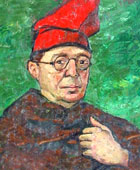
How many other examples of this might be found on the bookstore's Reference shelves? Roget, Brewer, Fowler, Follett, Strunk & White, and maybe one more, without thinking too hard, Benét. Go into almost any bookstore, selling new books or used, or both, anywhere in the United States, and you are likely to find, in one edition or another, Benet's Reader's Encyclopedia. The fifth and most recent edition came out just in 2008, but the book, in one form or another, has existed, as such, since 1948. That's pretty good for a reference book. I wonder, how many people who might even know that book, might even own it, remember William Rose Benét? That's him, by the way, in that rather whimsical portrait at the top. (Reference failure: it is not only a charming likeness, it is the only one I could find online or anywhere else, and I never could find the name of the painter.) Now, I've worked in bookstores for a quarter of a century, and I don't know that I ever knew that Benét's was so called because of it's first editor, or that that was William Rose Benét, that he was the editor of the Saturday Review of Literature for twenty five years, that he'd won the Pulitzer Prize for poetry, that he was married to the poet, Elinor Wylie, or that he wasn't the same guy as his brother, and fellow Pulitzer Prize winning poet, Stephen Vincent Benét. (All to you, Wikipedia.) Curious, isn't it? Must be the only American siblings to have both won such a prestigious literary award, and me working in a bookstore, and I didn't even know, or at least quite remember that these were two different poets, or that the one I remembered least well, actually made one of my favorite books. Such, it seems, is immortality.
But the name Benét, whatever else it may or may not still mean in American Literature, still means enough, has still sufficient recognition to it, to have survived William Rose Benét, if nowhere else, on a book with however many editors since, and on a book that is still the standard for an American work of literary reference. Pretty good.
I recently bought the two volume, illustrated, second edition that is shown in the other picture here. Didn't have to pay much for it, used. If you don't know Benet's Reader's Encyclopedia in this, or any other edition, let me just say what an odd and admirable object it is. I can't frankly imagine it surviving, as a reprinted book all that much longer, however extensively revised. Too much of what this book was meant to do for both reader and writer can now be done, and is being done with greater efficiency, if with no improvement in either style or accuracy, online. The idea of such a book was to anticipate the references and allusions in literature to other books, authors, myths, and familiar phrases, and to collect and define these in a single, handy volume. What Benét was hired by his publisher to do was take an existing reference work of theirs, Crowell's Handbook for Readers and Writers, and update and improve it. As Benét noted in his introduction to the first edition of his book, that book in turn owed it's existence to Brewer, now best remembered for A Dictionary of Phrase and Fable, but also the author of The Reader's Handbook. All of this information may be had now, in one shape or another, online, but what Brewer, and Benét after him, did, and what the contributors to Wikipedia are now themselves doing after their fashion, was a continuation of a tradition at least as old as the French encyclopédistes of the 18th Century.
The ideal of collecting all human knowledge into one comprehensive and accessible work, while an admirable and revolutionary concept, had, by the time William Rose Benét came along, long since been given over to an industry of professional encyclopedia-makers, but certain aspects of culture and science, having outgrown any such confines, almost required, and could still be profitably treated to their own individual volumes. Made sense, in 1948, to get an American man of letters, like Benét, in to do the job for literature.
What I've always liked best about books like Benét's is their confidence, one might better say their optimism or naïveté, in thinking not only that such a thing might be done, but that it should. The age of literature as the exclusive property of the academic had yet to so disastrously dawn. Benét, like Brewer, and Webster in his way, before him, could still assume that even so complex a subject as letters or literature might be understood by anyone, with just such help as might come from just a reference book or two, and moreover, that it ought to be. Remember, by the time Benét came to make a new reference book out of an old one, he could still mention, as he does even in his introduction, a book like Joyce's Ulysses without suggesting that no one but specialists might be qualified, or inclined to read it. Think of that.
That's exactly what has kept a book like Benét's in print all these decades, that assumption that the reader's curiosity might be best satisfied by actually reading our literature, with perhaps just such help as might be had from one or two other fat books. Until we were persuaded otherwise, by our own higher education, or the lack of it, men like Benét were still pretty sure we could manage these things, if we had to, for ourselves. The breadth of a book like Benét's is still impressive. As amusing and quaint as they might now seem to us, many of the assumptions these old editors made about just what to be valuable to their readers, weren't all that unlikely then. A literate American, in 1948, might have wanted a word or two on Swinburne without being thought overly eccentric. And as glaring as the omissions might look after more than sixty years, -- imagine! not a word on Filipino poetry! -- and in light of the most recent progress in the study of the various college programs of hyphenated-studies, a book like Benet's Reader's Encyclopedia, or Brewer's dictionary, still seem to find readers, and not just among fusty old eccentrics like me. How is it then that such books, if only for the time being, still find readers in the age of electronic information? How is it that I'm pretty confident, even if these books go completely out of print, one way and another, they will always find readers?
Old Aeschylus said somewhere -- at least according to one of my dictionaries of quotation -- "The man whose authority is recent is always stern." So it seems to me, for now, is much that might be consulted on the Internet as being even close to a respectable source for information. Whatever it's impressive reach, and however miraculous it's accessibility, Wikipedia is frankly a bit... dry. Nothing wrong with that, for what Wikipedia is or is meant to be. In matters of art and literature particularly though, the simple, verifiable Gradgrindian facts may not be quite enough for any but the most devoted students of the M'Choakumchild school. (Look 'em up.) To read literature at all well, one might be better served, at least as one goes along, by reference to the older,still very individual, if no longer unchallenged opinions of men like Martin Seymour-Smith, and William Rose Benét, the former a delightfully opinionated old party on the subject of Modern Literature, and the later, in his more subtle way, no less inclined to let slip, here and there, something of his own estimation of various giants, as in his little wink, just at the end of his thoroughly straightforward entry on George Eliot. In 1948, and again, it seems, as late as my second edition from 1965, it was still thought proper to refer without further comment to the living arrangements of Miss Mary Ann Evans and George Henry Lewes as "irregular," but that isn't the funniest bit, really. Benét, the poet, ends his entry on "Mrs. Lewes," the great novelist, with the following:
"Her greatest preoccupation is with moral problems, and more particularly, with the moral development of her characters, many of whom strive with the difficulty of arriving at an individual and mature view of life. See SPANISH GYPSY, THE."
Now one would have to have read poor Miss Evans' poor old poem, "The Spanish Gypsy," to find that amusing, I suppose, but of all the possibilities to which the reader might be directed for a better understanding of just how well Miss Evans' managed, at least artistically, to resolve her own "moral problems," there are few products of her mighty pen less likely to enlighten us than the painfully silly story of noble Fedalma, her equally noble beau and their ridiculously noble parting. Someone may have been suggesting a bit of the humbug just here.
That's the kind of odd charm only a book like Benét's can still afford the reader, and presumably only because there was no one back in the day with the superior authority to suggest that Benét was either being too eccentrically obscure in this closing reference, or wrong to be poking a little fun at the noble George Elliot.
One needs a certain authority to do either with, as it were, a straight face.
If I'm being honest, I bought this edition of Benét's mostly for the illustrations -- an equally eccentric selection of portrait plates and "148 line cuts of title pages, old woodcuts, and cartoons." (As this edition was published only after the great editor's death, I scent the musty pleasures of the copyright-free usage in this, more than any suggestion of William Rose Benét's.) Now I must admit that I think I will have to keep the old thing whole, and add it to my reference books, just because I like the idea of the thing as much or more than whatever use I may find for it as a reference. However much improved the speed of our communications, and however much I may personally have come to rely on the easy access to information provided by the Internet, I think I'd better be sure to keep as many good reference books as I may find always about me. Better to trust a man so confident in the sufficiency of his own dignity as to pose for his portrait decked in a cloak and a floppy red hat, than all the unseen authorities floating out there in the ether.
Saturday, February 6, 2010
Got to Put My Cheaters On
I heard a coworker today, in conversation with another at the information-desk, suggest that they might "google" the answer to a question I didn't hear. While he did this, she looked up from the desk, caught my eye and intending to be overheard, said, "-- or we could ask Brad, he's faster than google." That was very sweet of her. As it happened, I did know the answer, once I'd heard the question. Walt Whitman was a kind of a nurse during The Civil War, a most affectionate and patient kind of untrained volunteer, so one might say he put himself at the service of the wounded soldiers, rather than serving in the war. That was the answer. Not perhaps so innocently asked of me -- judging from the knowing smile I got with the question -- and easily answered. (I think quite innocently done by Walt, by the way, though I may be wrong, and happily so, about that.) I did point out, despite the flattering suggestion that I might best Google, that I'd been lucky, and the answer happened to be something I knew. It took no special knowledge of me, or of Whitman, to guess that I might.
Still, flattering to be thought of as likely to know such things.
While it is difficult to admit without sounding like a real ass, I do know quite a bit, at least in the way of books, and I do like being turned to as someone who does. My more experienced interlocutors, knowing better just how much I enjoy rattling away about such literary and biographical stuff, sadly may have learned to hesitate to ask me such questions, for fear of setting me off without being able to stop me once I've got going. They might also be right in thinking, however confident I may sound and or actually be in my answers, that I get things wrong frequently; that dates tend to escape me entirely, that I often muddle things and ascribe details of biography to the wrong people, or titles to the wrong authors, or imagine, having the most imperfect memory, that I'm talking sense when I may well be talking nonsense. I often misremember the books I've read, and I've caught myself, or been caught, with embarrassing frequency, telling more of a story than the story I was asked to tell. I like to think that this last is a flaw of my memory rather than one of character, but it may well be both. I want to be helpful, I want my answers, when I have them, to be not just informative, but entertaining, if always not as interesting, or accurate, as I sometimes imagine my answers or myself to be.
I mean to say, I'm not altogether to be trusted. My authority, my memory, even when it comes to books, may be no better than it is because I have never been, and can't really claim to ever really have wanted to be, a serious student of anything. A serious reader, I suppose, I am, but best check anything I might say against better sources.
I have my own, of course. Beyond what can be had from the Internet, I find certain books of reference essential. An old fashioned idea; that answers are best found in books, but I am what my education and reading have made me, and I still trust books. I should say, having found a book I trust, I believe in having it, and keeping it, at the ready. I own all sorts. Some live at my elbow as I write: like my two versions of the Compact Oxford English Dictionary, my various dictionaries of foreign phrases, my Oxford one volume Shakespeare, etc. I've mentioned all these here before. There are other books of reference, less straightforwardly practical, but no less valuable I've found, that I consult not to correct but rather to inform and direct my reading. Some, like Gosse's English Literature, whatever its reputation -- if it can still be said to maintain one -- are old books but still marvelously entertaining. The illustrated edition in four volumes that I came across not all that long ago, after having read about these books not infrequently, and about Gosse's misjudgements and mistakes, is now among my treasures. Not long after its initial publication, first one, then another contemporary of the author leveled a number of devastating criticisms, not only at certain failures of scholarship, but at Gosse, his style, his intentions and his qualifications for having even undertaken such a history. Doesn't much matter now, any of that controversy. The books themselves are lovely; beautifully illustrated, well made, easily arranged, and full of good things, I think. I can't imagine not being able to turn to books just like these, when, for example, I want to know something about -- opening Volume Two at random --Sir John Vanbrugh, who, says Edmund Gosse:

"... has none of Congeve's pre-eminance in style. He has no style at all; he simply throws his characters at one another's heads, and leaves them to fight it out as they will."
Now, I've know idea if this is fair to Vanbrugh, but it is good, isn't it? And it suggest that reading further might be fun, doesn't it? Does to me anyway.
Another such book, which I've owned a long time in a terrible copy and only just replaced with a very nice, used hardcover, is The New Guide to Modern Literature, by Martin Seymour-Smith. Seymour-Smith was a respected, if unproductive poet, when he took up criticism and biography as something like a mission. His life of Hardy was one of the last comprehensive, meaning impossibly long, literary biographies I undertook. The biographer's style was so good, and what he had to say not only of Hardy's life but about his poetry and novels, so good, that I was for once glad of the cumbersome length of his study. In fact, I took up Seymour-Smith's Hardy, and took up Hardy again as a result, because I first stumbled across Seymour-Smith's life of Kipling while trying to decide just how much more of Kipling I would ever want to read. I'd read a life of Kipling by Angus Wilson, a novelist I particularly like, but I'd found Wilson's Kipling to be someone of whom I would not feel the want of having read more. Seymour-Smith's Kipling, on the other hand, proved to be someone I wanted to keep reading, and read more closely.
Seymour-Smith's greatest book though was neither of these biographies. I admit, I've never looked out for his poetry, or ever seen it pass conveniently close enough to just pick up on my way. His "Guide" though, I've gone to time and again. It is a masterpiece. Far and away the most comprehensive literary reference book of modern world literature I've ever known -- he takes on literature from every continent in it -- it is also that rarest of critical works, one that can be trusted both as to the author's point of view and his judgement. Not the same thing. Seymour-Smith's enthusiasm is infectious, and brings before the reader an astonishingly wide-ranging appreciation for every kind of writing. He clearly believes in literature as a common, human good. He is always eager to say what he finds best, each in its kind, what he feels ought not to be missed. He does this succinctly, reasonably, and without, somehow, making the reader feel inadequate for not having read all that he did. Amazing, that. Seymour-Smith also explains why some things are not so good as the opinion of his day (he died in 1998, age 70,) held them to be. Many times I've found what Seymour-Smith had to say, about Eliot, for example, explains my resistance to a particular author or work. He is never disrespectful of the effort, but never shy of saying just what he makes of the result. Seymour_Smith had enormous resources to call on in making any comparison. He understood the author's place in history, literary and actual, yet his assessment of an author's gifts, or a book's virtues, is justified by neither. He judges what he's read, with sympathy, but as an individual achievement. And even his harshest judgments, rather than cutting off interest or allowing something lasting to be dismissed, always suggest further reading. And when I have read further, I frequently find myself in complete agreement with whatever he's said. His recommendation may make me want to read a book, but more than that, his brief analysis has often provided me with the means to do so.

To just turn to familiar names from my own shelves, almost at random, he likes best the Markandaya novel that, reading her novels, I found to be the best, A Silence of Desire. He explains Agnon's wonderful strangeness not as an affectation of modernism, but rather as part and parcel of "... already established Hebrew forms, which seem strange to readers unfamiliar with the literature and in particular with the Hasidic tales." Just so. On Gide, "In 1947 he was awarded the Nobel Prize. He is much hated, and seldom loved. Yet warmth is perhaps what his best work needs to be fully appreciated."
That is all good, and he is as good with poets. He is entirely fair, for instance, to the now all but forgotten, like John Masefield: "The illusion was that he could ever be wholly free of that stifling gentility which he seemed, to his first admirers, to be so effectively challenging." And equally good in celebrating the best of a genius like Yeats, without cutting him the least slack for his failure as both a man and a poet: "The problem is this: Yeats' politics are stupid or humanly disgraceful, or both..."
I've found it best to use Seymour-Smith's great book either to suggest unfamiliar reading, or to help me understand better why I may have liked or disliked a book already read. I'm not saying that I've adopted his every opinion, but I will say, reading him has helped me form my own better and more frequently than almost any other critic I've ever read on modern literature.
And he makes me sound smarter at least, when I'm asked about such things.
This is a kind of cheating, I suppose, using critics not only as guide, but shamelessly using what they've had to say to say something for me better than I might on my own, but I don't think critics much mind when one does that, so long as some acknowledgement is made. So here's mine, at least in part. So if you happen to notice me spouting off, here or elsewhere, about matters literary, check my sources. They've probably said the same thing, only so much better than I might.
And they can certainly be trusted to know a great deal more than me, or Google, possibly, come to that.
Still, flattering to be thought of as likely to know such things.
While it is difficult to admit without sounding like a real ass, I do know quite a bit, at least in the way of books, and I do like being turned to as someone who does. My more experienced interlocutors, knowing better just how much I enjoy rattling away about such literary and biographical stuff, sadly may have learned to hesitate to ask me such questions, for fear of setting me off without being able to stop me once I've got going. They might also be right in thinking, however confident I may sound and or actually be in my answers, that I get things wrong frequently; that dates tend to escape me entirely, that I often muddle things and ascribe details of biography to the wrong people, or titles to the wrong authors, or imagine, having the most imperfect memory, that I'm talking sense when I may well be talking nonsense. I often misremember the books I've read, and I've caught myself, or been caught, with embarrassing frequency, telling more of a story than the story I was asked to tell. I like to think that this last is a flaw of my memory rather than one of character, but it may well be both. I want to be helpful, I want my answers, when I have them, to be not just informative, but entertaining, if always not as interesting, or accurate, as I sometimes imagine my answers or myself to be.
I mean to say, I'm not altogether to be trusted. My authority, my memory, even when it comes to books, may be no better than it is because I have never been, and can't really claim to ever really have wanted to be, a serious student of anything. A serious reader, I suppose, I am, but best check anything I might say against better sources.
I have my own, of course. Beyond what can be had from the Internet, I find certain books of reference essential. An old fashioned idea; that answers are best found in books, but I am what my education and reading have made me, and I still trust books. I should say, having found a book I trust, I believe in having it, and keeping it, at the ready. I own all sorts. Some live at my elbow as I write: like my two versions of the Compact Oxford English Dictionary, my various dictionaries of foreign phrases, my Oxford one volume Shakespeare, etc. I've mentioned all these here before. There are other books of reference, less straightforwardly practical, but no less valuable I've found, that I consult not to correct but rather to inform and direct my reading. Some, like Gosse's English Literature, whatever its reputation -- if it can still be said to maintain one -- are old books but still marvelously entertaining. The illustrated edition in four volumes that I came across not all that long ago, after having read about these books not infrequently, and about Gosse's misjudgements and mistakes, is now among my treasures. Not long after its initial publication, first one, then another contemporary of the author leveled a number of devastating criticisms, not only at certain failures of scholarship, but at Gosse, his style, his intentions and his qualifications for having even undertaken such a history. Doesn't much matter now, any of that controversy. The books themselves are lovely; beautifully illustrated, well made, easily arranged, and full of good things, I think. I can't imagine not being able to turn to books just like these, when, for example, I want to know something about -- opening Volume Two at random --Sir John Vanbrugh, who, says Edmund Gosse:
"... has none of Congeve's pre-eminance in style. He has no style at all; he simply throws his characters at one another's heads, and leaves them to fight it out as they will."
Now, I've know idea if this is fair to Vanbrugh, but it is good, isn't it? And it suggest that reading further might be fun, doesn't it? Does to me anyway.
Another such book, which I've owned a long time in a terrible copy and only just replaced with a very nice, used hardcover, is The New Guide to Modern Literature, by Martin Seymour-Smith. Seymour-Smith was a respected, if unproductive poet, when he took up criticism and biography as something like a mission. His life of Hardy was one of the last comprehensive, meaning impossibly long, literary biographies I undertook. The biographer's style was so good, and what he had to say not only of Hardy's life but about his poetry and novels, so good, that I was for once glad of the cumbersome length of his study. In fact, I took up Seymour-Smith's Hardy, and took up Hardy again as a result, because I first stumbled across Seymour-Smith's life of Kipling while trying to decide just how much more of Kipling I would ever want to read. I'd read a life of Kipling by Angus Wilson, a novelist I particularly like, but I'd found Wilson's Kipling to be someone of whom I would not feel the want of having read more. Seymour-Smith's Kipling, on the other hand, proved to be someone I wanted to keep reading, and read more closely.
Seymour-Smith's greatest book though was neither of these biographies. I admit, I've never looked out for his poetry, or ever seen it pass conveniently close enough to just pick up on my way. His "Guide" though, I've gone to time and again. It is a masterpiece. Far and away the most comprehensive literary reference book of modern world literature I've ever known -- he takes on literature from every continent in it -- it is also that rarest of critical works, one that can be trusted both as to the author's point of view and his judgement. Not the same thing. Seymour-Smith's enthusiasm is infectious, and brings before the reader an astonishingly wide-ranging appreciation for every kind of writing. He clearly believes in literature as a common, human good. He is always eager to say what he finds best, each in its kind, what he feels ought not to be missed. He does this succinctly, reasonably, and without, somehow, making the reader feel inadequate for not having read all that he did. Amazing, that. Seymour-Smith also explains why some things are not so good as the opinion of his day (he died in 1998, age 70,) held them to be. Many times I've found what Seymour-Smith had to say, about Eliot, for example, explains my resistance to a particular author or work. He is never disrespectful of the effort, but never shy of saying just what he makes of the result. Seymour_Smith had enormous resources to call on in making any comparison. He understood the author's place in history, literary and actual, yet his assessment of an author's gifts, or a book's virtues, is justified by neither. He judges what he's read, with sympathy, but as an individual achievement. And even his harshest judgments, rather than cutting off interest or allowing something lasting to be dismissed, always suggest further reading. And when I have read further, I frequently find myself in complete agreement with whatever he's said. His recommendation may make me want to read a book, but more than that, his brief analysis has often provided me with the means to do so.
To just turn to familiar names from my own shelves, almost at random, he likes best the Markandaya novel that, reading her novels, I found to be the best, A Silence of Desire. He explains Agnon's wonderful strangeness not as an affectation of modernism, but rather as part and parcel of "... already established Hebrew forms, which seem strange to readers unfamiliar with the literature and in particular with the Hasidic tales." Just so. On Gide, "In 1947 he was awarded the Nobel Prize. He is much hated, and seldom loved. Yet warmth is perhaps what his best work needs to be fully appreciated."
That is all good, and he is as good with poets. He is entirely fair, for instance, to the now all but forgotten, like John Masefield: "The illusion was that he could ever be wholly free of that stifling gentility which he seemed, to his first admirers, to be so effectively challenging." And equally good in celebrating the best of a genius like Yeats, without cutting him the least slack for his failure as both a man and a poet: "The problem is this: Yeats' politics are stupid or humanly disgraceful, or both..."
I've found it best to use Seymour-Smith's great book either to suggest unfamiliar reading, or to help me understand better why I may have liked or disliked a book already read. I'm not saying that I've adopted his every opinion, but I will say, reading him has helped me form my own better and more frequently than almost any other critic I've ever read on modern literature.
And he makes me sound smarter at least, when I'm asked about such things.
This is a kind of cheating, I suppose, using critics not only as guide, but shamelessly using what they've had to say to say something for me better than I might on my own, but I don't think critics much mind when one does that, so long as some acknowledgement is made. So here's mine, at least in part. So if you happen to notice me spouting off, here or elsewhere, about matters literary, check my sources. They've probably said the same thing, only so much better than I might.
And they can certainly be trusted to know a great deal more than me, or Google, possibly, come to that.
Labels:
criticism,
critics,
Edmund Gosse,
Martin Seymour-Smith,
reading,
reference books
Saturday, January 24, 2009
Familiar References
Any reference to dictionary definition, in a speech or an essay, or even in such ephemera as this, specially anytime a paragraph begins with "as defined in Webster's Ninth Collegiate..." or the like, makes me low. Such is the laziness of writers. That any editor -- for such, I'm told, there are still in the world, though the evidence grows scanty -- should allow such juvenilia to see print frankly amazes. Surely this term-paper stop-gap ought not to be allowed to anyone beyond the age of consent?
And yet, just today, in taking up a new work of American history, from a recognized author and a large and respectable House, there it was: "As defined in Webster's... " And down the book was put.
Can there really be anyone still who does not find in this a sad and sorry sort of cliche, or sign of something worse about the state of reference libraries in a digital age? Webster's indeed.
Tonight, at my desk I find two handsome twins: the Compact Oxford English Dictionary of Current English and the Oxford Compact Thesaurus, Third Edition, bound in leather, ribbed and gilded, bought used, but published as a "bonus" for one book club or another. This pair replaced the Oxford Pocket Dictionary I kept since college, it's dustjacket finally in tatters, it's pages (shamefully) marked and dog-eared. I retained my copy, circa 1961, of The New Roget's Thesaurus in Dictionary Form, Revised & Greatly Expanded, Thumb-indexed, from Garden City Books, for reasons patriotic and sentimental.
And on the round table I bought in a junk-shop and painted white when I painted my pine bookcases, to better match the then anonymous room into which they had to go, I keep my treasured friends: The Oxford Universal Dictionary on Historical Principles, Third Edition, Revised with Addenda, 1955 -- revised by the delicious sounding Don, C. T. Onions, C.B.E., F.B.A., -- and the two beautiful volumes of The New Century Dictionary of the English Language, in the edition published in this format for the first time in 1930.
The Oxford Universal has been with me many years, The New Century is comparatively new to me. The former cost me twenty-five dollars, in a Pittsburgh bookshop many years ago and was brought home on a bike, though I can not now imagine how. It measures eight inches by eleven and sits three and a half inches thick. The cloth covers have gone from blue to gray, and show every evidence of being dropped and packed and unpacked and left repeatedly open and askew. The red cloth ribbon, presently marking the page "Orangeado/Orbitosphenoid" to the left, and "Orby/Order" to the right, is from some forgotten Christmas gift, no doubt long since discarded, though the ribbon remains. The New Century in two volumes, is a reheaded stepchild of that greatest American dictionary, the original Century Dictionary, in eight to ten to twelve volumes. Like the Universal Oxford, this edition of The New Century was meant for common folks, like me, who had neither the shelves nor the resources to own the genuine article. And as a common user, and owner of just these, I am content.
To be honest, I use the Compact Oxford most. But the old Universal is kept close and consulted regularly. The beauty of both volumes -- "A -- pocket veto" and "pock-mark -- zymurgy & supplements," -- make actually using The New Century Dictionary, with all that lovely line-illustration, the bold and handsome type, and the beautiful stamped covers, too distracting. At roughly twice the size together of the Universal, at least so far as thickness, though with much larger type and smaller entries, The New Century is neither more nor less practical in shape. But the difference is between dress pumps and workboots. The occasions for for the former are few, and special; a bird's name, as there might be a picture, or a butterfly, as that provides the excuse to examine one of the color plates. I would not willingly part with them for many times the money I paid (twenty dollars for the set.)
I have other, more specialize reference works, from the whimsy of Instant Yiddish to Fowler's, to commonplace books and more scholarly tomes, but my dictionaries, taken together, represent the better part of my self education. My affection for them is true. My reverence of the men and women who made them profound. I would not think of quoting from them, even here.
Subscribe to:
Posts (Atom)