"To wipe all tears from off all faces is a task too hard for mortals; but to alleviate misfortunes is often within the most limited power: yet the opportunities which every day affords of relieving the most wretched of human beings are overlooked and neglected with equal disregard of policy and goodness."
Samuel Johnson, Rambler #107 (March 26, 1751)
I have a dear friend much addicted to narrative. The condition is by no means rare as nearly all human beings have it to one degree or another, but my friend being himself a novelist has it bad. While he remains willing to start nearly any book, his interest invariably flags in the absence of a story. He does not see the point. I do not read quite the same way, but I understand the need.
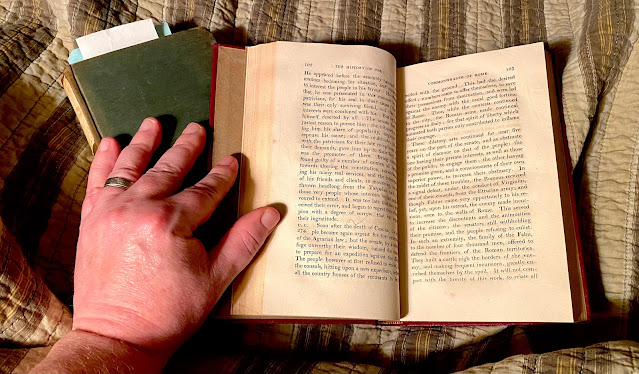
Just last night I set aside the fourth volume of six of Boswell's Life of Samuel Johnson, because I simply had to know what happened to Coriolanus. Now this is silly. I have read and watched the Shakespeare play. I have read pretty deeply into Mommsen. I know this story. And yet last night I read to the end of that noble, awful man because Oliver Goldsmith was telling that story so well and so briefly that I had to go back to his History of Rome. I bought a handsome, two volume edition of this recently for entirely too much money. Mine was published in 1821 and rebound some time I would guess in the early days of the last century. The first edition appeared in 1769 and unlike many of dear Goldsmith's many projects, actually earned its author a profit. Mine is a thirteenth edition, published nearly fifty years after the author's death. Clearly it was once a popular book. Johnson was very flattering. He defended Goldsmith's history as far and away one of the most elegant and readable products of the author's pen -- that same pen that Johnson also said "ornamented whatever" it touched. 'Deed. I always set aside Boswell reluctantly, but what was wanted last night, Sir, was a story.
It is worth noting that as smoothly entertaining as Goldsmith's Rome is proving to be, his contemporary Edward Gibbon had considerably more to say in general and at length not because he was the greater writer but because his purpose was more complex and his scholarship obviously superior in every particular. Reading one however does not preclude the pleasure of reading the other. Each in his own way undertook to tell the truth as best he was able and neither failed for want of what the other possessed. What's more the subject was such, and has proved since to be big enough to accommodate more writers many times over now than all the surviving sources combined. At my last go during my pandemic furlough I made it to volume six of eight in Gibbon's Decline and Fall of the Roman Empire. I can recommend it for many reasons, but not I think for the smoothness of his narrative or the simplicity of his style. There is always another way to tell a story honestly, and many ways to tell it well. Important to keep in mind that not every story is defined by the straight line of its telling, and not every life is worth reading for either its ultimate moral or its event.
For all his obvious labor in making his biography complete, to the modern reader of fiction, even of biography, Boswell's Johnson is an unfamiliar beast; thin at the front, swelling to enormous size as it goes, seemingly shapeless until it finally comes to the touchingly small end of its tale. There is more of 18th Century natural history to it -- though describing a man -- than the more familiar form we find in a Fielding novel, or even in a more traditional biography like Johnson's own The Life of Mr. Richard Savage -- itself a pretty weird story to a reader in the 21st Century. So for elegance of form, I can only suggest the reader look elsewhere. And yet everyone ought to read The Life of Samuel Johnson.
As an enthusiast of all things Boswell & Johnson, I should like nothing better than to tell some famous and funny Johnson stories, but there is no need. First, others have already told them better. Secondly, that is not my job in the book club. I am not the storyteller. That is Mr. Boswell. Neither am I an expert. I am just the host and where necessary, a background guy. That's what I do, if I am to do anything at all beyond ringing again my already resounding enthusiasm. I selected this book in part to break the habit of reading to just the one point and in just the one way: front to back, straight on from beginning to end, and faster, faster, as we go. There are so many other ways to read and so much pleasure to be had beyond traditional narratives! My arguments may not prove persuasive, but then I'm just an old bookseller, not a professional critic. I may not prove even so good an advocate as attorney Boswell. So be it. All I can really do is suggest, ask some questions, and answer others. There are always other, more usual book clubs. (Though I can think of few things more deadly than a book club the point and purpose of which would be to simply recapitulate the events described and then natter how like someone's uncle Sam Johnson seems. I have been to that book club before. All I could recommend was the wine.)
It seems I have made the rules and now must live with the consequences, to wit:
A member of my book club has asked me to explain Samuel Johnson's politics. Oh dear. This is no easy thing to do, even for a far better scholar than your humble and obedient servant, Madam, but I shall try.
When Samuel Johnson came to die in December, 1784, the eruption of a volcano in Iceland the previous year had caused the hottest summer and the coldest winter in Britain in living memory -- a cause and effect better understood now than then. In August a Scots apothecary made the first balloon ascent in the UK. Astonishment ensued. What would be the United States of America was still operating none too successfully under The Articles of Confederation and wouldn't even convene the Constitutional Convention for another three years. Critic and essayist Leigh Hunt was born in October of the year Johnson died. Leigh Hunt would himself die a most High Victorian Gent of Letters in 1859 at seventy-four, the same age reached by Johnson. Junipero Serra, poet Phillis Wheatley, Denis Diderot, and the Comte de Saint Germain all died the same year as Johnson.
All of which is offered to suggest something of just how long Johnson has now in fact been dead. Put it another way, the world as Johnson knew it, and specifically politics as Johnson would have understood them are all now so remote from present definitions and parties as to be quite dead to us indeed.
Like all things, politics tends to entropy, but interrupted by revolutions, personalities, and upsets not reduceable to scientific prediction, despite the noble efforts of Marx & Co. In my time I have seen the Republican Party transformed from the bulwark of big business and small government to a bear-pit for fanatics, fascists, freebooters, and boobies. I grew up with grandmas who kept a picture of FDR on the wall right next to a knocking Jesus. Meanwhile the Democratic Party they knew has largely devolved into what I can only describe as the Republican Party of my youth, but now with gays and bridge repairs. Doubtless there are pundits aplenty happy to explain these transformations but I do not myself feel qualified. I confess to having been taken by surprise more often than not since at least the first Clinton administration. I read history and the newspapers and I don't like to think I am inattentive to the politics of my own time, but the usual points of reference: left, right, progressive, conservative, are not terribly useful in discussing the politics of Dr. Johnson's day.
One of the unhappiest habits in the readers -- and many of the writers -- of history is the conscious or unconscious desire to make the dead fit into contemporary narratives. Someone once said that the whole thrust of the British private educational system was to make Roman senators into gentlemen and Greek philosophers into Anglicans. We Americans are no more immune to this than the British. If we are to have Jesus we really must insist that he wash more than his feet and not make a fuss in the visitor's gallery at the Stock Exchange. Lincoln has to either be a saint or a slaver, and so on. The past must either be made to conform to our present purpose or be recast as an entirely cautionary tale in which all the major actors were either equally awful or entirely superior to present party politics. This is history as a rhetorical devise, a series of competing narratives with little or no attempt to see the humanity in any of the dead save the ancestors we choose to venerate, often at the expense of not only the complexity of their circumstances but also of their characters.
Samuel Johnson is born a little less than a decade into the 18th Century. The United Kingdom came into existence two years before Johnson's birth in 1709. As a baby he was famously touched "for the King's evil" by the last serving Stuart monarch, Queen Anne. Johnson grew up in an England still shaped in the previous century; a world preoccupied with the legitimacy of the Hanoverian succession, nojuring clergy, Jacobite risings, and an unsteady peace with "the Northern Kingdom." By the time Boswell met Johnson in the reign of King George III, most of the upsets and controversies of Johnson's youth were largely settled -- as were most of Samuel Johnson's political opinions.
I don't know that Samuel Johnson ever voted. He was for most of his adult life a man without either property or a fixed address for any length of time. Unlike friend Boswell, Johnson was no aristocrat. Johnson was a poor man*. Even as he composed his great dictionary Johnson was frequently so embarrassed financially as to have no shirt either clean or sound enough in which to go out in public. If he ate like a bear all his life, he was often just as hungry as one. Such was not the qualified electorate in Georgian England.
To be poor in 18th Century England was simply the way of things for most people and likely the will of God. Modern readers would do well to remember just here that for Johnson, God was everywhere in the affairs of men, and often nowhere to be found but in submission to His divine will, proper observance of His religion, and in supplication to His mercy. This may strike us as somewhat medieval, but where else was someone like Johnson to turn for consolation? Faith, hope, charity, and Hell define Johnson's religion. Add ambition, reason, and genius and one has gone a long way to defining his character. As for politics, there was precious little comfort for Johnson or any other poor man to be had there. Other than God, the only hope lay in reputation and connection.
Johnson's politics came from the insecurity he saw all around him. Good men went bust and died embarrassed and broken. His father did. Penury bent the ambitions of supremely intelligent young men like himself and sent them down from University before their time. Ambition in even so obviously talented a man as Goldsmith was bent to immediate needs. The poverty of medicine sent many a younger man, including Goldsmith to an early grave. Want and disability put good and talented people like his blind friend Anna Williams in the way of Johnson's charity, even when he himself had so little to give. Johnson always gave, even if he had to borrow other men's money to do so. ("... but the greatest of these is charity.") The only stability in Johnson's world came from faith, not politics, and the uniformity of faith was society's only bulwark against the indifference of power and the the meanness and greed of fallen man.
There simply was no contest to be had, at least none worth having in Johnson's England, between what we would now define as the Right and the Left (that idea was probably born a few years after Johnson's death in the Assemblée nationale of Revolutionary France.) Instead there was the ongoing conflict between the competing interests of two gangs of gentry; the landed, agrarian Tories, and the more wide-ranging Whigs. The Tories were for God, King, and Country -- and in that order. In Johnson's day they'd only just given up, most of 'em, on the Stuarts and the divine right of kings. Change meant disorder to a Tory. Whigs, though every bit as conservative in vision, had been the rising men since at least the Glorious Revolution and their money was as likely to have come from sugar, tea, graft, and slaves as from their great, great grandfather's service to the Crown. Long out of power under the first two German Georges, under the Third, the Tories were making a come-back. Both parties were built from patronage, privilege, and plunder. Most of the Tories had just had their go at fortune-hunting further back along the bloodlines.
Johnson loathed the Whigs. To him they would always be the party of jobbers, snobs, atheists, and opportunists. Whigs made wars and fortunes, as he saw it, to serve themselves. They threatened the supremacy of his church and undermined the already lax morality of the day with their profligacy and indifference to tradition. An old Tory landlord might be ignorant as a hog (see Fielding) but he didn't seem so likely to starve his tenants to pay his tailors' bill or keep his coach. Tories, at least as Johnson saw the matter, lived at least as he did in fear of Hell.
Swift tells us that, “It is useless to attempt to reason a man out of a thing he was never reasoned into.” Johnson thought hard, but he believed stubbornly. He saw no evidence for example that Voltaire's atheism ever fed a beggar or that Jefferson's Liberty freed a single slave. For all the elevation of Reason in the Augustan Age of English Letters, outside of what Johnson saw as the need for the individual to do right and good for the sake of his or her immortal soul, reason seemed to him sophistry. Where he saw the need was in the proof, reason in service of stability: in religion, monarchy, poetic form, philosophy, and manners. Necessity and the hope of immortality dictated Reason's right objects so far as Johnson was concerned. Like all true conservatives before and since, Johnson put little faith in either men or innovation. He hoped for better always, with the help of God's grace, but assumed the worst. The evidence of sin as he saw it was all around him, reeking of gin in the gutters and smelling to high heaven of mendacity in the corridors of power, redolent even in the rarified air of a King's court levee.
"Our image of happiness is indissolubly bound up with the image of the past," says Walter Benjamin, and there I think is as near as we may come to a definition of conservatism ancient and modern (and conservationism too, now I come to think of it.) Like most conservatives, Johnson saw little when he peered with his one good eye into the future, anticipating little less than the likelihood of hellfire. That he should have lived to see the likes of Rousseau and Tom Paine preach a new gospel of freedom and progress and the Rights of Man could have caused him nothing but impotent fury. Rascals! Scoundrels! atheists!!! No easy thing to turn an old bear from his way.
Not just a case of the devil you know, either. Johnson's optimism was concentrated all in the good he found in the people around him, rich and poor, powerful and powerless, genius and blockheads. He believed in the nobility of good breeding and good fortune to safeguard the liberty of the citizen, the stability of a strong Monarch to check and reward the ambitions of good men, and the benevolence of a loving God to show mercy to the most grievous fault and save the sorriest sinner like himself. He also found great solace in the company he kept with his friends, his conscience, and his Savior. This is why he is still easy to love and admire, at least for me and in despite of the fact that I share neither his faith nor what for want of a better word I must call his politics. He reminds me that a good man need not always stand just where I do to see deeply into the hearts and minds of mankind or to leave the world better for his having been in it, if not entirely of it. He would certainly be the first to be glad of good company and always eager to make a friend. Thanks to Boswell's long and most flattering introduction, I cannot help but feel we might all find a friend in Sam Johnson, however little we might like his politics or ever stand just where he stood in that world long gone. There is an alchemy in that unlike any one might find in so common a thing as a novel.
*The year after his great dictionary was published, Johnson was arrested for debt and was forced to apply to the novelist Samuel Richardson for a loan, and not for the first nor the last time. Johnson did not experience any financial security until, age 53, he was granted a pension from the Crown in recognition of his literary achievements.