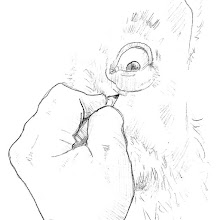
An Epitaph #4 (from the Greek)
At threescore winters' end I died
A cheerless being sole and sad;
The nuptial knot I never tied,
And wish my father never had.
A cheerless being sole and sad;
The nuptial knot I never tied,
And wish my father never had.
April 25th was the anniversary of the death of William Cowper, in 1800. I posted his final poem, "The Castaway," to mark the occasion. Just the night before, by coincidence rather than design, I happened to have finished reading both The Life of William Cowper, by Thomas Wright and the third of the four volumes of Wright's 1905 edition of The Correspondence of William Cowper. (I had read already two smaller, and in some ways superior, selections of the letters, as well as a much briefer biography, all reprinted for me on the Espresso Book Machine at the bookstore where I work.) Now, with genuine regret, I've finished the last of the letters.
Already, I miss him.
I have been reading my way through Cowper's poems for a few years now, in a rather hideous old edition in double columns, which can be rather daunting to aging eyes, but as I've found no better, on I go. I can't say I honestly remember now why I took him up in the first place, though I would imagine I knew at least a few of the poems: "The Diverting History of John Gilpin," "Epitaph On a Hare," etc., from other times and other sources. To be honest, as a poet known now, if at all, primarily for his piety, I would probably have avoided him still, were it not for his letters. I can say, it was the letters that led me to the poems, not the other way 'round. (As a child raised if not quite in then regularly in and out of the Methodist Church, I might well have heard more than one of Cowper's contributions to the Olney Hymns. I don't remember. I've listened to them since, but more from curiosity than from admiration for the sentiments expressed.) Certainly, I've posted a number of readings here, of both letters and poems, as well as reprinted a number of poems I admired, and any number of quotes from both his poetry and prose. I've been recommending him and writing about him here since nearly the start of this enterprise. None of this, I need hardly say, has been from any interest in or sympathy with his religion.
I'm sure I've said this more than once then, but it seems appropriate to point out yet again that William Cowper is not the most obvious of my enthusiasms. His God repels me. His madness breaks my heart. His indolence, his stubbornness and his selfishness, particularly now I've read a proper biography, ffrustrates and depresses me. As a poet he sits sometimes uncomfortably between the polished little Gods of the Enlightenment and dashing Romantics of the next generation. His interest to modern literary scholars and anthologists of the Norton school would seem to be confined largely to this. About this, I frankly could not care less. I don't read by movements, or pick poets by their placement in the lists. For all that, and unlike poets very much his superior, like Blake and Milton, I've come to love Cowper, as I never shall either of those geniuses.
But then, it's never fair to judge our affection for a writer exclusively by his place in the Pantheon. (I admire, for instance, Balzac, but I love Dickens, to turn to novels for a moment where I am, after all more comfortable and less likely to sound a perfect ass.) Yet, even among lesser lights of English poetry, Cowper may not be said to shown much ambition beyond his translations of Homer. Unlike Crabbe, for instance, so similarly situated in some ways, he hasn't much interest, really, in other people, and rarely feels any need to extend himself into minds or experience unlike his own. This is, in my reading of great letters anyway, more the rule than not. It doesn't suggest anything unsympathetic in the character of the writer, in my reading, so much as it does an isolation, both physical and emotional that would seem to require letters as a substitute for, rather than just a supplement to conversation. Just one other example might be Keats, whose great letters come to us from an equally lonely place. Keats, however it need hardly be said, was a greater poet for his isolation being less a matter of self-exile than of circumstance. Cowper's poetry might be called garden verse, even when he took on subjects beyond the view available from his greenhouse. His metaphors are all within walking distance. Even Cowper's most famous poem, "The Solitude of Alexander Selkirk," is fundamentally autobiographical. The poet's newspaper gave him the story, and he'd never been, so far as I know, in so much as rowboat, but his understanding being wrecked did not. Hopelessness, Cowper knew intimately. Again, unlike his near contemporary John Claire, so like Cowper both in his direct appreciation of the natural world, and sadly like him also in having a history of mental frailty, Cowper seldom seems to have drawn any unfamiliar reference or original conclusion from his time out in Creation. Clair as a man of the country rather than just a gentleman retired thereto, goes out into nature as into his natural element, his workplace and his place of worship. Claire is directly familiar with the violence of the natural world, for example, and hasn't Cowper's orderly universe always before his eyes. Perhaps because of this absence of a frame, from inclination and education, Claire's poems can still be quite original both in observation and language, whereas Cowper seldom surprises and almost never startles.
As for Cowper's letters -- a subject on which I find myself on surer ground -- he is not always so congenial as Edward Fitzgerald, and certainly less erudite and self-aware, and he is neither so consistently comic nor so generous a spirit as Charles Lamb. Nonetheless, having actually studied Cowper more seriously in recent days, and more closely than another other writer save Carlyle this past year, I now believe him to be not just an important poet, but occasionally a great one. There are passages in The Task (1785) fully the equal for beauty and style of any lines in English. More to the point of my recent reading, I believe Cowper easily one of the greatest letter-writers in English, and if not the greatest, then certainly the most endearing, for all his religious mania.
And that, his faith not just in his God, but his faith unto derangement in the reality of damnation, is the very thing that has best kept his name alive, regrettably. This to me is not just the least attractive part of his biography, but at times an almost unbearable burden to the reader -- as it so clearly was if not to the poet, than to the obviously fragile equilibrium of the man. (This is why I would recommend the more strictly edited editions of his letters, as these exclude, as a real kindness to the reader, his sometimes daily if not weekly consultations with various dissenting divines on the state of his soul, as these are tedious in the extreme, when not actually maddening to the secular reader -- meaning me, I guess.) His surprising popularity as a rather narrowly defined presence online would seem to be confined largely and unironically to his contributions as a Christian hymnist and his friendship with the Rev. John Newton, the author of Amazing Grace. Fair enough, so far as history goes, that would seem to have been significant enough to make a name. It does seem to me quite telling though that few if any of those still singing "There Is A Fountain Filled With Blood" draw the explicit connection between the morbidity of the poet's imagination and his regular deployment of such disturbing, if entirely traditional images of violence and debasement.
All of which still begs the question of why I love William Cowper.
As his last poem and the brief "Epitaph" above so movingly express, despite, or perhaps as a result of the sincere religious conversion in his early thirties that was to frame both the nature and purpose of the rest of his life, William Cowper died convinced of his personal exclusion from the grace of God. No one knows why he held to this unhappy conviction. In 1763, shortly after having been called to the bar and securing a modest living from a bureaucratic appointment arranged by a relative, Cowper suffered a mental collapse from which he never wholly recovered. He was to suffer a series of such prolonged periods of immobilizing despair, every few years, for the rest of his life. By the time he came to die at last at the age of seventy, this favorite of the pious public and most fervent Christian poet since George Herbert hadn't been able to pray in years, and hadn't willingly spoken in months. He refused any and all consolation on his deathbed from even his dearest friends and the Evangelical ministers he most respected. Convinced of his damnation, he died a sadly tormented man. And yet...
Here, his last poem in full:
The Castaway
Obscurest night involv'd the sky,
Th' Atlantic billows roar'd,
When such a destin'd wretch as I,
Wash'd headlong from on board,
Of friends, of hope, of all bereft,
His floating home for ever left.
No braver chief could Albion boast
Than he with whom he went,
Nor ever ship left Albion's coast,
With warmer wishes sent.
He lov'd them both, but both in vain,
Nor him beheld, nor her again.
Not long beneath the whelming brine,
Expert to swim, he lay;
Nor soon he felt his strength decline,
Or courage die away;
But wag'd with death a lasting strife,
Supported by despair of life.
He shouted: nor his friends had fail'd
To check the vessel's course,
But so the furious blast prevail'd,
That, pitiless perforce,
They left their outcast mate behind,
And scudded still before the wind.
Some succour yet they could afford;
And, such as storms allow,
The cask, the coop, the floated cord,
Delay'd not to bestow.
But he (they knew) nor ship, nor shore,
Whate'er they gave, should visit more.
Nor, cruel as it seem'd, could he
Their haste himself condemn,
Aware that flight, in such a sea,
Alone could rescue them;
Yet bitter felt it still to die
Deserted, and his friends so nigh.
He long survives, who lives an hour
In ocean, self-upheld;
And so long he, with unspent pow'r,
His destiny repell'd;
And ever, as the minutes flew,
Entreated help, or cried—Adieu!
At length, his transient respite past,
His comrades, who before
Had heard his voice in ev'ry blast,
Could catch the sound no more.
For then, by toil subdued, he drank
The stifling wave, and then he sank.
No poet wept him: but the page
Of narrative sincere;
That tells his name, his worth, his age,
Is wet with Anson's tear.
And tears by bards or heroes shed
Alike immortalize the dead.
I therefore purpose not, or dream,
Descanting on his fate,
To give the melancholy theme
A more enduring date:
But misery still delights to trace
Its semblance in another's case.
No voice divine the storm allay'd,
No light propitious shone;
When, snatch'd from all effectual aid,
We perish'd, each alone:
But I beneath a rougher sea,
And whelm'd in deeper gulfs than he.
My first inclination is to try to take the gentle and good humored author of Cowper's best letters, and the poet who so movingly memorialized his pets and made his walks immortal, and separate this man from the man who wrote that last poem, but it can't be done, by me anyway. Perhaps a better reader, certainly some better critic might be able to draw some clear distinction between the author of the poem that begins, "I sing the sofa" and the story in a letter of his runaway hare, from the author of "The Savior Hides His Face." But I'm afraid I must take him as I find him, and that means, however unhappy the thought, taking him whole; God-riddled, guilty, and yes, even glorious in his faith, as he was never out of it from the day he put it on. And there has been, if I may say, a lesson in that.
It is no bad thing to make a friend among the God-fearing, among even the mad, anymore than it is strange to me now to count new friends among the dead. At the simplest, I am reminded what a trial I might be to even my nearest and dearest without intention or a thought to their discomfort. There is a necessary reminder too in respecting the sincerity of religion even when I have no patience for the argument. It's influence may seem wholly bad to me in Cowper's life and work only if I willfully deny the comfort of his true friends; the friends that took him in because of the faith they kept in common, and supported him, and encouraged his writing, and kept by him even when he could neither work, nor pray, nor even speak. Still, one need not be Christian to read Cowper. To read him as I now have and will probably for the rest of my life, to count him now a friend, I need not be persuaded, as those friends nearly all were, that he was right with God even when he was most convinced he wasn't. I can't save him from his God anymore than they could save him with Him. What I must do, if I'm to read the author of The Castaway with anything like the respect the author of that poem deserves is to take his religion seriously, even if I don't acknowledge the God he so loved and feared.
It's a tricky thing, reading people with whom one may feel a great personal sympathy, while having no experience in common with, or sympathy for the philosophy and or theology that provided the whole context for their lives and much if not all of their work. It means, for me, not reading 'round what makes me uncomfortable, or just through it to the next amusing anecdote or bit of lighter verse, but reading respectfully opinions and perspectives antithetical to my own, and counting on my admiration for the work and my affection for the writer to see me through to a better understanding of minds in such important ways unlike my own.
Johnson is a teacher like this. Reading beyond the good company and wisdom recorded in Boswell, reading Johnson in his essays, and even in his prayers has meant, for me, getting to know the great man better, even when I do not like all I might learn. Reading Twain when he is old and unedited and inclined to think too much of what, indeed has proved to be too little considered or shaped into anything like the autobiography he seemed to think he was dictating, I would not presume to call an exercise in forbearance. There is much in even those ungainly new volumes I am glad of having read, and I genuinely look forward to the next!
So too now with Cowper and his letters. I was not unhappy to have read his letters first without so much of his unhappiness included, but I can't regret having now read the lot. We benefit by knowing better perhaps only those we already have reason to love. Cowper has been and continues good company to me. I looked forward to hearing from him, night after night. I read his poems with a new understanding. I read his life with gratitude for having access to so much of what his biography could not include. Not since I read the letters of Charles and Mary Lamb have I found better company in such an unhappy home with such happiness constantly breaking out through the gloom.
Reading my way through Froude's life of Carlyle, told through his letters, and in another volume from the same source, those of his wife, was a far worse trial than any I have mentioned here, but even that experience I would recommend. Great writers may have unhappy lives, so long as the reader can recognize that they record their unhappiness better than we have any expectation of being able ourselves to memorialize even our own joys. That is what makes a writer great, not the particulars of their politics, necessarily, or their example of how to be happy.
With Cowper I do find an example though, and not just his humor and wit, but in his capacity to get on, in even his small and troubled way with the business of making a life, of getting on. As a reader I am grateful that so small, so narrow a plot bore such bounty. As a friend, I wish him rest.
My first inclination is to try to take the gentle and good humored author of Cowper's best letters, and the poet who so movingly memorialized his pets and made his walks immortal, and separate this man from the man who wrote that last poem, but it can't be done, by me anyway. Perhaps a better reader, certainly some better critic might be able to draw some clear distinction between the author of the poem that begins, "I sing the sofa" and the story in a letter of his runaway hare, from the author of "The Savior Hides His Face." But I'm afraid I must take him as I find him, and that means, however unhappy the thought, taking him whole; God-riddled, guilty, and yes, even glorious in his faith, as he was never out of it from the day he put it on. And there has been, if I may say, a lesson in that.
It is no bad thing to make a friend among the God-fearing, among even the mad, anymore than it is strange to me now to count new friends among the dead. At the simplest, I am reminded what a trial I might be to even my nearest and dearest without intention or a thought to their discomfort. There is a necessary reminder too in respecting the sincerity of religion even when I have no patience for the argument. It's influence may seem wholly bad to me in Cowper's life and work only if I willfully deny the comfort of his true friends; the friends that took him in because of the faith they kept in common, and supported him, and encouraged his writing, and kept by him even when he could neither work, nor pray, nor even speak. Still, one need not be Christian to read Cowper. To read him as I now have and will probably for the rest of my life, to count him now a friend, I need not be persuaded, as those friends nearly all were, that he was right with God even when he was most convinced he wasn't. I can't save him from his God anymore than they could save him with Him. What I must do, if I'm to read the author of The Castaway with anything like the respect the author of that poem deserves is to take his religion seriously, even if I don't acknowledge the God he so loved and feared.
It's a tricky thing, reading people with whom one may feel a great personal sympathy, while having no experience in common with, or sympathy for the philosophy and or theology that provided the whole context for their lives and much if not all of their work. It means, for me, not reading 'round what makes me uncomfortable, or just through it to the next amusing anecdote or bit of lighter verse, but reading respectfully opinions and perspectives antithetical to my own, and counting on my admiration for the work and my affection for the writer to see me through to a better understanding of minds in such important ways unlike my own.
Johnson is a teacher like this. Reading beyond the good company and wisdom recorded in Boswell, reading Johnson in his essays, and even in his prayers has meant, for me, getting to know the great man better, even when I do not like all I might learn. Reading Twain when he is old and unedited and inclined to think too much of what, indeed has proved to be too little considered or shaped into anything like the autobiography he seemed to think he was dictating, I would not presume to call an exercise in forbearance. There is much in even those ungainly new volumes I am glad of having read, and I genuinely look forward to the next!
So too now with Cowper and his letters. I was not unhappy to have read his letters first without so much of his unhappiness included, but I can't regret having now read the lot. We benefit by knowing better perhaps only those we already have reason to love. Cowper has been and continues good company to me. I looked forward to hearing from him, night after night. I read his poems with a new understanding. I read his life with gratitude for having access to so much of what his biography could not include. Not since I read the letters of Charles and Mary Lamb have I found better company in such an unhappy home with such happiness constantly breaking out through the gloom.
Reading my way through Froude's life of Carlyle, told through his letters, and in another volume from the same source, those of his wife, was a far worse trial than any I have mentioned here, but even that experience I would recommend. Great writers may have unhappy lives, so long as the reader can recognize that they record their unhappiness better than we have any expectation of being able ourselves to memorialize even our own joys. That is what makes a writer great, not the particulars of their politics, necessarily, or their example of how to be happy.
With Cowper I do find an example though, and not just his humor and wit, but in his capacity to get on, in even his small and troubled way with the business of making a life, of getting on. As a reader I am grateful that so small, so narrow a plot bore such bounty. As a friend, I wish him rest.