My old friend Buff didn't have much in her house that hadn't been there since well before I was born. Everything from the furniture to the paper on the walls dated to roughly the time of the Second World War. Buffy was poor. She lived in the house in which she'd grown up. She kept the place clean, but that was about all she could afford to do. Among the old things in that house were treasures she kept, not out of necessity, or even nostalgia, but because these things were good of themselves: books she read and reread, a beautiful velvet skirt she wore only annually, at her Christmas party, the tools she used in her garden and kept in good working order so as to never need others, seeds and pots and dishes and string. Symbols of her self-sufficiency, these things all had a clear and continuing use. That made them good.
 Among her most treasured possessions was a small collection of records. She played these rarely, as they were as old and as fragile, most of them, as the machine on which she played them. To be offered the chance to listen to Miss Lena Horne "live!" was a treat reserved for special occasions. I first heard Mabel Mercer on one of these old records. Buff played me but one song, "Ballad of the Sad Young Men," knowing it was something I needed to hear; because it was exquisite, and perhaps as a warning. And one late night, to cheer the company, and to explain the small sign, made by another young friend years before and posted on the corkboard in her kitchen, proclaiming her house as an official meeting-place of "The Where the Hell is Betty Hutton Society & Unofficial Fan Club," Buff played me a record of Betty Hutton, singing "I Wake Up in the Morning Feeling Fine."
"I never rub the goose-grease on my skin/I open up the window and let the SMOG roll in..." Delight.
Off today for the holiday just past a week or so ago, -- adaptable bookstore scheduling -- I sat in bed this morning, watching a not very good Paramount picture from 1949, recorded from a recent broadcast on Turner Classic Movies. TCM host, Robert Osborne made no claims for "Red, Hot and Blue" being either great cinematic art, or even one of Betty Hutton's better musical/comedy vehicles. But he didn't apologize for showing the movie though, and why should he? "The always entertaining Betty" was how he introduced her here, and as he was her friend, he knew how right that was.
Delight.
I had to fast forward through some of of tedious bits of poor Victor Mature talking about "theatre" as Betty's miscast boyfriend,
a little-theater director trying to make the star-struck and publicity hungry Betty, as Eleanor "Yum-Yum" Collier, be serious. (The presence of dear, droll June Havoc as one of Betty's roommates was however an unexpected, camp pleasure.) But really, I watched the movie, just as audiences in the forties did, just to see Betty singing novelties, and one lovely ballad, not by Cole Porter, from an earlier and infinitely better musical of the same name, but by the great Frank Loesser, Betty's favorite songwriter, and the one who understood her style best.
As I first heard on that old 78 in Buff's living room all those years ago, nearly every song Betty sang was cocked with the first verse: Betty's voice as warm and smooth as Alice Faye's, almost maternal in it's sweetness, and then, at the first chorus, the trigger's pulled, the hammer drops and... BANG! The lyrics move into a nutty kind of near nonsense, the pace sometimes jerking up into the realms of W. S. Gilbert, but the beat invariably boogie. In "That's Loyalty," for example, Betty all but threatens to fly off the screen in a whirling pantomime of a date with a romantic brute who won't let anybody say what he can about his gal. Betty whoops, hollers, and giggles throughout the number, even playing both partners in a dance, rolling and pitching madly across an alley, while never losing either the beat or her uniquely hammering charm. It was a comedic formula that served Betty's outrageous clowning, and sweet innocent attractiveness, perfectly, throughout her Paramount career as the studio's greatest musical star and recording artist.
It was an unusual stardom, and all too brief. There were funny chicks in the movies then, with great pipes, like Martha Raye, and cute, like Betty Garrett, but forever either the comic sidekick or, at best, settling for the secondary romance. Betty Hutton blew through a few of these parts on Broadway. She even survived a ruthless Merman, cutting her best number on opening night. Betty had always been more of a speciality number than an ingenue; a band-singer with a good voice, great rhythm, and an explosive energy that was both wildly funny and more than a little surreal.
But Betty, as I saw today, could also be a fine torch, as when she sang "Now That I Need You," to a framed photograph of her exasperated and absent boyfriend. Her tears seemed quite genuine, her voice a lovely, plaintive and pretty thing.
Hutton's life was a disaster, largely of her own making, admittedly, but that she survived even her childhood was remarkable. Raised in abject poverty by a single, drunken mother -- to whom she remained fiercely loyal throughout her life -- Betty sang and clowned and earned a living at an age when she ought not to have had to even think of taking care of such things herself. And she went on taking care of herself, and of various lovers, producers, dependents, hangers-on, husbands, and scoundrels, for a very long time thereafter. When, barely in the middle of what should have been a much longer career, Betty Hutton, already dependent on pills and badly mistreated by the men who'd made millions of dollars from her performances, she lost it, she lost it all. For decades, Betty disappeared.
How I wish my friend Buff had lived to see Betty in revival! How Buff would have enjoyed seeing Betty's movies again on TCM, seeing her incredibly moving interview with Osborne in 2000, and recently rebroadcast. And how Buffy would have thrilled to read Hutton's autobiography, posthumously published just this past year, Backstage You Can Have: My Own Story, finally written at the end of her life with the help of two remarkably good, gay friends and fans, Carl Bruno and Michael Mayer. I can't recommend the book enough to anyone who loved Betty Hutton, or thank her coauthors enough for seeing what must have been an almost impossible project through to publication. Clearly, it was a labor of love.
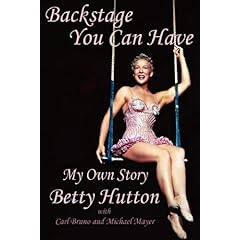
So now, as I write this, I'm thumbing through the wonderful pictures in the book, and listening to Betty's smiling Columbia recording of "Blue Skies," and remembering dear Betty Hutton, and my old friend Buff, and
delight.