Showing posts with label J. R. Ackerley. Show all posts
Showing posts with label J. R. Ackerley. Show all posts
Thursday, September 19, 2013


Monday, February 28, 2011
What I Learned at Book Club
 A coworker approached me in the street this morning and we shared that awkward, urban moment wherein neither party smiles, or risks a greeting, until eye-contact can be firmly established. I hadn't seen her coming up behind me, and, in all my winter bulk of hat & scarves and layers, she wasn't sure it was me, until she could actually see my face, by getting right up in my grille. That she did when we stopped for the light at a crosswalk. It was a little startling for us both. We had to laugh. We had both been practicing our urban walk: purposeful and fast, and our city look: straight-ahead and not to be messed with. It's a matter of self protection; against the cold and all the other difficulties of moving from point A to point B in a city. Don't know that either of us are all that convincing as serious city folk. Neither of us could be easily described as tough customers. On the winter streets of Seattle, I resemble nothing so much as a full laundry basket, and she's a pretty young blond, under her bulky coat. However, we have both learned to set our faces against the wind, as well as the beggars and the ubiquitous charity-shills that line the Ave., and to look neither left nor right until the traffic light changes at the corners, and to ignore even direct address on the way to and from work, unless and until we can be sure that the person looking to get our attention is actually an acquaintance, rather than a lunatic or some other potentially dangerous or distracting stranger hoping to get an "extra" cigarette from me, or a smile from her.
On my very first trip to New York City, as a teenager, I remember coming across the bridge into Manhattan. It was inexpressibly exciting for such a country bumpkin, seeing the City for the first time. As the car pulled up to the first traffic light, I saw some demented soul dancing in the median, dressed in only a bra and skirt, his filthy beard and dreadlocks mysteriously wet on a dry night. He had a large butcher-knife. From the safety of the car, with the doors locked and all the windows rolled up, I stared, mesmerized, until my ride, a City native, offered the following excellent advice:
"In the City, you're allowed to stare, darling, but if he catches you, he's allowed to stab you."
Never forgot that maxim of urban etiquette. Avoiding eye-contact in a city, in even so provincial and pleasant a city as Seattle, is not then an indication of bad manners so much as a strategy to avoid being late for everything, and for being sound when one arrives. Totally worth whatever trade-off in small-town-conviviality, just to live in a more exciting, interesting and potentially rewarding place than the one in which I grew up. There, no one with even the remotest acquaintance with the people passing from Walmart to car, or from bank window to the sidewalk, would think of not nodding, smiling, and saying hello. When I go back, I find this charming -- for the first few days. After that, I am reminded how oppressive it can be; how one may long for anonymity, how politeness may oblige a chat with every kind of bore, the way that even the simplest task or the fastest errand can be extended into an afternoon requiring review of unnecessary medical bulletins, fussing over unknown grand-babies, and listening to stories from near strangers of events in which one has had no part since high school and about which one had no interest even then.
Coming back to a higher civilization is less a return to a place where opera, liberal politics, bookstores and bubble-tea can be had for the asking, than a chance to walk a quarter of a mile unmolested by anyone or anything more distracting than the occasional spanging junky or loose dog. So much more peaceful. No survivor of the flood has any right here to interrupt a meal to ask after third cousins, or distract at a bank-machine with news of the outrageous price of canned peaches at the A&P, or share the Good News in a parking lot. In a city, as opposed to a town, people who do that sort of thing regularly are, quite rightly, ignored. What they deserve, frankly. What I may love best about living, as most people now wisely choose to do in this country, in places with long sidewalks. One can keep to one's thoughts on a proper, crowded sidewalk -- if one knows how.
In my preference for cities, I may be prejudiced by my ongoing experience of retail sales. Any ancestral need for wider community; for the practice of tolerance, for the cultivation of respectful patience, particularly with the elderly, or the infirm, any need to observe the full range of family and class interactions, may be met on an average shift clerking in a bookstore. The smallest of small-talk being a daily routine of retail, I perhaps feel less need of it in the rest of my life.
All of which, in addition to whatever questions of character that may be prompted by this piece hereafter, may be what has unsuited me for Book Club. I had never participated in such a gathering before joining my dear friend, N., in planning, promoting and leading this one. The Club, from the very beginning, has been almost wholly my friend's; it is ultimately his monthly selection which is read, he all but invariably leads the weekly discussions, and his are the personality and talents best suited to the task. As it has turned out, while always welcome, I haven't actually been much needed, and that is a very good thing indeed. As it has also turned out, I do not much like Book Club. Put it another way, while I genuinely like nearly all the men and women who have participated, and while I have enjoyed many, though by no means most of the discussions for which I have been irregularly present, I am quite simply a terrible Club member.
To begin with, I attend with an ever increasing infrequency. The hour at which the Book Club meets is inconvenient; necessitating an early and not always workable departure from the bookstore. If I leave on time, what with the rush hour traffic, I can only count on getting to the meeting a few minutes before it ends. This is a fairly minor point, but no less annoying for being that. What this usually means is that by the time I get to the meeting, early or late, I am already more than a little frazzled. Whatever enthusiasm I may be able to work up for attending, can be undone by an hour's crawl in the car. There have been evenings when, I left for Book club as early as I might, and with the best intention, only to keep going slowly South to home rather than turn off at the exit that would just as slowly get me to Book Club. In part, this is because I want very much, every evening to get home to my husband, Dear A., before he has had his supper and started to doze. He would never think to insist on such a schedule. He does not begrudge me spending time with friends or away from home. The window of time when we might both be said to be at our best however has narrowed a bit in recent years, and while I like best being with him, waking or sleeping, I have grown increasingly jealous of the time we have together and resentful of any impediment, however pleasant, to that communion. It is purely selfish of me. I know that, but there it is.
Neither of the reasons provided above, however, is by any means the primary reason why I have found myself, despite my respect for and deep loyalty to my friend, N., increasingly avoiding Book Club. I said before how much I've come to like and enjoy the company of most of the regular members of the Club. This is true. The majority have proven to be an exceptionally nice bunch; welcoming, considerate of others and their opinions, engaged and engaging men and women. They have also uniformly proved themselves to be intelligent and careful readers, open to almost every book selection, however old, obscure or exotic. There have been exceptions to this rule. Beyond the unavoidable presence, now and again, of the stray crazy person, and or the occasional cypher who shows up not having read the book and with no intention of participating, there have been a few participants with whom I felt an immediate and embarrassing antipathy. One pissy little puppy, out I suspect to express his disdain for failure of the Club that night to otherwise attract much in the way of hot, young ass, and to show off a little for the friend that brought him, during the otherwise polite discussion of the book, he dismissed in no uncertain terms both the author, J. R. Ackerley, and his book as both hopelessly dull and "irrelevant" to both literature and himself. This boy had been to the group just the week before, and, I was assured, afterwards, that he had been "delightful." I hadn't attended that week. He did not offer much by way of explanation or elaborate much further, but he was willing to suggest that as a serious student of altogether more serious literature, anyone who thought other than he did of Ackerley, which, as I say, wasn't much, was an idiot. The night I was there, I found it took everything in me not to slap the lil' fucker right in his sassy mouth. Not a good evening for him, evidently, or for me.
While I have rarely encountered at Book Club quite that level of open hostility to both the book under discussion and the people present, what has become all too common, and the thing I find it harder and harder to make myself listen to, is an all too ready judgement, from many if not most in the group, as to the moral and or ethical value of the books, and the tendency among most, having passed a negative opinion of a particular novel as an example of appropriate and proper uplift, to then leave the discussion at that. It seems many readers do not like books in which they do not consider the protagonist sympathetic, which is to say nice, and that however eloquently or interestingly or ingeniously argued, any conclusion that does not suggest the triumph of good, may be found either too depressing to be enjoyed or too wicked to be endorsed. A feature of this has often been to equate the perceived character of the author with the quality of the work. Difficult or even unpleasant personalities, it seems it may not be admitted, might write beautiful and important books. These would be those opinions to which, one is constantly reminded, everyone is entitled.
That no one seemed to find much they could like about Colette disturbed me. That Gide struck most people present the night I went as both melodramatic and cruel was an unhappy surprise. That Ackerley could be thought both unfunny and irrelevant, as I've already said, nearly brought me to violence. Really though, what convinced me that I was not fit company for Book Club, was the universal dislike and disapproval of Mishima. There was not one person, including my friend, the host, willing to concede even the possibility of his redemption, or even a passing interest in what he wrote, how he thought, or what he had had to say about sacrifice, beauty or immortality. Mishima was death. Now there is no getting around death in Mishima, but to see nothing else...
I do not offer that unfair reduction of the group's regular discussions to indite anyone but myself as unfit to attend. (Okay, that one rude little bugger is better off wherever it was he going after, and should never come back. So me, plus one.) The reason then? Whatever may actually have been said about Mishima, or Colette or Gide, or any of the other authors we've discussed and for whom I happen to have an unshaken respect, what I've just written by way of summary was all I heard. That's a problem. I admit, the problem is mine, but there it is, as I see it, and increasingly I find myself unable to see past it, or any way 'round.
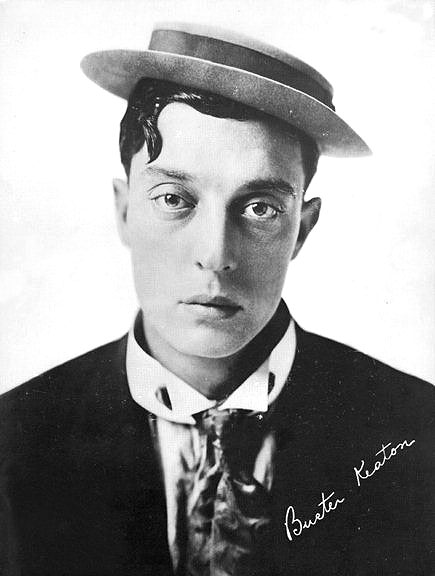
One of the great secrets of the successful bookseller -- which I may offer at this point, if for no other reason, but possible historical interest soon enough -- has always been a good deadpan. The term I take of course from comedy. When done right, the blank absence of reaction to any outrage, --whether it's a house falling down not on but just barely around Buster Keaton, or a customer in the bookstore explaining at length why Michael Savage is the greatest political thinker of our times -- can not only make an absurd and or dangerous situation bearable, but even amusing. Like the refusal to acknowledge all the hucksters and the crazies encountered on a city sidewalk, the lack of reaction to even the most overt provocation, in retail as in a Buster Keaton comedy, can lend an unexpected grace, and sympathy, to even the most seemingly hapless victim of unforeseen consequences, of simply standing in front of an unstable structure, or asking an unstable individual if he might require any help in finding a suitable book.
I like to think, after roughly a quarter of a century of living in cities and working in bookstores, that I may trust my own mug to not betray me, but all the evidence suggests that any such confidence, even now, might be misplaced. Clearly, however fiercely I may deny having an "extra" cigarette, something about me, other than just the cigarette in my hand, still suggests that I might. Likewise, however fast I manage to shuffle along against a strong wind, and however much I may scowl, something about my face and figure and the way I carry my increasingly heavy load, still suggests I might want to "save the children," donate blood, or overturn this or that referendum. Beggars, it seems, can just hear all the loose change rattling in my pockets. Worse though than any of these social deficits, as someone who still hopes to retire someday from a bookstore, however hard I may try, and however sure I may be of my hard-won ability to keep a straight face with any customer, I know, to my shame that all too often, the look on my face, whatever I might say, or however pleasant I may mean to be, and think I am being, will betray my actual opinion of Dan Brown, white gurus, books about cats and the people who read them, and any number of other perfectly legitimate areas of interest within the bookstore. I do try, I honestly do, and I don't mind saying that when I have really muffed a transaction with a raised eyebrow, I am as shocked by this as the customer. I won't say my reaction is involuntary, I have no such excuse at this stage of the game, but my repentance is genuine, almost each and every time. That doesn't seem to do me or anyone else much actual good, but there we are.
What going to Book Club has taught me, beyond anything I've learned there otherwise, and more forcefully than even my rather dismal performance in various bookstores over the years, is that not only do I not have a face for poker, I am not to be trusted among nice people who, as people have been at pains all my life to remind me, are entitled to their opinions. I may have finally come to understand, in my fifth decade on this earth, that not everyone is entitled to my opinion, and that fewer people than I may once have supposed will ever welcome it, but that is not quite the same thing as having mastered actual restraint. As it has indeed turned out, a small circle of comfortable chairs, occupied for the most part by perfectly nice people who may not see every book just as I do, or expect from literature quite what I might myself, or appreciate as I might certain authors and books widely venerated as classics, such an environment is for me, entirely too dangerous a place. I am reminded too much of the more tightly observant town of my childhood, of the possibility of offense in silence, even on the rare occasions I can achieve such a state, and that mine is not face that welcomes alternative points of view, nor a mind that respects the boundaries of friendly discussion, nor a person fit for most company.
So rather than go even once a month now to a perfectly nice room full of perfectly nice people and listen to them say perfectly justifiable things with which I may strongly disagree about books I may not even happen to specially like, I think everyone may be better off if on Wednesdays, for the foreseeable future, I plan on heading home at the regular hour, to argue over take out chicken with my husband, the relative merits of this boy's choice of boxer-briefs as opposed to that guy wearing a speedo all season on "Survivor." The husband is used to me, I may do my worst, and he will still, inexplicably, love me. But then, I love him. He must see that.
Tuesday, January 4, 2011
Daily Dose
 From Hindoo Holiday, by J. R. Ackerely
HIS HIGHNESS
"Such a queer, unearthly little figure he looked, bareheaded and wrapped in a dark-red toga, rocking on his rump in the moonlight.
'All day long,' he said, 'it has been a struggle between my conscience and my inclination. But I must go.'"
Monday, November 15, 2010
My Dog Tulip
 Not much can get me out of the house on my day off anymore. Haven't been out to the movies in ages. The husband works on Mondays, though not very long, nevertheless, by the time he gets home, we mostly eat and watch something we've taped, or a rented DVD. Then we nap. Yes, we have become those people. We saved up and bought ourselves a ridiculous television -- size of a drive-in screen -- and what with that and an excellent sound system, right there in the room with our giant and very comfortable bed, we venture out hardly at all anymore. The very idea of putting on pants, just to seek out entertainment, has become rather foreign to us, specially now it's gotten cold out.
Last night though I got a call from a dear friend, asking if I wouldn't take in a matinee with him this afternoon. I had any number of things I ought to do today, including writing here, as well as writing up my introduction for tomorrow night's reading at the bookstore where I work, -- to say nothing of all the more practical tasks I had neglected all week; like getting tickets for some entertainment or other when our annual November guest is with us, airing the bedding in the guest-room, etc., etc., -- and yet all my friend had to tell me was the name of the movie, and I said, "Yes!" I had plans, you see, to get caught up, and even get something going in advance of the last minute, for once, but I threw all that up today and instead went to the movies, to see My Dog Tulip.
I am not quite a dog-person. I grew up with dogs. I've known and like many dogs. I've know dogs I liked rather better than their owners. There were at least one or two dogs I can honestly say I loved. But I have never owned a dog of my own, nor am I likely to, so long as I am happily married. We are not people, as it turns out, who live with pets. Neither of us has much missed four-legged companionship, at least while we have each other. (We've discussed this. After twenty-some years together, I find, there's very little one hasn't discussed. Should I out-live the husband, I might have a dog, should he out-live me, he might take a cat. All very vague, but no less telling I suppose for that.)
I like a good dog story, just as I like a good cat story, or any other species of story, but only as a good story. I am no more likely to like a book for a dog being in it than I am for a dog being absent. There is a whole literature, the existence of which would seem to have been thought necessary, and profitable, because people will read about dogs. Of such books I will say nothing bad. Come the retail Christmas season, and I will no doubt be glad of having something new in that line to sell. Doesn't mean I have any interest in reading the damned things though. Not the reason I read J. R. Ackerley's book, on which this new animated film is based, certainly, nor should the fact that it is a memoir of Ackerley's dog be a reason to recommend it to the readers of more usual dog books. It is not a more usual dog book. Ackerley, certainly, was not the writer of usual books.
In the first place, Ackerley was not himself a dog owner, until one day he was, by which I mean he was not the kind of Englishman one associates with hounds and hunting, or the sort of tweedy gent that discussed breeds and kennels and pedigree. His own was perhaps undistinguished, but I don't know that he thought much about it, or anyone else's, on four feet or two. Tulip was perhaps the first dog Ackerley owned, I don't remember now, but she was certainly the only dog he loved and respected so much as to write about, and in more than one book, first in the memoir, then in his novel, We Think the World of You, as well as in any number of his published letters and in his posthumously published diaries. His dog Tulip turned out to be the great love of his life. No one, including Ackerley himself, would ever have predicted such a thing.
J. R. Ackerley was a difficult character. He was obviously brilliant, as well as being a quite physically attractive man, and he lived most of his life believing the latter offered him more opportunities for real satisfaction than the former. He wrote, and was a successful magazine editor and producer at the BBC, he knew nearly everyone worth knowing, at least among the most interesting English writers of his time, certainly among the gay ones, and he traveled and fornicated across quite a wide path. His London flat, at one time, saw E. M. Forster dropping by with trade. It was an exciting, and in it's way, rather glamorous existence. In latter life however, Ackerley, himself always something of a loner, despite the wide acquaintance among the best and worst characters of his time, found himself alone. He did not much lament his loneliness. He treated his declining sexual prospects as a simple fact of life, and his romantic and personal disappointments as just so much hard luck, if not inevitable, given his prospects and his temper.
Then he met a man, and through that man, met a dog. He had hopes of a relationship for the man and ended up with the most significant emotional attachment of his life being with the dog. They lived contentedly together for sixteen years.
Ackerley did not think, or write about his dog as others might have done, at least in that time. The writer's curiosity was first peaked by, and then all but wholly absorbed in his dog. He treated her as he might never have done with another human being, very much as an equal and as his primary responsibility; sacrificing not only other friendships when these could not be counted on to make accommodation for Tulip, but also something of his own rather rigid dignity. When he took in the dog, and learned what it was to be loved with complete fidelity, he found himself forced to accept a new and necessary modesty. Can't be to sniffy when there's dog doo to be seen to on the stair, or piss to be scrubbed out of the carpet. It is Tulip's love that teaches the writer to love, and Ackerley's expresses this deep emotion not by sentimentalizing his dog, but by assuming, with an unexpected and charming innocence, that his dog, if no other, is simply fascinating. Amazingly, he communicates his fascination to his reader, all the while refusing to make of Tulip anything other than a real dog. That is what makes Ackerley's perhaps the best book about a dog, rather than the best dog book, ever.
And now, a couple of very clever filmmakers have produced a brilliantly animated film of Ackerley's book. While being absolutely true to the writer's voice, and to the man and his dog, what Paul & Sandra Fierlinger have done is to use the unique properties of animation to free the narration from the restrictions of fact. When Ackerley describes a scene, and employs a metaphor, or makes a joke, the filmmakers can take any part of that and draw out of it some new comment, some extension of the thought, so that, for example, where the memoirist suggests the ladylike qualities of his pet as she pisses, the Fierlingers can stand her up on her hind-legs, and put her in a frock, and yet show her still about her business, without losing the authenticity of either the observation or the dog. There is a whimsicality to this that relieves what might otherwise have been an unpleasantly graphic, and even distasteful representation of what is almost never less than affectionate on the page. It is a brilliant choice. The movie is full of these moments.
My friend intends to offer Ackerley's book as his next selection, for December, for either one or both of the book clubs he hosts. I've encouraged him to do so. The excellent new movie might induce some members in either club, who have already expressed themselves otherwise reluctant to read another "dog book," to recognize that this book, and this new film, are not really anything like. My Dog Tulip, the book and the film, are neither of them anything but a love story, wonderfully told, a love story, curiously enough, that happens to be between a gay man and an Alsatian bitch named Tulip.
What's not interesting in that?
Subscribe to:
Posts (Atom)