Showing posts with label Pam Cady. Show all posts
Showing posts with label Pam Cady. Show all posts
Tuesday, November 10, 2015


Tuesday, December 2, 2014
Sunday, December 15, 2013


Saturday, April 20, 2013
Again

Someone suggested to me that I might try giving a talk about doing this, a talk for other independent booksellers, to encourage more people to try. I like the idea. In fact, there may be an opportunity to do just that. We'll see. The suggestion however was that any such class shouldn't be "limited to just reading aloud." The idea being that bookstores might welcome advice on creating events independent of author's tours and the more usual things that come our way like professional seminars, and school book fairs and the like. That's a marvelous idea! Someone should do just that, someone who understands, for example, organizing crafting classes, or fan gatherings, someone who has the patience, creativity and connections necessary for doing locally the kind of inspired community outreach perfectly represented by that extraordinary event, World Book Night. As booksellers, we need to have all sorts of engagement with our customers, and we specifically need to cultivate these connections in ways that do not depend exclusively on the talents we are lucky enough, some of us, to have come our way from publishers large and small, and authors, local and national.
If bookstores, and specifically independent bookstores are to survive in an era of seemingly constant changes in both publishing and reading, we must be not only flexible enough to adapt ourselves and the way we do business to new models and means, but also be willing to experiment, and, yes, possibly fail, but at the very least not to waste the new opportunities that this new era provides us; from self publishing services and design, to utilizing social media, partnering with small presses and existing community organizations, and expanding the scope of what we may do collectively to include more than what we have traditionally done; at trade shows and the like. The possibilities are, or ought to be, at least as exciting as the change that can often seem more than a little bewildering, else what's a bookstore for?
I would happily participate in any such discussion. I do dearly like to talk. I might, indeed, have something useful to contribute. Form a panel. I'll show up.
As for the possibility of me doing something of my own, well, here it is. This is what I do. I don't really ever do it alone. Even when I'm the only one up there at the front, I do not, could not do it without the help and support of coworkers, management, friends, to say nothing here of local media, or the wonderful people who force their children, parents and or spouses to attend one of our admittedly rather respectable shindies. (Though I do endorse any excuse for the introduction of spirits. Booze and nibbles make it a party.) That said, what I do, the thing about which I am myself most passionate is this, exactly the thing, it seems, most people, even most booksellers tell me they neither could nor would want ever to do, read aloud.
Nonsense. The thing I am passionate about -- appearances to the contrary -- is not the sound of my own rather reedy and unmusical voice. Years ago, when I was still in drama school and thinking I would one day be an admittedly rather diminutive, gap-toothed Hamlet, I had a voice class specifically to learn the proper way of speaking verse. That meant Shakespeare. I had a marvelous teacher. He was no Romeo himself, by the look of him, by the way. What he did have was a marvelous, musical baritone that made everything he said, from Othello's asides to ordering lunch, sound like a hot bath feels. It was magical. I worked very hard in that class. I learned how to scan a line, to mark a speech, how to listen. It was marvelous. I loved it. It wasn't very long after I'd been up on my hind legs doing, I believe, Richard the Third's first great speech, "Now is the winter of our discontent..." before my teacher gave me the critique that still stings to this day.
"Brad," he said, rather gently, in that deep, rich, Shakespearean voice of his, "you make everything sound as reasonable as an annual report to stockholders."
And, scene.
When I abandoned the theater shortly thereafter, it was no fault of his. I saw how professional actors, most of 'em, lived. Sobering. Not all that long after that, I became a Rhetoric major, then met my beloved and left school altogether to pursue opportunities in fast food, banquet service, video rental and eventually bookselling. I like to think that I finally found my métier.
All this autobiography is offered just to show that whatever talent I bring to this business of reading aloud may best be described as more the result of practice and an almost missionary enthusiasm for the sound of the language, than any particular gift for spellbinding. I have to work at it, still.
I do believe however not only in the importance of reading aloud for the full appreciation of literature, but also in the very real possibility that while not everyone can do it in public, more can do it than will probably ever try. My experience of organizing and creating readings at the bookstore has shown conclusively that while there are people who will never read a word when anyone else other than their own small children will hear, there are in fact more potential readers for such events than anyone, including myself might ever have imagined had we not tried.
It's true that I have not just invited, but also cajoled, begged, bullied, and frankly blackmailed not a few people into reading aloud with me. I've been lucky enough to work with more than a few people with more natural talent than I ever possessed, which has been thrilling. Actors, musicians, comedians, singers, public performers of every stripe, I've found will often end up, if temporarily working in a bookstore. Great good luck, that, for the kind of thing I try to do. There have also been just as many people without any such inclinations or experience, with natural voices no better than mine, and personalities considerably more retiring who have been surprised to find that with the right material and in the friendly and supportive setting of the bookstore, the experience was not only educational but even fun.
(If you're one of the people reading this who might be shaking your head in disdainful disbelief, I might collect the necessary affidavits from the now scattered readers who have come and gone; from booksellers and students, and members even of the general public who have surprised us all with a poem, a story, even a song, but I doubt even that would convince you. I leave you in peace, though I'd be willing to work on you.)
This latest reading presented new challenges to both of my fellow readers, neither of whom was comfortable reading verse. One of the greatest pleasures for me in doing these readings has been working with forms that might challenge us in new ways. The rehearsal process, however abbreviated by scheduling difficulties and or other commitments has actually proved to be one of the real joys of doing this. I am an enthusiast of poetry, but neither a practitioner myself, nor, as my teacher pointed out long ago, a very musical sort of guy. I haven't, as I've already suggested, a gift. What I do have is a dogmatic conviction as to the best way to read and hear poetry and that is frankly to speak it. I'm not saying that it mightn't be better for everyone concerned to hear the poet him or herself reading the stuff they wrote themselves, but then that is not always true, as anyone who has ever attended more than one poetry reading can doubtless attest. Some great poets were pretty miserable readers. (My theory being that too many poets, even good poets, either read too little themselves or listen too little to anyone else.)
I've been nattering on for years to anyone who will listen, to anyone specifically who claims to neither read nor understand poetry to try putting voice to the words, even if it is just in the snug seclusion of some safe corner of their own homes, or alone in the woods. Doesn't matter where or when or even to whom one reads poetry aloud so much as it matters to say the words and hear them said. There's pleasure, and meaning in that, and more to follow the more that's done. Part of the pleasure specific to poetry, but common to all great literature, is in the sound. Literature is meant to make a noise, and not just in one's head, if for no other reason than to make better sense.
And so I'm back to what it is I would do and would like to do for other people perhaps similarly situated in independent bookstores, in need of some occasion to share with the communities, large and small in which they happen to be and which they mean to serve. This business of making an event from the very stuff we love, from the books we sell and the people who like us love them, is as simple as starting with the sound, however tentative, however unfamiliar, of one voice raised. There are children's booksellers doing "storytime" all over the map, you know there are. Is it such a leap then to start from there, from reading as nearly every mother, every parent or grandparent already does to our children to reading to our friends and patrons and peers? Is there any reason to think that reading one poem and inviting others to read one as well, and then another read another, and so on, might not easily enough become something other, something more, something new, for being nevertheless as old as the sound of human stories as far back as humans go? We have the stories already, all around us! We already love them, our poets, our writers, living and dead.
All the words need is breath.
It's worth mentioning again just here that these readings are popular, in their modest way, with a minimum of notice and with as little by way of requirements as a chair, a book and someone willing to read it out loud.
I'd be happy to help anyone who's interested. I can. I've done it before. I mean it when I tell you that if I can, so can anyone else. If you don't believe me still, I'm willing to work on you.
Just ask.
Tuesday, April 16, 2013
Thursday, July 14, 2011
The Only Record of Tonight's Event

Well now. As tonight's reading drew nigh, pretty much everything that could go wrong -- short of a tornado or death -- did. Our third reader, intended to be Mr. Timmins to dear P.'s Mrs., came down with a violent stomach flu and has not been to work all week. He was unable to participate. This was a damned shame, first because he's a perfectly nice fellow, but also because he was already advertised as our only actual Englishman. I felt the loss particularly, as this not only meant I had another voice to read, but also because I had edited the piece in such a way as give Mr. & Mrs. Timmins of "A Little Dinner at the Timmins's" as much focus as I could, so that they might break up at least a little of the monotony of just me reading. With Mr. Timmins absent, that balance was lost. (Feel better soon, poor M.)
And then there is the unfortunate business of my own unhappy head. I too have been absent from work for some days. What is probably a very simple little head-cold has triggered a far less pleasant, and considerably more inconvenient recurrence of vertigo, a truly awful condition I would not wish on anyone not registered Republican and or currently kicking a dog. As a result of my own infirmity, I was forced to carry a cane, not as I might once happily have done, as an affectation appropriate to the period of the story if not altogether to a reading in a bookstore in the present day, but carry a cane I did just to keep from tumbling over between the door and my seat for the reading. Between having a cold with all the usual symptoms, including the likelihood of losing my voice at some point soon, I had also then to worry about possibly reading from what to the world might look like a stationary text but to me what at any moment might be a moving target. Not fun.
I will just here only add to these complaints, the absence of a number of our usual loyalists for this sort of thing, including, alas, my dear A. who is off in Pennsylvania with family. True, a number of good and very dear friends and coworkers came and rallied 'round us, and we did have at least a couple unfamiliar faces as well, but I did miss some of our regulars nonetheless.

Oh yeah, then there's this: in my muzzy state I brought and carefully set up my little video camera to record the proceedings, and then failed to turn it on properly, although I thought I had. These photographs then will have to constitute the entire record of the evening.
This however, while a personal loss to me as I should very much like to have had some record of Pam Cady's wonderful performance, may in the end be no great loss to literature and history. Everyone was quite kind and complimentary, but I must admit I haven't the slightest idea what kind of muddle I made of things tonight. I do remember having to save some perfectly easy lines with some clumsy improvisation, never a good thing, and I'm sure the various voices I had intended to employ for the various characters I read must all have had an unintended nasal drone in common. (I'm quite sure my accents wandered rather widely tonight.) Perhaps the failure of the video camera was a kindness to me.
Afterwards, I was treated to a birthday dinner out by my dear P. and her beloved, S. and that did me a world of good. Nothing like fried cheese, naan and lamb in a rich, almond sauce to make the world right. A good Indian dinner then, in honor of William Makepeace Thackeray, born July 18th, 1811 in Calcutta! (Wish you could have been there, at least for the pakoras. Delicious.)
Friday, July 8, 2011

Saturday, November 20, 2010
Pictures from Our Visit to Niagra Falls Park (Look it Up)

The Man of the Hour.

Our line-up.

That's our Adam, Matthew Simmons, on the near end, our Eve, Pam Cady, in the middle and that glimpse of bald at the end would be me.

View from the side.

A view of the body of our listeners, bless 'em.

Part of the overflow crowd, no joke.

A view from the audience of what it was all about.
Thursday, November 18, 2010
Come Into the Garden, Mark
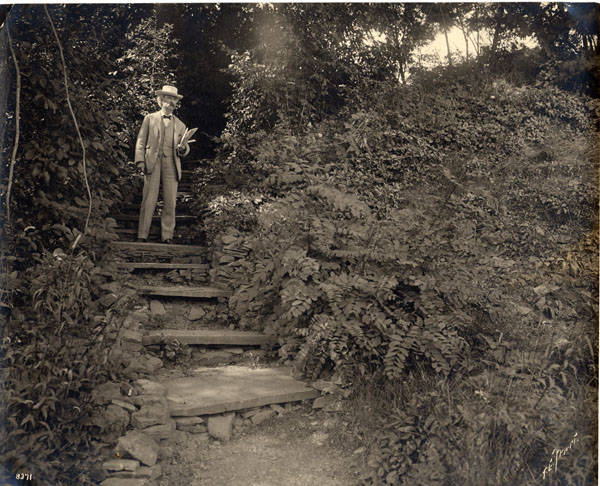 Our Twain reading was, I think, a success. Had a good, big crowd of roughly forty souls-- big anyway for this sort of thing -- and from the beginning, people laughed. My brief introduction proved to be perhaps a bit too brief, as we ended with time on our hands, but the passage I quoted from the new edition of the Autobiography went down well, as did most of what followed. I tried to frame the evening by sharing a scene from Twain's domestic life, and hoped that, and a few comments from me, would be enough to suggest Twain's own happy marriage in what followed. I made a mistake though in assuming that the audience would accept, even in our much abridged version, some of the rougher judgements of the gentler sex, understanding that these were not meant to be heard as Twain's, or our reader's, but of the first fool man. We'd but only just got going on our primary text, Extracts from the Diaries of Adam & Eve, when our Adam read the following of Eve:
"I wish it would not talk; it is always talking."
The laugh came, but was not universal. It was three pages in though, when Adam began the sentence -- a sentence I ought to have cut -- "She is such a numbskull..." that I heard an audible intake of breath from more than one in the crowd. I believe our Adam won them back, but it was not easy work.
The text as read was a week's work, at least, as I tried to get 27 pages down to roughly three quarters of an hour's worth of reading. Both of our readers whittled at it too, our Eve paying particular attention to anything, specially when isolated from a longer narrative, that was too renascent of female complacency , while I kept an eye on the worst of Adam. Here was the problem. In Twain's telling, Adam & Eve are both simple and not. To take from Adam all his pomposities and unkindness would spoil not only him, and the fun, but make of Eve a simp for loving him so, not in despite of his faults, but just as he is altogether. That, to my mind, was not only the comedy, but the point. A tricky thing then, at least with a contemporary audience, to let Adam be both wrong and lovable, as Eve herself concludes later on. The reading, as I said, went well, but in this, I do not think we were entirely successful. I blame my introduction as much as the editing. (Can't blame Twain, as he's dead and had no clock to watch.)
In The Ordeal of Mark Twain, the great American critic, Van Wyck Brooks said, "His wife not only edited his works but edited him." Brooks may or may not have meant to flatter Mrs. Clemens, but I did. By emphasizing in my introduction not only her devotion and critical importance to Twain's writing, but her willingness to be made the butt when he teased her by intentionally introducing passages to which she was sure to object, and strike out, I had hoped to show something of the humor that dominated the household, Twain's propensity for mischief, and his wife's tolerance of it and him. He dearly loved his daughters' arguments for restoring what their mother cut. Further, he admits joining in with them and, on the rare occasions that their side prevailed and the rougher stuff went back in, he would later cut it himself. Clearly, Mrs. Clemens, sooner or later, was in on the joke. I had originally planned to tell another story, from the same section of the Autobiography, in which Twain's "strong language" is repeated back to him by the beautiful young wife he had thought to spare by confining his curses behind what he'd thought was a closed door. "There," she says afterwards, "now you know how it sounds." He laughs aloud and says:
"Oh Livy, if it sounds like that, God forgive me, I will never do it again!"
Twain continues:
"Then she had to laugh herself. Both of us broke into convulsions, and went on laughing until we were physically exhausted and spiritually reconciled."
I needed that story. It would have helped.
Twain wrote "Eve's Diary" in 1905, not long after his wife's death. Together they had already endured the death of more than one child, including their daughter, Susy, closest to Twain in character and a favorite in the family. It is said that Mrs. Clemens never recovered from the loss. Twain himself would outlive all but one of his children. The loss of his wife would seem to have motivated Twain, who had written previous satires on the subject, to take up again with Eve, and give her something more of the wisdom and intelligence of his late wife.
Olivia Langdon Clemens was an extraordinary woman. From a progressive Northern family, she was liberally educated, fiercely intelligent and physically delicate all her life. As I did say in my introduction to our reading, it was she "who informed his opinion, refined his politics, and his style, assuaged his melancholy, and had his whole heart." I had hoped our version of Twain's story would communicate something of his delight in and awe of her, as well as his gloomier estimation of the general worth not only of mankind, but specifically of Man.

I think our audience missed some of the satire and more of affection, not because of what Twain, or even Adam said, but perhaps because of what I failed to say. Ah, regrets!
I'm indulging in this critical hindsight here not because I would take anything away from what was a lovely evening in the bookstore. A good time was had by all, including if not chiefly, me. I just wanted to demonstrate first, how difficult it can be to tinker with a finished work of art, and to read something from the beginning of the last Century to an audience at the beginning of this one, and finally, to say that even for all one may get right in such an undertaking, there may still be plenty one gets wrong. For all that though, I can think of few things more satisfying than the attempt.
I've had some experience before with both success and failure in this line. I've given, for example, readings from Dickens at the bookstore on three separate occasions to date, and will again if I can, and of the three, I think only the one I did some time ago, on Dickens' birthday, came close to being entirely successful. My reading from The Pickwick Papers for Christmas last year, suffered from the introduction of too much movement -- as I was attempting the ice-skating scene -- and I stumbled both verbally and physically, for not having rehearsed the piece enough up on my feet, and on the store's carpet. My other less than happy experience was in trying to trim a reading of The Chimes down to an hour without sacrificing the full narrative. I ended up awash in plot, which was hardly the point of the evening.
Doesn't matter. What working on Mark Twain for a reading, and on his Adam & Eve specially, has taught me most strongly is that fun of this kind requires a certain innocence of consequences. As Eve says, having accidentally invented fire, "...I was full of interest, and began to examine."
 I think we pleased the people who came well enough. They were uniformly encouraging and gracious. I know I was mightily pleased by the efforts of our Adam and our Eve. As for my own efforts, I am glad of the opportunity to have a go at so great an artist, and to have spent some time back in the garden, with Mark. I'd go again. (Maybe we will some day, and I can try to do my bit better. Eve would understand the urge to do so, even if Adam wouldn't. Mark would too, I'd like to think, and Livy. What fun it must have been to make that woman laugh!)
Wednesday, November 17, 2010
Tuesday, November 16, 2010
Monday, November 8, 2010
Guerilla Promotions

A bit of the ol' improvisation can be required when looking to promote an event from scratch. We got our stock of Mark Twain's Autobiography, Volume 1, well in advance of our upcoming reading in the bookstore where I work. With the months of press and reviews the book has received, I don't know that we had to do much more to draw our customers' attention, beyond making a great stack thereof. But our upcoming reading of extracts from The Diaries of Adam & Eve needed some attention too. The rather grand poster of Mr. Twain we had in duplicate from the publisher of his "new" book. Dear S., a coworker at the store, added the the text, with the author inviting folks to join us November 16th, at 7PM for our reading. Clever lad, is our S.

Made us another one with the second poster. This one we've slipped into the window next to authorized promotions for upcoming author appearances. Don't know how long this one will last in it's present position, but for the time being at least, passersby might actually glance Mark's way and be arrested just long enough to see the details -- though one can't in this photo -- and maybe even come in, come the 16th, and join us.
We do what we can, as best we can. Remains to be seen if the poster stays in the window for long, or if anyone comes. Here's hoping.
Friday, November 5, 2010
An Upcoming Event

Lester Ralph did a series of beautiful illustrations for Mark Twain's first edition of The Diaries of Adam & Eve. This one has been, shall we say, modified. For our reading at the bookstore, Matthew Simmons will be our Adam, and Pam Cady our Eve. No, that does not make me the Serpent. Though my subjects might think me so, after this. Actually, I've drawn Matthew before, and my beautiful friend Pam had the good grace to laugh when I showed her this, so I feel alright sharing it here.
Now at this point, having had absolutely no publicity for this event, we are prepared to do almost anything to draw an audience for our reading, but, no, in case anyone was wondering, neither Matthew nor Pam has actually agreed to read au naturale. One will simply have to imagine...
Tuesday, November 2, 2010
Pictures from an Upcoming Exhibition
And so, we make ready to go again. Despite knowing that we may be reading just to each other this time -- with even less publicity than our last venture, and fewer friends even to participate and or form our audience -- it seems we simply will not stop.

Here then the first images of the first reading of Extracts from the Diaries of Adam & Eve, by Mark Twain. I am not actually doing much of anything here but reading along. My task will be to help edit and to introduce the evening. I'm planning to say all sorts of clever things, all of them Twain's, come November 16th, at 6PM. I haven't collected up my text yet. For now, I'm just along for the ride.

This would be the redoubtable Adam of the evening, novelist and copy-writer, Matthew Simmons. A dab hand at this sort of thing, in addition to reading his own work aloud regularly, Matthew was one of the joys of an evening of Dorothy Parker readings we did at the bookstore some time back. Cute as a bug, ain't he? Talented fellow. Lucky to have him.

And here is our Eve, beloved bookseller and me boss, Pam Cady. Funny woman, grand reader, and my regular coconspirator in this sort of thing.
Mark the date, any who may. Everyone's welcome.

Here then the first images of the first reading of Extracts from the Diaries of Adam & Eve, by Mark Twain. I am not actually doing much of anything here but reading along. My task will be to help edit and to introduce the evening. I'm planning to say all sorts of clever things, all of them Twain's, come November 16th, at 6PM. I haven't collected up my text yet. For now, I'm just along for the ride.

This would be the redoubtable Adam of the evening, novelist and copy-writer, Matthew Simmons. A dab hand at this sort of thing, in addition to reading his own work aloud regularly, Matthew was one of the joys of an evening of Dorothy Parker readings we did at the bookstore some time back. Cute as a bug, ain't he? Talented fellow. Lucky to have him.

And here is our Eve, beloved bookseller and me boss, Pam Cady. Funny woman, grand reader, and my regular coconspirator in this sort of thing.
Mark the date, any who may. Everyone's welcome.
Subscribe to:
Posts (Atom)