Showing posts with label Saki. Show all posts
Showing posts with label Saki. Show all posts
Friday, October 22, 2021


Saturday, July 27, 2019
Daily Dose

UNWONTED
"An unwonted peace hung over the Villa Elsinore, broken, however, at frequent intervals, by clamorous lamentations suggestive of bewildered bereavement."
From The Quest
Monday, March 11, 2019

Monday, December 24, 2018
Daily Dose

WASSAIL
"'Wassail, you chaps!' he shouted.
'Wassail, old sport! the shouted back; 'we'd jolly well well drink y'r health, only we've nothing to drink it in.'
'Come and wassail inside,' said Bertie hospitably; 'I'm all alone, and there's heaps of "wet."'"
From Bertie's Christmas Eve, by Saki
Saturday, June 25, 2016
Daily Dose

From The Best of Saki, edited by Martin Stephen
THE DOWAGER LADY BEANFORD
"Susan Lady Beanford was a vigorous old woman who had coquetted with imaginary ill-health for the greater part of a lifetime; Clovis Sangrail irreverently declared that she had caught a chill at the Coronation of Queen Victoria and had never let it go again."
From Louise
Wednesday, November 11, 2015
I Love You, Diana Secker Tesdell

Dear Diana Secker Tesdell,
I adore you. Don't be scared. I mean you no harm. Mine is a remote and chaste affection, circumspect in all but this simple declaration. I realize that you don't know me "from Adam," as Grandma used to say. To be fair though, I've been able to learn very little about you either. Periodic if desultory searches of the Internet yield up little or nothing; no pictures, little biographical material, no "Wiki", few traces but the evidence of your editing of various anthologies for Everyman's Library in their wonderful Pocket Classics and Pocket Poets. Fair enough. Let the work speak for itself. Nonetheless, yours is now a name I hope to see in every addition to either series. I've come to know and trust the words, "Edited by Diana Secker Tesdell" on a title-page as a guarantee of good reading. Like meeting a very dear old friend, or teacher by now.
I've followed you since 2007, when Everyman's Pocket Classics put out your first anthology in the series, Christmas Stories. I have a special fondness for holiday stories, and have quite a collection of same. Your anthology remains my favorite. In part the reason is a sentimental one. The inclusion of Truman Capote's A Christmas Memory inspired me to create an event and read that story aloud at the bookstore where I work. This reading has since become an annual event and something like a tradition. In fact, I read another story from your collection for my encore that first year, Reginald's Christmas Revels, by the great Saki. All of which is incidental to my appreciation of the book however. Your book was fresh, bright, adult and very interesting. No easy thing to achieve in a Christmas anthology. Unlike most such holiday collections, yours had many surprises, even for an old Christmas junkie like me: recent stories from Muriel Spark (Christmas Fugue), Grace Paley (The Loudest Voice), Alice Munro (The Turkey Season), Richard Ford (Creche), and unexpected titles from older writers like Willa Cather (The Burglar's Christmas) and Damon Runyan, whose Dancing Dan's Christmas was my second story at the following year's reading. The mix of contemporary and classic stories was deft and unexpected. In short, I am still mightily impressed by selection and I still recommend and sell your wonderful little book every Holiday Season.
All your subsequent contributions to the series have likewise proved delightful. (And two others, Dog Stories and Cat Stories both inspired a series of public readings at the bookstore.) From the most seemingly familiar titles like Love Stories, or Stories of the Sea, to the least anticipated like Stories of Art and Artists, every book has proved to be a delightful mix of the familiar and the unexpected. Even something so seemingly innocent sounding as Bedtime Stories, in your very capable editorial hands became a thought-provoking exercise in the exploration of consciousness. I usually despair of dreams in fiction. You reminded me that great writers can go anywhere, even to sleep, without being boring. It was startling to consider just how modern Hawthorne could be in his nightmares, or how close a contemporary writer like Steven Millhauser or A. S. Byatt can to the remembered feeling of fairy tales and yet remain wonderfully, ruthlessly adult. It even made me read an old chestnuts like Washington Irving's The Legend of Sleepy Hollow in a new way.
No easy thing, for an anthologist to be witty, I should think, but time and again you've proved it. Yours are not just collections of short stories on common themes. Your stories speak to one another, comment on each other, play together. Your books, each and every one, provides a new context for thinking about just what makes a love story a love story, how a New York story might fit in a distinct fictional geography, or even how a truly great dog story is something other than just another shaggy dog story.
And now I have your latest, Stories from the Kitchen, and could not be better pleased. At a glance, I am unacquainted with two thirds of your selections, and would not have thought to see any of the rest but for Saki's Tea (doesn't that sound odd?) and maybe the excerpt from Proust. Names I don't know: Laura Vapnyar, Erica Bauermeister, Elissa Schappell, and stories I don't know from many of the names I do; for example, Love and Oysters -- whatever that might be -- from Dickens. I am excited to get started! This will be good. Thanks, again.
Thus this mash-note, my dear, dear Ms. Secker-Tesdell, wherever you are. I am and shall remain then
Most gratefully yours,
Usedbuyer2.0
Sunday, November 30, 2014
Daily Dose

OH
"'Oh, do let's all go down to the cow-house and listen to what they've got to say?'" exclaimed Beryl, to whom anything was thrilling and amusing if you did it in a troop."
From Bertie's Christmas Eve
Sunday, December 15, 2013


Thursday, December 12, 2013
Wednesday, July 27, 2011
Beastly Man
 Birds might not have been a bad ideas. From Flaubert's parrot to W. H. Hudson, to say nothing of Poe's raven, there are birds to be had by the dozens in books. The skies of fiction are black with them. The trees sing. (And, AND, many are delicious. However, sensitive to the tender emotions of some of our listeners, best avoid Babette's Feast, and the usual roast goose, and or the prize turkey, "big as a boy," hanging in the poulterer's window, in Dickens, for instance.) We might even have got away with a hunting story, as I can think of at least one American, and another English, in which the bird outsmarts the dogs and or the sportsmen. Aesop has some awfully clever birds. Even limiting ourselves to just domesticated fowl, there's still plenty of variety. For heaven's sake, Dumas, père, had a vulture, among other feathered pets in his ménagerie!
But there was no one piped up for the birds. We started with dogs. Dogs were the point. Cats could not be ignored, though I had reservations I'll try to address later. I thought someone might speak up for Flika or Black Beauty, but as the bookstore does not actually employ ten year old girls, that proved not to be an issue, and no one mentioned so much as the Houyhnhnms in defense of the equine. Reading Wodehouse, I naturally thought of pigs as well.
But, no. As it now stands, we will have three days of dogs, and one of cats, and that will be that.
I speak of course of the upcoming reading series, Dog Days, at the bookstore where I work. Every Saturday in August, from six until the store closes at seven, we will be reading classic short animal stories, all to do with our best four-footed friends. (Please come if you can.)
The initial inspiration for these readings came in the latest volume in the wonderful Everyman's Library series of new short story anthologies, each organized by theme, the latest being, forthrightly enough, Dog Stories. See? Perfect idea. Like all the best books in this series to date, this little book of treasures, old and new, was selected and edited by Diana Secker Tesdell, about whom otherwise I have been unable to learn a damned thing. What I do know is that every book she has edited for this series has been wonderful -- and that any she didn't, hasn't been. (I still use and sell her first collection, Christmas Stories, every year for my Capote Christmas reading. Still the prettiest and best such book, at a perfectly affordable price, that I know.) At least two of the dog stories included in this latest, if not more, I hope to hear at our readings: I may yet read the Kipling story aloud, though it's a bit long for our purposes, and I very much hope to get a coworker I still have in mind to read the Penelope Lively, which would be better aloud, I think, in a woman's voice.
As it turns out, Tesdell has a book of Cat Stories coming, but not until October, too late for our purpose this summer, but something for readers to keep in mind, come October 18th, when it will be released.
I mention some of the other possibilities above because, having hit on the idea of Dog Days, the very first person I ran the idea past was my beloved friend and supervisor, P., a woman very much devoted to her two beautiful young cats. "What about cats?" asked P., predictably enough. Sigh.
It isn't as if dear P. doesn't like dogs. She is in fact one of the cadre of animal enthusiasts in the bookstore who seem to share the uncanny ability to scent fur at any distance, and she descends with the rest en masse onto the sales floor whenever anything remotely lovable pads unsuspecting through the front door. P. is almost sure to be in the pack. It is a sight. They come from the four corners, these women, and quickly surround and admire nearly to the point of insensibility every canine lucky enough to be caught.
Her strong suggestion that we not neglect the feline then, expresses an admirable loyalty and fairness, rather than a strict preference or any sense of grievance. Thus the 20th of August, of necessity, has been set aside for cat stories. Having no wish to be difficult, I will contribute one of Saki's most famous stories," Tobermory."
The point being that we might just as easily be reading stories about ferrets, or birds, or Betsy Barker's Alderney Cow, from Mrs. Gaskell's Cranford, come to that. Animals other than Homo sapiens sapiens figure throughout fiction, and much as dogs numerically, I should think, are far and away the most popular subject, they are far from being of exclusive interest, or alone in our affection. Never the less, given the confines of space and time in the series as planned, cats have proved to be the only concession of necessity made. This is not, after all, so an ark that we are launching so much as a skiff, designed to pass a pleasant summer's hour together, once a week for a month.
All of this I mention because in the week after the signs for the reading series went up, before we had so much as decided on what is to be read when and by whom, I have already heard from any number of unhelpful people that we really ought to read something about _____, particularly the famous story by ______, even though it's nothing to do with dogs.
Really?
Should we do another series some day, on say the theme of "Love" in February, or Irish short stories in March, I can not frankly imagine that there would be nearly so many opinions proffered on what we might read as there have been on this occasion. As broad as the word love, and as specific as one might think the Irish might be, I do not doubt that folks not directly involved might find plenty to suggest. But on the subject of animals, people are, quite simply, mad.
What we can not read about dogs is of itself a list too long to include here. Suffice it to say that dogs must never die, ought not to suffer, or even be unduly discomforted, whatever may tragically happen to the human beings around them. Dogs must not fight, or bite, or be in any way villainous or even bad tempered, unless most cruelly provoked, in which case the story sounds too unpleasant anyway, etc. And all that, mind, is just to do with dogs.
Among the suggestions I've had to date are that we ought to read something about chimps or gorillas, as these are, even I would agree, fascinating animals. Yet other than The Murders in the Rue Morgue, is there an ape in fiction not in the company of a nearly naked man, and in bad prose? Lions I've had thrown at my head likewise, and tigers and bears... oh my.
Fundamentally what seems to be the source of the confusion here is that the proposed readings are not intended to celebrate the assumed superiority of the four-footed, or just to tell stories, but to read aloud great short fiction in which the animals traditionally nearest our hearts are central to the tale. Now what the animal-mad readers I've encountered seem not to have noticed in our promotional materials is that this, as with every reading we've organized likewise, is meant to be about reading good writing aloud, whatever the organizing theme. Yes, we come hopefully to please and praise the lovers of dogs, but also the lovers of great books. I don't see that we need choose between good writing and good dogs, do you?
What will be excluded, if I can help it, is the fulsome, often cloying animism of most popular, contemporary animal writing, specially the kind of thing that seems most common in the pet-memoir and other, non-instructional, animal-oriented nonfiction. It's all well and good that someone's Persian Blue saved her life or marriage, or that a Golden Retriever taught a family how to love. It's lovely that a cub raised in a Manhattan apartment and released into the wild should recognize his foster-fathers years later. What's cuter than a gorilla asking for hugs in sign language -- except maybe a gorilla that loves kittens? Admirable animals all, human and otherwise. That there are devoted readers of this sort of story, in hardcover no less, as a bookseller, I must applaud. But with one thin hour to fill each Saturday evening in August, I think we would do better to concentrate first on the quality of the writing to be read though, don't you? We can hardly do justice to to the whole of sentient evolution in that time, now can we? Whereas, we might be able to make someone laugh with something silly from Wodehouse, or typically smart from Twain. We might move not just someone's heart with the story of the great dog Rab of Edinburgh, but move that same listener to read the great author of that story, Dr. John Brown, who wrote not only of that dog and others, but many charming and wonderful essays and stories and letters besides.
That, to my mind at least, is the real point of these readings. As much fun as these things can be, both for readers and audience, there is also always the chance that we might, in this way, find new readers for great writers, old and new, and lead someone present to a book they may have forgotten or might never otherwise have known.
So, fair warning, even though I admit to being specially careful in our selections to not offend or in any way willingly put off the very people happiest in the company of dogs, cats, canaries and any or everything else that fetches, or flies, purrs, barks, sings or slithers, I hope whoever comes to hear us read will come in the hope of great stories and good company rather than in expectation of worship. It's not the Blessing of the Animals, people, it's a bookstore reading.
That in mind though, if I haven't already offended you too much, or your pets, please, do bring your dogs. We love dogs.
Thursday, March 24, 2011
Daily Dose
 From The Complete Works of Saki, by H. H. Munro
POOR WALDO
"'Waldo is one of those people who would be enormously improved by death,' said Clovis..."
From The Feast of Nemesis
Wednesday, March 23, 2011
Daily Dose
 From The Complete Works of Saki, by H. H. Munro
CLOVIS CURED
"Whenever I feel in the least tempted to be business-like or methodical or even decently industrious I go to Kensal Green and look at the graves of those who died in business."
From Clovis on the Alleged Romance of Business
Thursday, November 4, 2010
Daily Dose
 From The Short Stories of Saki (H. H. Munro)
THERE IS
"'There is such a thing as letting one's aesthetic sense override one's moral sense,' said Mrs. Panstreppon. 'I believe you would have condoned the South Sea Bubble and the persecution of the Albigenses if they had been carried out in effective color schemes.'"
From Hyacinth
Wednesday, October 6, 2010
Daily Dose
 From When William Came, by Saki
AT THE CLUB
"He entered with a diffident sense of intrusion, conscious that his standing as a member might not be recognized by the keepers of the door; in a moment, however, he realized that a rajah's escort of elephants might almost have marched through the entrance hall and vestibule without challenge."
From Chapter XV, The Intelligent Anticipator of Wants
Sunday, October 3, 2010
Daily Dose
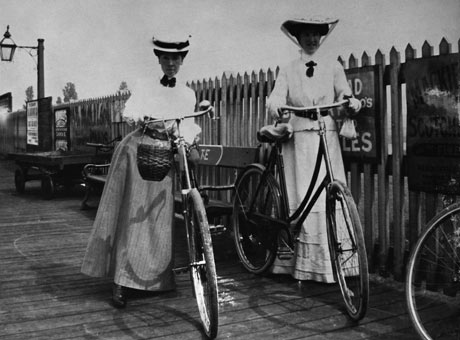 From The Toys of Peace, by Saki
DIRECT
"To go direct from a shopping expedition to a tea-party was what was known locally as 'living in a whirl.'"
From Quail Seed
Saturday, October 2, 2010
Daily Dose
 From Reginald and Reginald in Russia, by Saki
TEMPTATION
"Temptation came to him, in middle age, like a neglected butcher-boy who asks for a Christmas box in February for no more hopeful reason than that he didn't get one in December."
From Lady Anne's Reticence
Friday, October 1, 2010
Why Saki?
 We've undertaken, as I may have mentioned here before, to read aloud something in the way of the supernatural, or at least, the unusual, every Saturday afternoon in October at the bookstore where I work. I must confess, the idea was indeed mine. Beyond my well established penchant for showing off in just this way, I thought the opportunity to get a few other clerks up and on their feet, reading, if to no one else, each other every Saturday for a month together might prove not only fun but the point that we need not spend either an inordinate amount of time, or money, to provide a slight entertainment to the the reading public. As of now, it remains to be seen if anyone will notice, or if anyone other than myself and my usual co-conspirators in this sort of silliness will show up. It was easy enough getting my immediate supervisor and pal, dear P., on board. Like me, she's had some theatrical training -- though she took hers considerably further than I ever managed to drag mine -- and she's already proved herself, in our earlier go at 84, Charring Cross Road, and our birthday tribute to Dorothy Parker, quite the game gal, and quite the accomplished performer. Likewise, the resident young novelist and in-house copywriter, my friend M., allowed himself to be bullied into participating without much protest. He too read for the Dorothy Parker event, as well as at various venues in his own person as an up and coming member in good standing of the local literati, hip division. I then set about recruiting among the rest of the staff and while some I thought likely enough never the less declined, and while some fell away, there are, as of this date, no less than another three or four readers lined up for the month, to say nothing of a volunteer or two from outside the store; one a staff member from another store, and the other -- our very special guest star, if all goes well -- a man who reads aloud regularly to adult audiences at the Seattle Public Library and who has been widely acknowledged as something of the local authority on just how this sort of thing might best be done.
All very exciting, I must say.
Now if it turns out that no one comes to these afternoons, and each reader should find him or herself reading just to the other one set to read that day, I don't know that that would much discourage me from suggesting we do this kind of thing again, and again, and yet again. One of the functions of an independent bookstore, I should think, is to not only offer our customers opportunities to interact with books in ways they may not otherwise experience, but also to offer the staff opportunities to join in and do likewise. Working in independent bookstores, whatever else it may or may not have done for me, has regularly provided me with a platform from which to preach The Good Word about good books, old and new, in print and out, to anyone who might listen. Because I work in a bookstore, I've had the chance to write about books, talk about books, discuss books not only with a variety of people who write and read them, but also with the people who teach them, the people who sell them, the people who publish them, and even the people who buy and read them. I have represented the bookstore where I work on a committee, spoken on a panel at a college store conference, and handed out coupons in the street. I've given interviews about the business, and the used books business, most recently, to actual reporters for real magazines, and while I can't say I did that last very well, it was rather fun doing, whatever it was I ended up saying. Finally, and most satisfactorily from the point of view of my inner dancing bear, the bookstore has periodically allowed me to rise up on my hind-legs and growl and grunt before the public. I have proudly, if somewhat prematurely, seen my annual Christmas reading described as "a tradition," already, and if only in-house. Still. Makes one blush, someone saying something sweet like that.
Reading aloud is an activity I endorse anyway and everywhere as generally good for the soul. Good for the books, and the common reader too. I always argue that if one would understand great writing, in poetry or prose, one ought to get in the habit, sadly now thought to be somewhat eccentric, at least among the laity, of reading it right out loud. If one would have some better sense of what was being being said in books, one simply ought to say it, as written, and listen. Voice doesn't matter, or skill. That may come with practice. The point, at least when one is alone or in the company of trusted friends, is to take the words in and then say them out, tell the story, listen to the language and the thought, learn the punctuation, have a go.
Reading before what we who do it always rather hopefully insists on calling, "the public," is just a natural extension of this harmless private hobby, a way to extend one's pleasure in a book to other people, and a chance, rare enough these days, for anyone who might wish it, to hear our literature aloud, as most human beings once heard it, for want of any other means, but also because there can be a magic different in kind somehow to listening to a story in a group to reading one alone. I can't quite explain it, but reading, as it were, a book together is something more people should know.
And so we're off with this little series for Halloween, starting tomorrow afternoon.
I've taken on doing the first reading just on my own. Nothing to do with wanting the spotlight all to myself, I hope. The idea was to give everyone else, specially the new ones, that much more time to prepare without delaying the thing or missing a Saturday. Next week, as I'll be in Portland, some of the other readers will get their first crack. Wish I didn't have to miss it, but there we are.
So, why start with Saki?
Well, the supernatural, by definition, would seem a rather quaint idea, nowadays. Ghosts, goblins, gods, and all such bogeymen and beastly things already seemed somewhat antique even so long ago as when the greatest 19th and early 20th Century practitioners of the supernatural story were at work perfecting the form in English. From Poe to Le Fanu, Blackwood to Wharton and or either James, Henry or the great M. R., there's not really a mystic among 'em. Cold eyed rationalists would seems to make for the very best companions when wandering out into the dark and possibly on to the other side. One might be forgiven for thinking, back around the middle of the last century when I'd just about arrived on the scene, that superstition had about gasped it's last in the new and improved, technocratic West, and that the ghost in the machine would soon be given up entirely, and yet...
The devils, it seems, have survived the deity. Now just why is that? I would suggest a theory, based I freely admit on absolutely nothing at all but my own ample and well established gut. Speaking then just for myself, the most frightening monsters now about lurk not so much under the bed, or in the shadows, the ghouls aren't in the graveyards nowadays, but rather preside in the well-lit, exquisitely appointed executive offices of Wall Street banks, run for congress on the new Know Nothing ticket, conduct youth retreats, rather than the traditional black Mass, and now preach via satellite prosperity gospel to the poor and the worst of the old superstition and hatred of the other to an audience around the world. These then are the monsters to make a grown man, in the 21st Century, shiver in his slip-on shoes.
In such a world, is it not perhaps better then to revisit something of the innocence lost to most of us when we graduated from story books to the faerie tales told in The Wall Street Journal? Better to remember, this Halloween, when ghosts might still be made to disappear with the coming of the dawn and monsters might be killed by a silver bullet. To return then to one of the lost pleasures of childhood, when we might be frightened for no better reason than because it can be fun, when our nightmares were populated just by werewolves rather than "pitbulls in lipstick," when we were haunted only by ghosts rather than the spectre of some disaffected, undead zombie, sure of Heaven, with a bomb strapped to his chest.
Hector Hugh Munro, also know as Saki, was an English gentleman of the most exquisite lettres. An unrepentant old Tory and lifelong bachelor, who lived with his dear sister, Ethel, wrote hilarious and macabre little books, and who, at only 43, too old to be there but there none the less, was last heard in in a shell crater near Beaumont-Hamel, France in November 1916, to say, "Put that bloody cigarette out!" before he was shot dead by a German sniper. I can think of no more thoroughly modern figure with which to begin our somewhat nostalgic return to the horrors of childhood, can you?
Saki, in his all too brief career, transformed the typically sentimental, Edwardian English short story into something distinctly less predictable, something much funnier, really, but not so "nice." A Saki story was likely to tilt away under the reader's pince nez and suggest something fundamentally unwholesome about everything familiar, something a bit mean about even the best people, and something rather nasty, just there, under the anti-mascar. He didn't dislike the traditional dish, you understand, he just thought the treacle wanted a bit of acid.
Saki isn't the sort of writer that meant to scare the children. He meant to discomfort the grown ups, though always and only in a most amusing way.
Well, so do we. So first, Saki.
Daily Dose
 From Beasts and Super-Beasts, by Saki
QUITE INNOCENTLY
"He trotted out some well-worn chestnut as the latest thing in good stories, and I remarked, quite innocently, that I never could remember if it was George II or James II who was so fond of that particular story, and now, he regards me with politely-draped dislike."
From The Forbidden Buzzards
Subscribe to:
Posts (Atom)