Showing posts with label Matthew Simmons. Show all posts

Friday, February 14, 2014

The Test of Affection


This is the last day at the bookstore for yet another of my friends.  His name is Matthew Simmons.  He's been working there for more than a decade and we've been friends for at least that long.  I will miss him.

When I met him, he was hosting events at the bookstore.  Good looking boy, not yet thirty at the time, very attractive; bright, blushing and clever.  One day he posted a note, a charming confession of certain deficiencies in his reading to date.  He'd finally mastered Moby Dick, I think it was, and had determined to do more in that line; the great unread classics.  In the note, he'd asked his coworkers, a fairly literate bunch as might be imagined, to provide him a list of the books he most needed to read.  Delightful, and absolutely earnest.  As I remember it, it came to quite a list and so far I can remember, he read every book on it.  My nomination was Daisy Ashford's The Young Visiters, or, Mr Salteena's Plan, easily the greatest novel ever written by a nine year old, but hardly required reading.  It was a fatuous suggestion, a not entirely nice poke at a young writer's supposedly "late start."  Matthew read the book.  What's more, he enjoyed it.  And he appreciated my joke more than it, or I, deserved.  Makes my face burn now to think of it.  Nonetheless we became fast friends.

Since then Matthew has become the company's copywriter, an editor and a published author of some reputation.  I've had the privilege of reading what he's written as it's come.  From the first story of his that I read down to his most recent published book, Happy Rock, I have been a fan.  This is of itself odd, despite our now long-established friendship, as Matthew writes, and writes superbly well in a style so unlike anything I might otherwise read as to make my genuine appreciation of his work well neigh miraculous.  The clear inference would be that either my judgement has been clouded by my affection for the writer, or that he is just that good at what he does.  He is just that good at what he does.

What he does is write the most fantastical modern nonsense; witty, elliptical, loopy, but always grounded in an acutely concrete and recognizable, very American, reality.  His is not the sort of thing I would normally read.  Moreover, and most amazingly, in stories seemingly made up of nothing more than long car rides, dreadful metalhead music, dull suburban driveways and thwarted conversations, sometimes with the dead or just the dull-witted, stories with more than sufficient darkness in them, some of them, he manages an elegant play of serious ideas, good humor, and sincere emotion.  No idea how he does it.  None.  He's never written an awkward sentence in his fiction.  His essays and occasional pieces have never been less than delightful.  He's never been cruel.  He never fails to surprise me.  There is just so much we do not have in common, generationally and personally, particularly when it comes to contemporary literature and music, and yet I can honestly say I have happily gone wherever he decided to take me. I look forward to where we'll go next, wherever that might be, god help me.

He has, as it turns out, an exceptional talent, a sound head, a great ear.  He has a good heart.

And now he has a new job.

It isn't the writer I will miss.  What he writes, I'll read.  I will miss his dear face, his bright eyes and ready giggle.  I will miss him popping up -- he does actually seem sometimes to pop -- at my desk on the sales floor, just to say "hello," or to bump me with his dear, shaggy head, like some affectionate cat.  I will miss our conversations on the fly about this and that, about books and whatnot, our jokes and absurdities, our rare shared miseries.  I'll miss the very sight of him.

I wish him of course nothing but good things.  It's time he moved on, time other people and other places had the benefit of him, his talent, his good sense.

When he confided in me that he'd got this new gig and would be gone in a week, I was genuinely happy for him.  I am still.  But miss him I will.  And proud of him I am as well.  What a good writer he's become in just the time I've known him!  What a good man, and a good friend.

(I'm reminded of yet another friend from work, himself now a published novelist, also moved on, largely, to other pursuits and about whom I was not even able at the time he left to write so much as this, as it was just too hard to think of the bookstore and my day without him.   I regret that, though I tried to say something publicly thereafter.  Still.  I determined this time to be a bit less self-pitying and mark the day.)

I admit, I will probably get a bit misty when I see Matthew, later today, for his last day working at the bookstore.  Ridiculous, really, more my sort of thing, I should think, than his, the Byron I'm reminded of.  Such a drama queen, me.   At it's full length it's far too much for the occasion -- nobody's died here, people -- and it is a bit silly, but the first stanza, at least, by way of farewell, then, to ward off some even more maudlin or worse, if sincere, demonstration:

When Friendship or Love 
Our sympathies move;
When Truth, in a glance, should appear,
The lips may beguile,
With a dimple or smile,
But the test of affection's a Tear.


Now, go kick the world right in the ass, Matthew, my dear.

Friday, December 7, 2012

A "gif"

My dear friend, the novelist Matthew Simmons made me this.  I'm not sure I understand how this thing works, or why I look to be deflating as I speak, but here it is, my first "gif."  Thank you, Matthew.

Saturday, January 29, 2011

A Caricature

Daily Dose

From The Moon Tonight Feels My Revenge: One-Man Black Metal Bands and Stories, by Matthew Simmons

AT THE STORE

"At the store, we are helped by a man with an orange vest and a lazy eye.

'What's wrong with your eye?' Sport asked.

The man did not answer, but looked over at me. I smiled at him, and gave a shrug. He returned the shrug. We commiserated over the innocence of children.

'Some people just have messed up eyes,' I told my son.

'Wow,' said the man."

From This Mountain I Built

Saturday, November 20, 2010

Pictures from Our Visit to Niagra Falls Park (Look it Up)


The Man of the Hour.

Our line-up.

That's our Adam, Matthew Simmons, on the near end, our Eve, Pam Cady, in the middle and that glimpse of bald at the end would be me.

View from the side.

A view of the body of our listeners, bless 'em.

Part of the overflow crowd, no joke.

A view from the audience of what it was all about.

Thursday, November 18, 2010

Come Into the Garden, Mark

Our Twain reading was, I think, a success. Had a good, big crowd of roughly forty souls-- big anyway for this sort of thing -- and from the beginning, people laughed. My brief introduction proved to be perhaps a bit too brief, as we ended with time on our hands, but the passage I quoted from the new edition of the Autobiography went down well, as did most of what followed. I tried to frame the evening by sharing a scene from Twain's domestic life, and hoped that, and a few comments from me, would be enough to suggest Twain's own happy marriage in what followed. I made a mistake though in assuming that the audience would accept, even in our much abridged version, some of the rougher judgements of the gentler sex, understanding that these were not meant to be heard as Twain's, or our reader's, but of the first fool man. We'd but only just got going on our primary text, Extracts from the Diaries of Adam & Eve, when our Adam read the following of Eve:

"I wish it would not talk; it is always talking."

The laugh came, but was not universal. It was three pages in though, when Adam began the sentence -- a sentence I ought to have cut -- "She is such a numbskull..." that I heard an audible intake of breath from more than one in the crowd. I believe our Adam won them back, but it was not easy work.

The text as read was a week's work, at least, as I tried to get 27 pages down to roughly three quarters of an hour's worth of reading. Both of our readers whittled at it too, our Eve paying particular attention to anything, specially when isolated from a longer narrative, that was too renascent of female complacency , while I kept an eye on the worst of Adam. Here was the problem. In Twain's telling, Adam & Eve are both simple and not. To take from Adam all his pomposities and unkindness would spoil not only him, and the fun, but make of Eve a simp for loving him so, not in despite of his faults, but just as he is altogether. That, to my mind, was not only the comedy, but the point. A tricky thing then, at least with a contemporary audience, to let Adam be both wrong and lovable, as Eve herself concludes later on. The reading, as I said, went well, but in this, I do not think we were entirely successful. I blame my introduction as much as the editing. (Can't blame Twain, as he's dead and had no clock to watch.)

In The Ordeal of Mark Twain, the great American critic, Van Wyck Brooks said, "His wife not only edited his works but edited him." Brooks may or may not have meant to flatter Mrs. Clemens, but I did. By emphasizing in my introduction not only her devotion and critical importance to Twain's writing, but her willingness to be made the butt when he teased her by intentionally introducing passages to which she was sure to object, and strike out, I had hoped to show something of the humor that dominated the household, Twain's propensity for mischief, and his wife's tolerance of it and him. He dearly loved his daughters' arguments for restoring what their mother cut. Further, he admits joining in with them and, on the rare occasions that their side prevailed and the rougher stuff went back in, he would later cut it himself. Clearly, Mrs. Clemens, sooner or later, was in on the joke. I had originally planned to tell another story, from the same section of the Autobiography, in which Twain's "strong language" is repeated back to him by the beautiful young wife he had thought to spare by confining his curses behind what he'd thought was a closed door. "There," she says afterwards, "now you know how it sounds." He laughs aloud and says:

"Oh Livy, if it sounds like that, God forgive me, I will never do it again!"

Twain continues:

"Then she had to laugh herself. Both of us broke into convulsions, and went on laughing until we were physically exhausted and spiritually reconciled."

I needed that story. It would have helped.

Twain wrote "Eve's Diary" in 1905, not long after his wife's death. Together they had already endured the death of more than one child, including their daughter, Susy, closest to Twain in character and a favorite in the family. It is said that Mrs. Clemens never recovered from the loss. Twain himself would outlive all but one of his children. The loss of his wife would seem to have motivated Twain, who had written previous satires on the subject, to take up again with Eve, and give her something more of the wisdom and intelligence of his late wife.

Olivia Langdon Clemens was an extraordinary woman. From a progressive Northern family, she was liberally educated, fiercely intelligent and physically delicate all her life. As I did say in my introduction to our reading, it was she "who informed his opinion, refined his politics, and his style, assuaged his melancholy, and had his whole heart." I had hoped our version of Twain's story would communicate something of his delight in and awe of her, as well as his gloomier estimation of the general worth not only of mankind, but specifically of Man.

I think our audience missed some of the satire and more of affection, not because of what Twain, or even Adam said, but perhaps because of what I failed to say. Ah, regrets!

I'm indulging in this critical hindsight here not because I would take anything away from what was a lovely evening in the bookstore. A good time was had by all, including if not chiefly, me. I just wanted to demonstrate first, how difficult it can be to tinker with a finished work of art, and to read something from the beginning of the last Century to an audience at the beginning of this one, and finally, to say that even for all one may get right in such an undertaking, there may still be plenty one gets wrong. For all that though, I can think of few things more satisfying than the attempt.

I've had some experience before with both success and failure in this line. I've given, for example, readings from Dickens at the bookstore on three separate occasions to date, and will again if I can, and of the three, I think only the one I did some time ago, on Dickens' birthday, came close to being entirely successful. My reading from The Pickwick Papers for Christmas last year, suffered from the introduction of too much movement -- as I was attempting the ice-skating scene -- and I stumbled both verbally and physically, for not having rehearsed the piece enough up on my feet, and on the store's carpet. My other less than happy experience was in trying to trim a reading of The Chimes down to an hour without sacrificing the full narrative. I ended up awash in plot, which was hardly the point of the evening.

Doesn't matter. What working on Mark Twain for a reading, and on his Adam & Eve specially, has taught me most strongly is that fun of this kind requires a certain innocence of consequences. As Eve says, having accidentally invented fire, "...I was full of interest, and began to examine."

I think we pleased the people who came well enough. They were uniformly encouraging and gracious. I know I was mightily pleased by the efforts of our Adam and our Eve. As for my own efforts, I am glad of the opportunity to have a go at so great an artist, and to have spent some time back in the garden, with Mark. I'd go again. (Maybe we will some day, and I can try to do my bit better. Eve would understand the urge to do so, even if Adam wouldn't. Mark would too, I'd like to think, and Livy. What fun it must have been to make that woman laugh!)

Monday, November 8, 2010

Guerilla Promotions


A bit of the ol' improvisation can be required when looking to promote an event from scratch. We got our stock of Mark Twain's Autobiography, Volume 1, well in advance of our upcoming reading in the bookstore where I work. With the months of press and reviews the book has received, I don't know that we had to do much more to draw our customers' attention, beyond making a great stack thereof. But our upcoming reading of extracts from The Diaries of Adam & Eve needed some attention too. The rather grand poster of Mr. Twain we had in duplicate from the publisher of his "new" book. Dear S., a coworker at the store, added the the text, with the author inviting folks to join us November 16th, at 7PM for our reading. Clever lad, is our S.

Made us another one with the second poster. This one we've slipped into the window next to authorized promotions for upcoming author appearances. Don't know how long this one will last in it's present position, but for the time being at least, passersby might actually glance Mark's way and be arrested just long enough to see the details -- though one can't in this photo -- and maybe even come in, come the 16th, and join us.

We do what we can, as best we can. Remains to be seen if the poster stays in the window for long, or if anyone comes. Here's hoping.

Friday, November 5, 2010

An Upcoming Event


Lester Ralph did a series of beautiful illustrations for Mark Twain's first edition of The Diaries of Adam & Eve. This one has been, shall we say, modified. For our reading at the bookstore, Matthew Simmons will be our Adam, and Pam Cady our Eve. No, that does not make me the Serpent. Though my subjects might think me so, after this. Actually, I've drawn Matthew before, and my beautiful friend Pam had the good grace to laugh when I showed her this, so I feel alright sharing it here.

Now at this point, having had absolutely no publicity for this event, we are prepared to do almost anything to draw an audience for our reading, but, no, in case anyone was wondering, neither Matthew nor Pam has actually agreed to read au naturale. One will simply have to imagine...

Tuesday, November 2, 2010

Pictures from an Upcoming Exhibition

And so, we make ready to go again. Despite knowing that we may be reading just to each other this time -- with even less publicity than our last venture, and fewer friends even to participate and or form our audience -- it seems we simply will not stop.

Here then the first images of the first reading of Extracts from the Diaries of Adam & Eve, by Mark Twain. I am not actually doing much of anything here but reading along. My task will be to help edit and to introduce the evening. I'm planning to say all sorts of clever things, all of them Twain's, come November 16th, at 6PM. I haven't collected up my text yet. For now, I'm just along for the ride.

This would be the redoubtable Adam of the evening, novelist and copy-writer, Matthew Simmons. A dab hand at this sort of thing, in addition to reading his own work aloud regularly, Matthew was one of the joys of an evening of Dorothy Parker readings we did at the bookstore some time back. Cute as a bug, ain't he? Talented fellow. Lucky to have him.

And here is our Eve, beloved bookseller and me boss, Pam Cady. Funny woman, grand reader, and my regular coconspirator in this sort of thing.

Mark the date, any who may. Everyone's welcome.

Thursday, September 16, 2010

An Uncommon Talent: Kevin Sampsell's A Common Pornography

I pause to recommend a new book I didn't like.

This, given what I do for a living, is not actually all that uncommon. Do it all the time. Were I in the bookstore where I work just now, I'm confident I could recommend books on any of the following subjects about which I could not actually be made to care:

Knitting
Curt Cobain
Fly-fishing
Lithuanian poetry

Okay. Maybe not that last one. (Not even Google or Nancy Pearl could help me there, I think.) But I would try.

The point being that, as a bookseller, it is a substantial part of what I do; connecting readers unlike myself with books I need not like. It would disingenuous to suggest I'd read every book I might recommend in the course of the day, or that I had any intention of ever knowing more than the little I may have inadvertently come to know about Antarctic exploration, for example, which to my mind is just the unappetizing story, repeated entirely too often, of people going where they really ought not and getting, frankly, just what they deserved. Doesn't mean there's anything wrong with me recommending books about this to the people who enjoy reading that kind of thing. Hardly an ethical quandary for someone in retail. Doesn't mean there's anything wrong with those readers, either. A particular favorite of mine, the English novelist, Nancy Mitford, adored reading books about Captain Scott, Ernest Shackleton and the like. That would be something I only know because I've read all her published letters, which happen to be very much more to my taste than, say, Heart of the Antarctic. Doesn't matter. In Heretics, Chesterton famously said, "There is no such thing on earth as an uninteresting subject; the only thing that can exist is an uninterested person." When it comes to gentlemen dying heroically or otherwise on ice, fair to say, I am uninterested. Doesn't mean I can afford to be wholly disinterested though. So, I read a little at least what I don't like. Part of the job. Necessity. I've certainly sold more people on Caroline Alexander's Endurance than I ever convinced to read Mitford's letters. I'd like to think I haven't done anyone a disservice by only finishing one of those two books. That's what bookselling allows me to do, if I'm any good at it; read things I otherwise never would so that I might talk to people who ought to, learn something of people unlike myself, and make a very modest living at it. What matters is knowing what's good, even what's best, even if it isn't something I like.

Kevin Sampsell, the author of A Common Pornography: A Memoir, being a bookseller himself, would understand this. I don't know Mr. Sampsell, though I may well have encountered him at some point, as he works in one of my favorite bookstores, Powell's, in Portland. No reason I'd know that about him, or anything else, had I not had occasion recently to read his new book. I'm glad I did, though as I've already suggested, I didn't entirely enjoy the experience.

Kevin Sampsell likes things I clearly don't. He likes music to which I would never willingly listen, he reads books, presumably, it would never occur to me to read, and what's more, he publishes, at his own press, Future Tense Publishing, authors of whom I would never otherwise have heard. I've actually read some of these now, because I read Sampsell's book. He knows what he's about. His taste, while not mine, is clearly admirable.

Taste. As a memoirist, Kevin Sampsell could be accused of having very bad taste indeed, or at least of being indiscreet in a shockingly unappetizing, even heartless way. No one in his new memoir, which is almost all to do with his childhood and immediate family, on the evidence of this one book, could be described as having any taste that wasn't bad, even the author. There's not a room, not a meal, not a song, not a relationship, not a conversation that doesn't sound godawful. There isn't one ugly thing that might have been overlooked in the author's life, or his sister's, or his sister's living room, for that matter, that escapes mention. In fact, I can't remember the last time I read a book with more ugliness in it.

And yet, Kevin Sampsell has written a beautiful book. I can say that, having read the book straight through now, twice, without apology for not having liked the book. It isn't, I suspect, the kind of book one is meant to like. Doesn't mean it isn't good.

Wilde said, "There is no such thing as a moral or an immoral book. Books are well written or badly written." Kevin Sampsell's memoir, whatever else it is, is well written, though even here, I should amend that statement by adding that the book is written in a style I can not like. Seventy-some years ago, the British critic, Cyril Connolly, wrote a very influential book called Enemies of Promise. In it, he described the triumph of modernism and the vanquishing of what he brilliantly and brutally dubbed the "Mandarins," meaning the fussy insincerity and affectations of style that had dead-ended English literature in a kind of bloodless, drawing-room politeness. Dishonesty, Connolly felt, was the only natural result of a discretion that had come to stifle sincerity all but entirely, and a style that had become so refined as to end by saying nothing of the slightest importance or relevance to modern readers. Neither Connolly nor the modernists might have anticipated a time when nothing might not be said just because it probably shouldn't be, or the popularity of a style, the most admired aspect of which would be the flat philistinism of the prose. Yet, here we are.

If I were to write about the faux wood panelling in my parent's double-wide, I would feel an obligation to at least defend the aspirational triumph represented by my parent's first and only "new" house. What's more, I should probably do so in just such a clumsy, pendulous sentence as this. The most obvious reason to do so would be to spare something of my family's feelings, though it is unlikely that anyone in my family would ever read this. Then there might well be some shallowness of character on my part that would need to reassure my readers that I know perfectly well how aesthetically doubtful even the most expensive prefab is likely to be. Finally, I should be genuinely afraid of boring anyone with what might seem a careless description of an ugly fact, unalleviated by either humor or at least the suggestion of something of interest about that plywood environment beyond my personal experience and or my own distaste.

Setting whatever motive aside, what Sampsell does, something that I never could, is trust in the story he's decided to tell, to the interest of his readers in the experience of a not all that unusual or interesting boy growing up in a profoundly uninteresting time and place, and in a family one can hardly envy, and in the seemingly neutral, even artless voice in which he has chosen to write. That last of course is what makes Sampsell's book so good, and what I actually like least about it. I find the facts of Sampsell's memoir all too boringly familiar, when they aren't actually horrifying or distasteful. I find his willingness-- even eagerness -- to expose his family's darkest secrets and dysfunctions less shocking, having watched more than my share of daytime TV talkshows, than depressingly inappropriate in a man nearly my own age, whose poor old mother is still alive. What I can not but admire, and yes, even envy, is the skillful, even masterly concision of the writer's prose. There's no other word for, at least that comes to mind tonight, but delicacy.

That one could write so gracefully, seemingly without affectation or obvious reference to his own, adult judgement and experience, so exactly in the voice of childhood, that the reader, this reader anyway, might never have had cause to doubt the veracity not only of the vignettes and short, anecdotal chapters from which the author has fashioned his book, but also the honesty of the writing, and the writer, is flatly amazing in a book of this kind. I know there is art in this. I can almost smell it. Take just his description of the day in the brief chapter, "Mt. Saint Helens," in which, without a wasted word, or a single beautiful phrase, Sampsell writes what could easily stand as a perfect, perfectly American, prose poem. Want to know what it was to be a boy living in Washington the week the top came off the mountain? There it is. Every detail, down to the named Gerber baby food jars in which the narrator and his classmates gathered ash from the sidewalks and car hoods, is right, even magical because, "Someone said the bottles would be worth money someday." That is exactly the logic of boys and how a source of astonishment is made understandable, commodified and sustained by childish aspirations to bottle the ineffable. The whole moment is then made more touching and true for the charmingly deflated conclusion:

"It was spring break when this happened, and when I went back to school the next week, everyone had bottles of ash to show."

What I can't do is recommend just these scenes of harmless, even sentimental wonder, because they do not occur in isolation from either the brutal reality of Sampsell's family life, or the author's determination to treat everything, good and bad, with the same careful, regretful passivity. Shit happens. I can't imagine the discipline required to break neither character nor mood and comment directly, as an adult, on what did. Kevin Sampsell the writer does comment, of course, on the pathetic mess his father in particular made of not only his life, but the ruin he left all around him, but the son only comments in the selection, the organization and the subtle cool with which he writes. It's disquieting, even disturbing, that cool.

But then, I've never known or really aspired to cool. I don't understand it. I fundamentally distrust it as a value. It is a kind of sophistication that has always seemed to me antithetical to either the good or the sustainable. Cool, to my mind, requires an isolation, most obviously from other people's judgements, but just as certainly from any sincere emotion other than the most visceral, a wariness of sentimentality and affectation that all too easily can become an affectation every bit as crippling and wearisome as ostentation and extravagance. There is no room, it seems to me, in all that blunt, brutal, fuck 'em-if-they-can't-take-the-truth honesty, for forgiveness; not of other people's sins, as it seems part and parcel of cool to barely acknowledge the capacity of other people to really affect, let alone undo cool, but forgiveness of self, of one's own sins. To whom would one's repentance be addressed?

Cool would seem to be the one thing in search of which the boy Kevin, like so many boys of roughly my generation and after, spent his youth. The writer, Kevin Sampsell, has it. No question. From what can be gleaned just from the memoir, he learned a certain cool from his best brother, or at least he admired in the elder boy what the younger still so obviously lacked. And Kevin just as clearly came to cool by means of a kind of trial and error common to all kids, but was lucky enough, or smart enough I suspect, to see music as the likeliest and quickest path to his goal. It is music that would seem to have saved him. Clearly, the boy had an ear. ( Just as clearly, from the sureness of his prose, he still does.) Once an aspiring musician and lyricist, Sampsell listened to the right stuff, and would seem to have read the right stuff, though he mentions this less frequently, to make a style that works so well as his.

(If, by the way, any young person should be confidently informed by anyone of of my generation that they did indeed listen to The Clash in high school, much as one would with someone of my husband's generation who insists he or she was at Woodstock, the youth should feel free to demand some kind of proof. At best, your dad probably had "Frampton Live" pounding his brains out through his giant headphones, while trying to master the chords on his unplugged electric guitar. And to be brutally frank, it's likelier Pops probably just had an acoustic guitar and the John Denver Songbook.)

So, my recommendation? I still can't say that A Common Pornography is not a good book. I've tried in fact to explain why I think it is, even if I don't like the damned thing. It isn't just that it is yet another exploration of suburban horrors, or that I can't be made to read suburban horrors. I've been reading a lot of that lately, actually, and not all of it looking for things that might give grown ups a bit of the old thrill of Halloween, come our October readings at the bookstore. The suburbia of Matthew Simmons, for example, can be pretty horrible, but at least in all the things of his I've liked best, it is weighted with a kind of allusive, folkloric nuttiness -- mom, being a golem dad made in the garage, for example, doesn't talk much -- so that what might otherwise be merely uncomfortable or uninterestingly proverbial, instead has a wonderfully weird, and childlike horror. Like Sampsell, I'd have to say that Simmons would seem to feel being at last all-grown-up as something of a shock. Neither still youngish writer would seem to have survived their adolescence without a certain terror of the oncoming adult world, and a persistent fondness for the lost innocence of magical thinking -- yet both would seem to share an enviably acute memory for the actual confusions, and joys, of childhood. That said, while Simmons' rhetoric can be every bit as blunt as Sampsell's, his writing seems tempered by a less self-consciously serious dignity. For me, reading Simmons, the pleasure of the thing has almost everything to do with the wit and aptness of his seemingly goofiest choices, his evident pleasure in the whole enterprise of invention, and finally, something of that that same cool confidence as a writer I admire so much in Sampsell. Obviously, Simmons shares Sampsell's, and perhaps their whole generation's fetish for economy, but with Simmons, there is a surprisingly happy propensity to giggle now and then, to break in as an entertainer, and run a little patter, or do a little, awkward white boy dancin', even as he proves he's quite the clever dick, too. Simmons' first novel, A Jello Horse, for all it's grim, 2010 hipness, in tones at least, might almost be an audio abridgment of On the Road as read by Fred Allen or Robert Benchley.

So it isn't just the fucked up, quotidian nastiness of Sampsell's family that makes me not like the book I'm recommending. I'm a big boy. I can take it. Really, it's that cool.

But, as I do know at least a few cool characters, including the afore mentioned Matthew Simmons, I can without hesitation recommend A Common Pornography, at least to them.

Tuesday, May 18, 2010

Daily Dose

From The Pacific Northwest Reader, edited by Carl Lennertz

VERY LARGE

"He is very large, but he is wearing a teal T-shirt and a matching pair of teal shorts. He has sandals and tall white socks. A dangerous man would not make this footwear choice, I decide."

From Bigfoot Calls, by Matthew Simmons

Tuesday, February 2, 2010

A Caricature


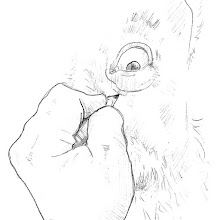
From just a few years ago, when he was still promising and not yet accomplished, author of A Jello Horse, and me pal, Matthew Simmons.

Saturday, January 30, 2010

Daily Dose

From A Jello Horse, by Matthew Simmons

STATE

"You will never, ever be in a sadder state in these United States than the state of Nebraska."