This is the season of the 10 Best Lists. Everybody does them: reviewers, critics, radio-hosts, bloggers, and one sees them everywhere, from newspapers -- remember those? -- to morning TV talk shows. The agenda of course is to promote sales, not just to rank the year's best books. Well, I work in a bookstore. Doesn't bother me, the commercial aspect. In fact, recommending books with the idea of selling books is about the best part of what I do. This sort of thing comes to me as easily as pointing from my desk to the restrooms ("Up the stairs one floor and to the left.") Need a list? I'll make you one. I'll make you a dozen. Well, one to start, anyway.
I love lists. I make them constantly; everything from groceries to poems I mean to remember, to books I wish were back in print. Like most compulsive list-makers, I seldom read my lists after making them -- as in a way it is the making that counts -- and besides, I don't always remember to take them with me wherever I'm intending to go, can't find them when I get wherever I end up, or can't read what I wrote. Yet, I keep making 'em. There's something satisfying, as I've said, in just the making; perhaps the brain conflates the list with the task, the titles with the reading, etc. Fine with me. Still gives me a charge. (Such a sedentary character must accept such endorphins as come my way.) Come the end of the average workday, my pockets are littered with notes, some of which, if closely scrutinized in a strong light, I may even be able to decipher, and some of these, most likely, will be lists: movie recommendations from coworkers, book titles on fiction featuring bees, compiled for a customer's Christmas list, ten books on Greece, or by Greeks, or about Greek cuisine... whatnot. In keeping with the rush to recommend, I offer this list, not just of books, new this year, that I happened to have read and really enjoyed, but of books I ought not to have read at all, would not have read had circumstances not required that I do so, or that few would think to find on a list of mine, or that I was frankly surprised to find I liked better than some of the books I took up with more enthusiasm. These then are the least likely of the best this year, at least from my lists.
Here goes:
 1) This would be best example this year of a book I much anticipated -- and yet was prepared to dislike. A "new" life? Was that necessary? I've read at least two full-length biographies already, and Kermode's latest book of criticism, among other critical works on the gentleman, so did I need another book on the author of Out of India? Well, yes. A Great Unrecorded History: A New Life of E. M. Forster, by Wendy Moffat, was in many ways among the most satisfying new biographies I read this year. Quite a surprise.
What I feared was a point being made at either Forster's expense -- as has happened all too often in the last few years when theorists have decided to use the work of artists to prove art inferior to theory -- or an attempt to either traduce or sanctify the man. Either of the latter possibilities almost makes for as dreary a reading experience as the former. Homosexuals seem to specially tempt scholars to this sort of thing. There is a category of modern biography, probably defined for me at its best and worst by C. A. Tripp's Lincoln, wherein a respected scholar makes a mission of reinterpreting the evidence in such a way as to, as it were, queer the picture. This can be, as it was with the book by Tripp, both a delightful provocation that sends all the old birds of The Ivory Tower aloft in indignation -- which, I admit, can be fun to watch -- but usually ends in a book that is less a biography than a not altogether satisfying exercise in embroidery. (See also some relatively recent writing on Henry James.) With a personage like Forster however, there would seem have been no one since the more innocent days of Lionel Trilling who didn't already know. (Morgan Forster was the kind of fellow that one's grandmother, even had she been convent-raised and lived her whole life on a Montana cattle-ranch, would have pegged as rather a queer bird.) With all the details in numerous memoirs by his friends, and in the earlier biographies, and the evidence of his posthumously published novel, Maurice, what more needed to be said about E. M. Forster's sexuality? Well, as it turns out, quite a bit.
What Moffat does is restore to Forster, and to the people with whom he spent the better part of the second half of his life, the dignity of preference. Using Forster's personal papers, and taking him at his word, Moffat convincingly shows that far from some tragic old eunuch who'd written himself out, Forster in middle age made himself a new life, a queer life, about which he felt he could not write honestly as a novelist. When it came to the so-called "battle of the sexes," Forster had to admit, he did not have a dog in that fight. And he did not feel he could write, or more importantly in a way, publish fiction that dealt honestly with his life as a homosexual, after he'd secretly written Maurice, so he did other things. Unlike earlier biographers, Moffat takes this choice seriously; she does not psychoanalyze, conjecture or prevaricate, she quotes, bless 'er, the man himself, and the result is not only admirable, but remarkably readable and convincing.
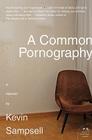
 2)A Common Pornography: A Memoir, by Portland bookseller and publisher, Kevin Sampsell, is also a book I've already written about here, but having read it through a second time, I've come to think it even better than I did the first time. This book represents a whole school of writing, as I was at pains to stress when I first addressed it, that I do not like. It is cool. I do not like cool. Sampsell writes about horrible shit, like his father's abuse of his sister, with the same detachment that he writes about his sister's bad taste in interiors. I found this maddening, and mean. Even the first time through though, I had to admire his ruthlessness, not as regards his family, but his writing; not a word but what was right, not a sentence that he didn't need, not a thoughtless paragraph.
Well, maybe I calmed down a little about the decline of Western Civilization, or at least civility, or maybe I was just forced to defend the book to other people and found myself making a better case than I intended, but for whatever reason, when I read it a second time, Sampsell's book felt... honest. It moved me. It was still uncomfortable, and not an experience I would recommend to anyone unwilling to be made impatient with the emotional stupidity of the American straight male -- at least as represented here by what I can't help but think is a careful self-parody of the author -- but the book is that good that more people should read it. I came to see that there may not have been any other way for Sampsell to write this memoir than the way he did. The only alternative I can imagine would have been for him not to write it all. A case, I still think, could be made for that, but not anymore by me.
 3) Shell Games: Rogues, Smugglers, and the Hunt for Nature's Bounty, by Seattle environmental reporter, Craig Welch, is not the kind of book I would ever pick up and read. All that green. Among my like-minded leftists, there is no subject on which we are less likely to be thoughtful, let alone interesting, let alone entertaining, than what's still being done to "nature's bounty." Craig Welch manages to make his book on environmental piracy in the Puget Sound all three. How'd he do that?
Well, to start, by being a reporter. So much of what I might read on matters environmental is just polemic. I don't need to read that. I agree. I'm not an idiot. Global warming is real. Capitalists are greedy fuckers. I should be composting more. You've convinced me. (I live in Seattle, for heaven's sake!) Real reporting; factual, observed, researched and considered reporting, is all that is required to inform the citizenry in a functioning democracy -- when it is done ethically and well, which is admittedly an increasingly rare thing nowadays -- about serious matters. I'm not saying somebody shouldn't be shouting, just not at me, thank you very much.
Welch also made what I think is a pretty brilliant choice about how to report this story. I don't know if it was something that seemed self-evident to him while he was following the facts, or if he consciously decided, when he came to write the book, to write it as true crime, but it works admirably. From the first scene on a dark city street, staring down into the water from a cop's truck, looking at what may be an empty boat... or a crime in progress, I was hooked.
I'm going to use a word that might discourage some of the devout, but this book was fun! Oh, yes, yes, I was outraged, indignant, credulous and all that. I was also turning the pages -- fast. This was exciting stuff! And not just because I didn't know a damned thing about this murky business, but because I wanted to know what happened next. I cared not just about the geoduck -- pronounced "gooey duck" and an admirable if revolting animal it is for all that -- but about the human beings, good and bad, about whom the author was writing with the same objectivity and curiosity. This is how it is done, my fellow sandals & socks wearers, when telling a story to grown-ups.
 4) In the realm of the even less likely read, I can think of no work of fiction this year that I took up more stubborn reluctance than Matterhorn: A Novel of the Vietnam War, by Karl Marlantes. Everybody loved this thing. There wasn't another new novel I heard so many booksellers go on about since it came out, and the reviewers were tripping over themselves to be among the first to proclaim its historic significance, the power of its realism, its devastating emotional truth.
Well, I hated every minute of the damned thing. I know everything, by way of our disgraceful history in that benighted country, that I need to know to be sure that the idea of reading a first time novel, of inordinate length, told at a grunt's eye-view, by a veteran of that war, was for me about as attractive a prospect as spending a week on a battlefield tour of Pleiku in a vintage jeep. No, I was not old enough to either serve or march on LBJ's White house, but I am just old enough to have been made thoroughly sick of hearing, and reading about the whole ugly business for forty fucking years.
So why did I read the whole damned book? I didn't have to do it. True, I only took it up because it was being considered by the awards-committee on which I was serving, and I put it down as often as I picked it up, but I wasn't required to finish it. I was assured that if I just stuck it out, I would become engrossed, that the characters would get to me, that the detail would fascinate me. Well, I didn't, they didn't, and it didn't. The story was neither new to me nor told especially well. The characters were as familiar to me as they would be to anyone else who'd read Michael Herr's Dispatches, or anything much of the two volumes from of the Library of America's war reportage, or Joseph Conrad. And all that realist detail as to everything from bullets to rotten boots? I suppose, had I otherwise have been made to care about the book, that stuff might have really put me right there, in the shit.
I remain unconvinced that Malantes has written the great novel so many insisted this was. So why then recommend it? Because the book Karl Malantes did write, for all its tedium, its familiarity, and its grossness, is still a damned good book, and easily the best new novel I read out of all the new novels I had to read this year. Like reading Dreiser, I found myself wondering how a book this clumsily written, this bloated and ugly, could be so satisfying, could make me keep reading even when there was nothing in it that appealed to me as either history or fiction. My only answer to this would be a value I do not generally bring to the reading of novels: sincerity. Malantes means what he says. This is important to him. It is important not just that he get it all down, but that he get it right. I trust absolutely that he did. I don't have to admire the book to believe it. What the author did is admirable. It did move me. It did teach me something of what that war was, of what that experience was for him, and for all the men like him.
I have no more interest in the subject now, or Malantes as a novelist, than I did when I forced myself to start the first chapter, but I can recommend the experience. It was salutary.
 5) To those that know me well, this next one will seem like cheating on this list. I collect every book published in this series, whether I want the damned things or not. It's a series. As a collector, that's what one does. Also, I collect and am a fan of the writer, as a writer, and as an important figure in American lettres. So how could I not buy H. L. Mencken's Prejudice: The Complete Series, in two volumes, from The Library of America? Obviously, I did. Employee shopping day, right on the top of my stack to get the extra holiday discount, there he was. First book I opened and started reading when I got home. I already own these essays in their original volumes -- actually, in rather shabby later printings, but still, I own 'em all. And yes, I've already read most if not all that's in them. But the truth is, I ought not to love Mencken as I do. His politics, generally speaking, were appalling, (meaning not like mine,) and these books, in particular are often Mencken at his least nuanced, shall we say.
Mencken was a brute and a bully, in addition, as one learned from some of his posthumously published diaries and such, to being a closet anti-Semite and a racist. Mencken was also, by every report I've read from Manchester to Teachout, a charming man, a boon companion, a good husband, brother and son. Mencken was also an exceptionally good, largely self-taught scholar and thinker, among our greatest newspapermen, and one of our most important and influential literary critics and editors, but what Mencken was above all else, was the supreme sonofabitch in American literature. As I've already said, I shouldn't love him, but I do.
With the considerable and painful exception of never having written a single masterpiece, Mencken is America's Swift. Like the bitter Dean, what Mencken does better than almost anyone else in the language is invective. Mencken was a cynic, a reactionary in everything but sex and literature, and an atheist of the trip-your-grandma-on-her-way-to-church variety, but he was also a stylist and a champion of language. Swift was a priest, a Tory, a jobber and a misanthrope. He was also a genius. I don't think Henry Louis Mencken was quite that, but he wielded a blackjack better than anyone in English after Twain had laid down his cudgels. It is to Mencken, more than any other American in the first half of the last century, that we owe the vanquishing from intellectual respectability of the canting, couthless, boobs, bores, and incompetents that stifled our literature, censored our press and reduced the discourse in this country to "the level of the chiropractor, a press-agent or a Congressman." If the idiots are still very much in evidence in our politics, our culture and what we would now call "the media,"
it was not for want of effort by Mencken.
To read even just the first paragraph of his "Essay on Pedagogy," from the Fifth Series, and so from fairly late in his career and from well past the heydays of his influence on the culture, is to marvel at his prescience, his unstinting enthusiasm and his solid common sense. In good, plain language, he defines what makes, and unmakes, a good novel. It is an excellent example of Mencken as a critic, and rational crusader for the good book. He is, by the time of this piece, the guy who knows a good cigar by his fingertips.
But why I for one can't help but love the old sonofabitch is for stuff like "Star-Spangled Man," his devastating deflation of the Fraternal American on parade, from the Third Series, or his more famous vivisection of the South in "The Sahara of the Bozart," from the Second Series. Mencken is best when he's mean.
So while far from the dearest companion in my library, Mencken defines for me the pleasure of obloquy, sober swearing, and the company of a grand grouch. The man, simply put, is funny as Hell.