Showing posts with label Marchette Chute. Show all posts
Showing posts with label Marchette Chute. Show all posts
Friday, November 14, 2014


Sunday, October 26, 2014
Field Trip

Just some casual snaps from my most recent border-crossing. My friends tend to be biblio-maniacs not unlike myself -- not sure why that is. Anyway, this means that when I want to make our visitors happy, the easiest way is to pack the car with shopping bags and overnight bags, book a room at the always reliable -- and recently, beautifully renovated -- Mark Spencer Hotel, Portland, and head South for a day or two of budget-busting book buying fun.

Powell's has likewise recently renovated their landmark, "Burnside" location. The results are both beautiful and in no way a diminution of either the the stock or the floor-space devoted to great used books. No easy achievement, that.

For me this meant coming home with nearly a shelf of Samuel Butler books I'd never seen before, none of which cost more than fifteen dollars apiece, a Marchette Chute duel biography of George Herbert and Robert Herrick, "etc., etc.," as Yul Brynner used to sing/say.

Nothing makes me happier than that moment when, having collected up a heap of treasure, I retire with a friend to the cafe and review the day's loot! The idea is always to put back a few things (in my case, one Defoe I already owned,) which makes one feel terribly judicious and well-budgeted, even as the orgy of book fondling and mutual admiration of purchases goes on through the afternoon. Heaven.

Bless you Powell's, and all that sail in her! You make entertaining so simple!
Friday, February 20, 2009
A New King (temporarily) In the Cave
 Tonight I had to move five books from my desk just to see the computer screen. This is typical, both of my present state of mind, and of my habitual untidiness. I might want Heinrich Heine later, or Dryden, or Woodforde, or the O'Reilly computer book I bought with great resolve but can not understand. Honestly though, everything here on my desk is here on my desk because I had cause to want it, today or a week ago, whenever it was that I did, and, as I so seldom can be bothered to put anything back where it ought to go once I've done with it for the night, the moment, or, in the instance of the O'Reilly book, in
 all likelihood, forever, here it will stay until displaced by some other book, or until the cleaners come because we're having guests. We seldom have guests. As I'm home with the mumps, we are unlikely to have any visitors soon, save from the Health Department. (They seem to have taken a disquieting interest in me and my mumps, by the way, sending a car to pick up my blood sample from my doctor today. I do feel ever so special, in a creepy way. Perhaps I should tidy up, in case the men in hazmat suits are just around the corner? Will photos of my library, and this entry be used on the news to show just how precipitous was the zero-patient's decline into incoherence, immediately post-diagnosis? I will practise John Hurt's cornered scream from The Elephant Man, just in case I'm afforded a close-up before being spirited away to the CDC: "I am a human being! An indifferent housekeeper, and somewhat slovenly in my appearance since becoming ill, I admit, but I am Not an animal!") Whatever my intentions, owning these books means I have the use of them -- when I can remember where they are -- anytime I choose. Mine is not so much a library then, lacking as it does a proper purpose or any but the most rudimentary organization, so much as it is a private hoard. I sit in the pirate's cave, atop the miser's pile, my uncounted treasure spilling all about me.
I suppose my subject here, to the extent I can be said to have one, is my library/hoard, the relation of book to book and books to me, and the ways and means by which my books have come into my life, into this room, and onto my desk. Working in a bookstore, I have access to entirely too many books, and I only too obviously have entirely too little self restraint. I have only to look around me for proof. True, all but two of the books on my desk just now came from Magus, or some other used bookshop. The computer book I'll never use I bought at full price, minus my employee discount, but atop the lot sits a remainder; a book sold off by its publisher to be got rid of, and sold in the bookstore at a dizzying discount when compared to its original price. The greatest danger in the bookstore to me is, as I've mentioned here before, the Bargain Books tables the length and breadth of the bookstore's lobby. History, biography, science... all those lovely hardcover books, marred only by a black Sharpie dot, or even, when I'm specially lucky, unmarked, and all priced to tempt the poorest book-obsessive. My manager, M., is also the remainder books buyer, and he is a devil. He knows just what will tempt impecunious but acquisitive magpies like me. Damn and bless him. History most often snags me.

The Fears of Henry IV: The Life of England's Self-Made King, by Ian Mortimer, a handsome British book, on a subject largely unknown to me otherwise than in Shakespeare, is the latest prize from those damned Bargain tables to find its way into the cave and onto my desk. Read only to page 75 to date, it sits now waiting to be picked up again from the stack and carried off to my sick-bed. I know just why it caught me, I've been reading Marchette Chute's biography of Chaucer, saved from a Clearance Sale, and this other is quite serious history on the same period. And I bought the Mortimer book because it is a handsome brute of a book, read well at lunch one day, and seemed, somehow, necessary in that moment of temptation. As in so many moments of temptation, I yielded. Now, here it is.
In an earlier post, I praised Margaret Lane for serving her biographical subjects without dismissing her predecessors. Mr. Mortimer's introduction, now I look at it again, might be the model of exactly what Lane didn't do, as he dispatches his rivals in it, one by one, as his Henry dispatched his; enemies and otherwise, they all go to the block. I do not say Mortimer is unjustified in this, or that Henry IV was for that matter, as I have never read the books or authors disposed of in this way, or needed to assert so strong a claim to either expertise or the throne of England. I trust that King and biographer were both well within their rights. And Mortimer is, after all, not writing of gentle times or of a gentle subject, as Lane and Gaskell were. Mortimer is telling the story of one bloody great king, from the look of him by page 75, and a certain bloody-mindedness would seem to serve his subject admirably. Perhaps that explains why I've nearly finished the Chute book, and read but so far in the Mortimer. One tells the story of a man, contemporary to the King, but otherwise unlike him to the extent of having given to our Language it's first masterpiece, while repeatedly, habitually and amusingly remaining deprecatory of his own considerable intellect, his person and his talents. Geoffrey Chaucer is a delightful companion, as met in Chute's biography. Henry IV, as met at least in Mortimer's biography, is a right bastard, however impeccable his lineage. Which would be likelier to be a welcome companion to me as I suffer with the mumps? Which would be the better friend to my future reading? Which book has the ring of real treasure to it? Which is likelier to find a permanent place in my cave?
It is no reflection on the value of Mortimer's research, or on the felicities of his style, to say that, like so much of the history and biography that tempt me to take them up from off the Bargain table, I ought to have put his book right back after my lunch. Instead, it may be read again -- after all, it is right here -- but ultimately, like so many books I've bought on impulse, it will probably end up in a box, waiting for a trip to Bellingham, to be sold for something likelier to be wanted again hereafter. That is, if it doesn't end up at the bottom of some stack, undisturbed for years. And so it goes.
Saturday, February 7, 2009
An Exile Redeemed
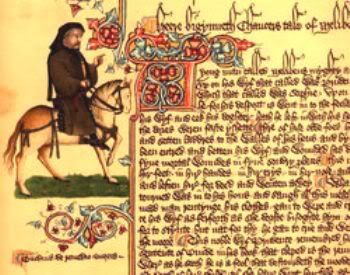
My dearest friend, R. is a poet and a scholar. He was the perfect companion when A. & I took our one and only trip to date to Europe. While A. went sporting on Saville Row, my friend R. and I haunted the bookshops. While A. inspected the tomb of Queen Bess, R. stood with me elsewhere in the Abbey and looked with wet eyes at the tiny box said to hold the bones of the founder of our literature. More than once he has tried to make me see all the good in Geoffrey Chaucer. From memory, R. can recite, in what I assume to be a perfect, burring rendition, the famous prologue:
"Whan that Aprill with his shoures soote
The droghte of March hath perced to the roote,
And bathed every veyne in swich licour
Of which vertu engendred is the flour..."
I have tried before, but never managed Chaucer in any but the Tales done-over by Dryden and the flat prose of a "Chaucer for the modern reader." R. looks at me with pity from the photo above my desk as I confess this.
From the ongoing slaughter of innocents which is the February clearance sale, I just today rescued what I suspect to be a treasure. A New York Times obituary dated only May 11th, 1994 tells me that biographer and children's writer and illustrator Marchette Chute died that year at 84. She seems to have few other references made to her online, other than notices of her books for sale, and various genealogical tracings -- she came of a clan of writers and scholars it seems. I can find no photograph. In my hands tonight though I hold Geoffrey Chaucer of England, written & illustrated by Marchette Chute. Priced at only $3.99 for a good, clean hardcover, this book went unclaimed on our shelves for the better part of two years. Well, I decided to take Marchette's Geoffrey home with me tonight, based on it's attractive and well preserved dustjacket, illustration by the late Mz. Chute, and on the footnote quoted in today's Daily Dose. This was Chute's first biography, published in 1946. My copy is a twelfth printing, from November 1966. That says something more for the book, that twelfth printing, nearly twenty years after it's first publication. Many years ago, caught without another book on a trip, I bought a tatty paperback of Ben Johnson of Westminster by the same author for, as I remember it, fifty cents. It was a delightful book; soundly reasoned, lively and well written, popular biography as it was once written for the common reader. I read more Ben Johnson than I might ever have done otherwise because of that good little book.
"When Geoffrey's father, John Chaucer, was not yet fourteen, he was kidnapped by his Aunt Agnes." That being the first line of Chute's biography, I realized on reading it that I had found again an old and trustworthy friend.
Perhaps the late Marchette Chute can do what sweet R. has for so many years failed to do and bring me before Chaucer's tomb with something more than respectful silence. Perhaps a biography, written when narrative need not be sacrificed to theory, or history told without a smile, a biography snatched at the very last before clearance and disappearance, may bring me back to Chaucer. If she succeeds, R. will be, I know, so happy for me.
Daily Dose

From Geoffrey Chaucer of England, written & decorated by Marchette Chute
A FOOTNOTE
"To say that Chaucer's work does not scan is the equivalent of saying that Pope was careless when he rhymed 'join' with 'divine.' Pope was never careless. It was the growth of the English language that betrayed him when 'join' was no longer pronounced 'jine.'"
Subscribe to:
Posts (Atom)