Showing posts with label Guy de Maupassant. Show all posts
Showing posts with label Guy de Maupassant. Show all posts
Thursday, December 15, 2016


Tuesday, February 16, 2016

Wednesday, September 2, 2015
B&N

Montaigne calls it, "the most fruitful and natural exercise for our minds," and goes on to say, "The study of books is a languishing and feeble motion that heats not, whereas, conversation teaches and exercises at once."* Close as I'm likely to come to exercise or a classroom then.
As booksellers, all but the most practical parts of our job: shelving books, ordering books, ringing up books at the cash register, are to do with making conversation. Selling books is a talker's trade. I've known some perfectly lovely people; intellectual, diffident, bookish, who weren't much at selling books. Good at other things, necessary things, but disinclined to say much. The idea of a bookstore job appeals to the introvert. Must be lovely, reading all day, seeing all the new books as they come out, wandering the quiet aisles with a cart. I've heard the same said of libraries, by people who've never worked in a library. Then comes the Holiday trade, or the fifteen minute phone-call with a lady who liked Donna Leon but can't remember what she's read, the aunt convinced that her seven year old nephew is a genius and ready for "something more substantial." Nothing for it but listening -- the better part of conversation according to more than one famous talker** -- and then finding something to say. Bookselling is more questions than answers mostly, but Heaven help the bookseller with nothing to say.
A good part of what we do is talk amongst ourselves. This can look suspiciously like idle chatter, because that's what it mostly is, but it is also part, and quite an important part, of the business of selling books. I don't read what you do. I don't know much about travel, or sports, popular music, raising puppies, contemporary Scandinavian mysteries, cryptozoology, children's books, pie-baking, middle eastern languages. Sports, did I mention sports? What I don't know, let me tell you, I could write a book on what I don't know. Somebody does. Somebody knows. We get lucky, that somebody is on the Information Desk the same time I am, somebody walks up and asks about baseball, or football, or golf, soccer, lacrosse, marathons, fishing, bowling. (I include fishing because I know nothing beyond Izaak Walton and Tom Sawyer and I'm pretty sure there's something called "sports fishing," or did I make that up?) We talk amongst ourselves. That's how someone like me knows who Peyton Manning is, roughly, or why Chloe Sevigny should have a new book of photographs, though I couldn't tell you if she took any of the pictures in it. How I heard about Gone Girl before it was published. How I heard about coloring books for adults before we had dozens upon dozens of grown-up coloring books from which to choose.
For almost a decade now I've been having a regular conversation, every Thursday -- baring illness, vacations and the like -- with Nick DiMartino. Nick's worked at the University Book Store since the first Nixon administration. Nick reads the way alcoholics drink. You can learn a lot from Nick. I have.
A year ago I started recording our Thursday morning conversations. After much struggle and the help of younger persons, I learned how to edit our conversations on my home computer and post them as podcasts to Soundcloud. We've recorded more than forty of these to date, more than forty Breakfast at the Bookstore with Brad and Nick. We'll do another come Thursday.
In the course of the year Nick has talked his way from Archipelago Press to Zola, from Arctic Summer, to Tales of the City, with a surprising number of stops in Catalonia, and a good part of the year spent in The Neapolitan Novels of Elena Ferrante. Meanwhile, I've gone from the Battle of the Plains of Abraham and the conquest of Quebec to the court of Queen Anne. I've made projects of Parkman, Cowper, Carlyle, Scott, and now Swift. There've been comics and comic novels on the breakfast table between us, history, biography, movie stars and muck, and loads and loads of translations throughout.
 We've had on librarians, fellow booksellers, a publisher's rep., and poet.
 And always, or nearly always, there's been at least one Lucky Lou's maple bar for Nick, though these seldom last the length of the conversation.
All in all, it's been a good year for us, the bookstore, the podcast, and books. We've heard from regular listeners at other bookstores, from a nice fellow in Mumbai, and from old friends and new across the country and the continent.
That would seem to me to be the point. Maupassant somewhere calls conversation "the art of never seeming bored, of touching everything with interest," and so we seem to do, despite or perhaps because of our very different reading. It seems we've succeeded at least to the extent of extending our conversation to include people we've never met in places we've never been. That's what good booksellers do, or try to, every day. This is just our latest effort.
It wouldn't work without Nick. He's the magic of the thing. There are few people with a greater enthusiasm for literature, for life, than our Nick. It would be all well and good for me to just gas on about the old, dead darlings of English Belles-lettres -- like I do -- but without Nick there to exclaim, "Really?!!", to change the subject and say sensible things in the face of my all-too-predictable outrage at nobody reading Charles Lamb nowadays... well, it wouldn't be so much a podcast as something to avoid at the bus-stop. "Oh, God. It's that guy who reads 'Froude.'"
As it is, our conversation would go on anyway, but then, we're old friends. Now it seems we've made more.
To those that do, thanks for listening. Start your own conversations too, come to that. The more we talk books, the better some of us like it. So, let's keep the conversation going, and as one or the other of us invariably says each week, "keep reading good books."
* Charles Cotton's translation.
** “The art of conversation is the art of hearing as well as of being heard.”-- William Hazlitt, himself no small beer as a talker. See, Table Talk.
Saturday, August 22, 2015
Daily Dose

LUNCH
"Lunch lasted an age, and they made a separate meal of the crime."
From The Little Roque Girl
Thursday, October 10, 2013
Daily Dose

OFTEN
"Often he had felt the tenderness of woman attached to himself, and although he knew himself unassailable, he became exasperated at this need of loving which trembles always in their hearts."
From Moonlight
Wednesday, June 6, 2012
Daily Dose
 From Bel Ami, or The History of a Scoundrel, by Guy de Maupassant
PARIS
"In Paris, it is better to have no bed than no clothes."
From Chapter One, Poverty
Wednesday, July 13, 2011
Daily Dose
 From Letters of Max Beerbohm, 1892 -- 1956, edited by Rupert Hart-Davis
ONLY ONE
"There seems to me to be only one good method of narrative -- Homer's and Thackeray's method, and Tolstoi's, and Tom's, Dick's, Chaucer's, Maupassant's, and Harry's; all of them very different men spiritually, and employing the method in very different ways, but not imagining that a new method is needful, or couldn't be unhelpful, and wouldn't certainly play the deuce and all, in its own time, and might by dint of various alterations and improvements become a sure and shining instrument in the hands of the Hereafter."
From a letter to Virginia Woolf, dated Villino Chiaro, 30. December, 1927
Tuesday, September 28, 2010
"ventre de bische!"
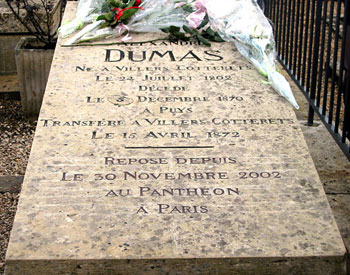 And so, all good things must come to an end. Damn it. Despite various diversions, interruptions and other, more pressing demands made on my reading, I've done the last page of The Fort-Five. I did not want the book to end. I could just pull another volume from my shelf of Dumas, and go on, and I will, but not yet. One of the best things about acquiring old books not individually, but in these great, neglected sets: no mater how long one has owns such a thing, no matter how much one has already read, it seems there's always another, and another, and yet another volume as yet unopened, the pages yet to be cut. If used judiciously, my shelf of Dumas, with my shelf of Scott, my shelf of Guy de Maupassant, my shelves of Dickens, etc., should see me through to whatever end I come. Were I to lose every other book I own, and be left with just my sets, -- heaven help me -- I might read away the rest of my days. (I'm greedy though, and wouldn't like to think I might not always add to what I have. I'm inspired by one of our regular customers at the bookstore where I work; an old gentleman, quite bent, who must balance his acquisitions on one frail arm so as to have the other free to use his stick. He shops and buys our used books nearly every week, buying history, and fiction, and whatall by the basket. Just the sight of the dear man gives me hope.)
 One can never really come to the end of Alexandre Dumas. Obviously, I'll read The Count of Monte Cristo again, but even if I didn't, there are so many other Dumas novels, and so many I've yet to read, or reread. Whatever else might be said of the old boy, good and bad, there will always be another Dumas. That, of course, is one of the reasons for the failure of his reputation: he wrote too much, or rather, he put his name to too many books, whether he wrote them, in the strictest sense, himself or not. Dumas worked from collaborators outlines, wrote up what others wrote for him first, did not always acknowledge what he used, and so on. Who cares? Matters now only to scholars and fussbudgets, frankly. And Dumas' work can be uneven, tedious at stretches, ridiculously plotted, even sometimes silly. What of it? Is Balzac any less bombastic, any less dependent on coincidence, etc.? Not everything from the pen of either Frenchman's a masterpiece, but then, who else wrote so much so well, and then who wrote only masterpieces? Name one major author without minor work. Besides, I've always been fond of my favorites even in their minor turns. Half a Dumas might yet be better than none, or a whole Scott, in some books, for that matter.
Another reason he came so late into the Pantheon? Dumas wasn't important. Sounds silly, but that argument's been made. Dumas might have given us immortal fiction, his Edmond Dantès and his d'Artagnan might be better known and loved than any other characters in the whole history of French literature after Gargantua and Pantagruel, but Dumas wasn't serious, somehow. Romance was not thought the proper stuff of literature. Dumas wrote only for popularity and money. Dumas' books were the sort of thing read just by boys. It's all been said about Twain, too.
The bones of Alexandre Dumas, now however white, belonged to a man who wasn't, quite. That may well have been another reason they were left so long in a provincial grave.
"The basis of these theories was an idea which in our opinion was quite as good as any other; it was as follows: chance is God's reserve." -- That's Dumas, explaining the philosophy of Chicot, near the conclusion of The Forty Five. Dumas might have smiled to find that more than chance would ultimately determine his place in literature, and in France.
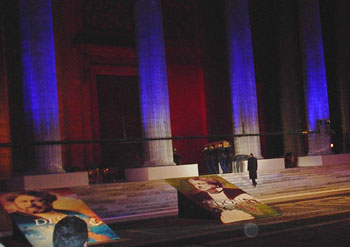
There's not, for me, much to admire about Jacques René Chirac. Had he not done this one noble thing, I don't know that as an American, I would now give the old bastard a thought, but I am grateful to him for what he did for Dumas. On the 30th of November, 2002, the then President of France brought Dumas back to Paris. Calling the great novelist one of France's, "most turbulent children, one of its most talented and one of its most creative geniuses," Chirac presided as Alexandre Dumas was reinterred in the Panthéon of Paris. His coffin draped in a blue velvet cloth on which was written, "tous pour un, un pour tous", -- "One for all, and all for one," carried by an honor guard dressed in the uniform of The Musketeers, Dumas, at last, was laid to rest with Voltaire, Rousseau, Victor Hugo, Émile Zola...
"With you, it is childhood, hours of reading relished in secret, emotion, passion, adventure and panache that enter the Pantheon. With you we dreamed. With you we still dream," Chirac said, and then bowed to Dumas.
As Dumas père himself famously said, "All generalizations are dangerous, even this one," yet some things are true, no matter who says them, and worth saying, even late.
I add my thanks again, to all the rest.
Subscribe to:
Comments (Atom)