Showing posts with label horror. Show all posts

Monday, March 21, 2022

My Monsters


“I do know that for the sympathy of one living being, I would make peace with all. I have love in me the likes of which you can scarcely imagine and rage the likes of which you would not believe. If I cannot satisfy the one, I will indulge the other.”
-- Mary Shelley, Frankenstein

I have always loved monsters. Maybe it's because my first friend was King Kong. Not the one you're thinking. My friend is fifty-six years old now, about ten inches tall, with a stout, corduroy body and a blue rubber face. His black beard is all but gone, as is his hair. He is very much the worse for wear. He came to me at Christmas. When we were both young, more than one adult took the liberty of saying that Kong was ugly. We didn't mind. I liked that he was. Still do. He was a promotional toy for a short-lived Saturday morning cartoon. I recently looked up the show online and... oh, my. But when I was three years old?  Kong was my guy. It was the nineteen-sixties. Kid's television was not a sophisticated enterprise. Even by the standard of the day though, this was a pretty poor effort. The animation's crude. King Kong was variously the size of  a skyscraper or a Mack truck, consistency and perspective not being obvious priorities in children's animation then. Evidently I loved him for all that. He was good hearted, but he could be scary. I think I kinda liked that. Looking at the cartoons now I realize that the show was designed to be as wholesome as cooked farina, despite having a a rollicking if stupid theme-song and a giant ape. Kong had top billing, but really he was just a sidekick for a stupid little blond boy who was always falling off things or being threatened by other big things and always needing a ride or to be rescued. I hated that kid. Of course I wanted to be him too. I had the same resentment of the actor who played Jai (boy) to Rony Ely's Tarzan. Little bastard got to ride an elephant while sitting in Tarzan's loinclothed lap. (It all may seem so very obvious now, but come on, I was three or four at the time.) My Kong used to have a little plastic version of this boy/friend -- blandly named Bobby Bond -- permanently attached to his arm. When he was new, Kong talked when you pulled the string in his back, or rather Bobby talked and Kong roared sympathetically. Even then I'm pretty sure this seemed lame. Let Kong be Kong! King Kong doesn't need an interpreter, or another friend. (Get lost, Bobby -- and he promptly did, as soon as I was able to pry him off Kong's arm.) No idea why they made the Kong doll blue as he wasn't in the cartoon or the movies, but I liked that he didn't look like anything real. He was a monster. Made sense. We were then always together. Where I went, he came along. Arm came off, got stitched right back on. Lost his voice? I didn't mind. Kong is a survivor. He lives with me still. Now he just sits, benevolent and silent as a Buddha, on my dresser. He wears a little blue sock-vest -- a tiny toy-truss, really -- that my mother made for him when he lost his figure and his stuffing threatened to spill. He was my first monster.  

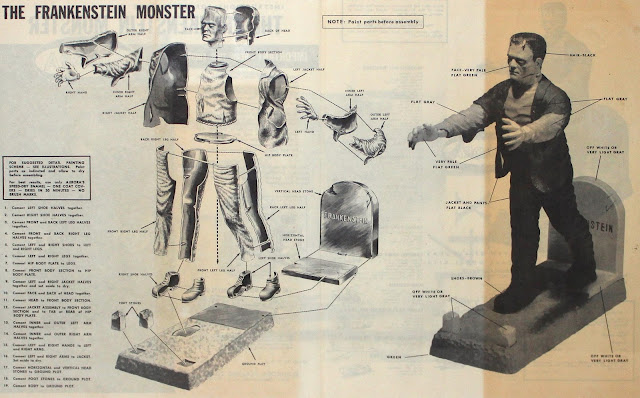
Just a few years later I was a subscriber to Famous Monsters of Filmland, had a full set of Universal Monster Model Kits that I'd assembled and painted myself, and a poster of the 1931 Frankenstein at the foot of my bed. I loved them all, my monsters, but Frankenstein's monster was my favorite. Still is. I thought Vincent Price the greatest actor of the age and counted Karloff, Peter Cushing, and Christopher Lee as among my dearest imaginary friends. I could tell you more about Bela Lugosi's filmography, and or the process employed in Jack Pierce's best make-ups, than I could about the history of the American Civil War or the illustrators of the OZ books -- with both of which I was nearly as obsessed by then as I was with horror films.

At eleven-thirty on Saturday night in those days there was Chiller Theater with "Chilly Billy" Cardille on Channel Eleven, Pittsburgh, PA. Before I was old enough to stay up late to watch horror movies, I would sometimes creep down the stairs and peer over the back of the sofa while my older brother watched House of Dracula, or The Man Monster, or Blood Sucking Monkeys from West Mifflin, etc. (In those days you watched what they ran.) Before I was really old enough to understand or appreciate the nuances of  cultural exchange, the film that scared me the worst was a fleeting glimpse of a Mexican lucha libre movie in which it was not the bloody werewolf who terrified me, but rather the leading man; a hulking wrestler who wore a skintight mask that covered his whole head. Only his eyes and mouth suggested a man under the mask. He was powerful, violent, and hyper-masculine. What made him scary though was that absent face. Otherwise he dressed like a huge but rather natty car salesman; polished shoes, golf shirts, and tailored sharkskin suits. Nobody in the movie seemed to find this sartorial combination the least bit odd, let alone disturbing. I found it unsettling in ways I could not understand or explain; so many muscles, great, hairy hands, a featureless face, such sharp creases in his slacks. And yet the leading lady clearly found him attractive, mask and all, and nobody ever told him to take it off. No one seemed to notice it. When he lit a cigarette the smoke would curl out the corners of his mask. Scared the bejesus out o' me. When I was a little older, adults regularly asked me if all these monsters didn't give me nightmares. Well, sure. The only one I actually remember giving me more than one sleepless night though was that faceless wrestler in a custom suit.

Television was all rather hit or miss in those days; three channels, four if the weather allowed, and other than Saturday nights, horror wasn't regularly featured in afternoon shows like The Million Dollar Movie. Many classic horror films I knew only by reputation. There were stars like Lon Chaney Sr.  encountered only in film-stills and descriptions in the monster magazines. I had his Phantom of the Opera as a plastic model of course, and I studied the photographs of his make-ups the way other, more pious little boys might study the face of the Virgin in a Renaissance annunciation or St. Sebastian's (ahem) wounds. I learned facial anatomy by way of drawing Chaney's Phantom and his Quasimodo, the actor's face distorted by wires and putty. I drew monsters constantly, the ones I could see and the ones I invented. One of the few drawings to have survived from those long ago days is a fairly accomplished portrait of Karloff in his famous entrance from Frankenstein. (When my father died a few years ago I found this drawing and a number of others I'd done as a child, carefully preserved in a box in Dad's closet. I kept the Karloff.)   

When I was a teenager in the later 1970s my interest in horror films waned as the genre devolved into mindless slashers with high body counts and featureless killers. I still went to those movies, everybody did, but I never loved them the way I'd loved my old black & white monsters. By then books -- including books about film -- had largely supplanted movie monsters as my primary obsession. Novels gave me monsters more complex than the staggering mummies and giant tarantulas of my childhood. Of course by then I'd read Poe, Mary Shelley and Bram Stoker, Sheridan Le Fanu, all those Hitchcock anthologies, The Monkey's Paw, Interview With a Vampire (four times in a row,) and the early Stephen King. At some point I came across Dalton Trumbo's antiwar novel of oppressive body horror, Johnny Got His Gun, and The Yellow Wallpaper by Charlotte Perkins Gillman, and Guy de Maupassant's The Diary of a Madman. I read William L. Shirer's The Rise and Fall of the Third Reich, cover to cover. I began to appreciate that horror may actually have less to do with ancient curses and supernatural visitations and more to do with anxiety, violence, and ideology. Evil doesn't require a curse or chemicals in technicolor tubes and pipettes, or the substitution of good brains for bad. (And good can come from the defiance of God.) Not all monsters are made in interesting ways. Some monsters we make for ourselves, and or of.

Can't be a serious student of monsters for long and not know that the villain is not always the monster. Anyone may prove a villain. Anyone. Monsters are made. 

Considering my age and established affection for old books, no one should be shocked to learn that I am not much of a fan of new words. The wonders of science and technology require an expansive vocabulary, and nonsense thrives on the scroobious and the runcible, but literature for adults gets largely by on what's already to hand. The answer to this is usually Shakespeare and sometime Joyce, with neither of whom am I prepared to argue. My discomfort* comes mostly from verbing, and words like "verbing,"  aka denominalization, and verbification, all of these words for rendering a noun into a verb, and all, please note, almost equally ugly. English does this easily enough, as it does most things other than spell. Most commonly you just add "ing'' and you're in, friend. I would still argue for "befriend," but I grow old, I grow old, and wear my trousers rolled. (No, honestly I do, 'cause I'm short.) It is not just the newness that makes me wince. "Hashtag" was already ugly to my ear, vaguely German, long before it was verbed (?). There is however one such word I am more than ready to endorse, though I doubt I will ever use it much myself. "Othering" seems to me an idea I needed back when my monsters came mostly in shades of gray and often had fangs. Had I that sense then, I might have understood a bit better my fellow-feeling for protagonists pursued by torch-bearing villagers. I will leave the queer theorizing to them what do it more easily than I, but indeed there was a little fairy at the bottom of our garden, Maud, and it was me -- in case you were missing this.

Later still when I took up reading not only literature and biography but literary biography, I was introduced to yet another category of loveable monsters -- the authors themselves. Not that there aren't absolutely admirable and very decent people who've written great work.  No one really has a cross word to say about Washington Irving and so far as I could tell Charlotte Bronte never hurt a fly. Harmless isn't the same as happy of course. Think of poor John Clare. I still remember the deep and abiding shock of reading a prize winning biography of a prize winning novelist and realizing that the biographer had clearly come to loath his subject. I understand getting in too deep to pull out, but that book seemed cruel. Where was the sympathy for the monster so clearly misunderstood, for the scars and the pains that made him? I had a similar experience some years later when I read a good writer's devastating memoir of a great writer who had once been a friend. In the end neither seemed a very nice man. (It was an interesting book though.) More usual was finding that even favorites were flawed in ways not anticipated from reading their fiction. Dickens did not so much end his first marriage as -- metaphorically -- set his house afire with his poor wife in it. Dear Barbara Pym, the very definition of minor genius clothed in twin-set and pearls had a dalliance among the Nazis and organized a stalking party to trace her gay neighbors' comings and goings?! Heavens, Miss Pym! The diaries of Henry Louis Mencken, the letters of Philip Larkin, there would seem to be no end of ugly, posthumous revelation yet to be had among the surviving papers of the great. The only really monstrous aspect of most writers usually is ego and that's a small price to pay, at least retrospectively, to gain War and Peace or Les Miserables. Some writers seem to have been more than man-sized, their destruction clumsy and unintended, their monstrosity strangely glorious as their intentions were probably good, or at least in noble service of their art. Writers are made just like monsters by compulsions they may never and need not understand. Real writers, great monsters, are fascinating because they want nothing so much as to understand and to be like the rest of us though they aren't. What do most monsters want? To find love, be normal, or worse comes to worst, to be left alone to talk to their maker as they drift on an ice-flow. I certainly get that. Their struggles are ours writ large. Frankly, to me at least it seems easy enough to love Balzac and Jean Rhys and even Gore Vidal now they are all safely (un)dead and cannot die.

Of villains there is no end. The world right now is over-run. Literature? I'm glad to say that genuine and thorough shits like Louis-Ferdinand Celine and Philip Roth are reassuringly rare. Real villains cannot help but gloat and glower and justify themselves despite not having been asked. No more attractive on the page than in the last reel. Other than one's own, resentments are seldom interesting and bullies are always boring when they explain themselves. (That's it? That's how you justified that nasty shit you just did?! Pretty lame, son. Time to go.) Much as we may enjoy the villain, we wait to watch him go off the side of the building every Christmas and we cheer. But, oh my monsters! Monsters are different. Monsters don't die. Some of them can't even when they want to. Villains are selfish. Monsters are cornered. Monsters are compelled, confused, cursed, more than the sum of their badly stitched parts. One might envy a villain his lair or covet his toys, but ultimately we're glad of his failure. Monsters are sympathetic in a strange way even at their worst. Might be as simple as recognition -- there but for. We've all looked in the mirror and seen a monster -- and if you haven't, guess what? You're a villain. Unlike the villain's crimes, the havoc of monsters is made for us all.

Ours is not really a time for great monsters as who has the time for all that back-story? Times are complicated. The future is uncertain. We like our heroes simple again, alas, and our villains barely animated. It's boring. Most of our monsters now are just villains in rubber masks. The masks come off in the big reveal and we've all been Scooby Doo-ed again. Not a monster, just another bad guy, and if it hadn't been for those darned kids! One grows so very tired of those damned kids. But there are still monsters, ancient and modern, and more being made if you only know where to look. My monsters hide in dark corners, covered in dust, and smelling of the tomb. It seems they've been waiting. Some of my monsters are just where I left them, quiet now as Kong, if only for the time being.  The ones I love best haunt old libraries and hide in old bookshops, but their descendants and progeny are not unknown anywhere in the wide world. There are always monsters I haven't met yet. Like still calls to like and I've only to listen. Hear them? They hector and howl and laugh at odd moments and talk to themselves, often in foreign accents. The children of the night, oh, etc. Their variety can be surprising even to those like myself who love them. To admire a monster one must try to understand its nature and yet one must be willing to accept it as it is.  I do not support the idea that monsters make for bad art, or that bad art is always made by monsters. It's the villains you've got to keep an eye on. They always lie. It's rank villainy to deny our monsters, to make men with big muscles our heroes again, and then suggest they are somehow made unhappy in the exercise of their gross power. It's a villain who describes cruelty as common, sees the weak as risible and insists that unkindness is funnier than the fall of pomposity. Villains are selfish and see no sin in this. Monsters rage at the loss of love and long for humanity and death. Good taste and happy endings have their charms, I don't deny it. So do puppet shows and Saturday morning cartoons. But so does a rude Rabelaisian belch, a roaring story, loud women, old witches, so do blood, guts, anguish, and Beckett, and maybe a sustained maniacal laugh. It is personality makes the great monster, not the cleverness of a scheme or the elaboration of a plot or perfectly articulated reasons for past bad behavior. That's all villain shit. Large or small the best monsters are more than just badly behaved, they are us. Monsters belong to us as few characters can. No one loves Dickens for his heroes. Great monsters are never simple, anymore than we like to think ourselves. Monsters are better for being wrong and righteously indignant at their cruel fate, lost and twisted, and trapped, and tragic. Face it, monsters are inherently better than any dull binary of heroes and villains (-- and that, fan-boys, is why Guillermo del Toro deserves an Oscar and the Marvel Universe can suck it!)

Right now my monsters tend to behemoths. Weird in a way, as I've never really been a Kaiju guy. (As a youth I read a crushing essay by a science writer explaining patiently how gravity would defeat most giants and I never quite recovered.) Seems I like 'em big now. Whatever the dimensions and limitations of their authors, I am now in the business of reading big books at least in large part because they big. For the neglected little gems of world literature there will always be customers, and dealers. Happy to help you to a Nina Berberova. Have you read Jenny Diski? Has a working hour passed without my having mentioned Beerbohm and a whole day gone by without Brigid Brophy? How hard can it be to convince a reader of contemporary fiction to pick up a reissued novella or to try a funny essayist when I've been doing largely that for most of my working life? I've always like short books and slight things. I've always preferred the miniaturist to the muralist, the minor to the major, a jazz trio to a big brass band. I am myself a maker of little art. So why and from where this attraction to the monstrous again? 

I need Samuel Johnson now. I need the monstrous profusion of his conversation and the loudness of his voice. I need, Sir, the rolling, sonorous wisdom of a big man of large experience and big, even brutal honesty, to stand surety against the villains. Heroes are all well and good so far as they go, and nobody is kicking Chris Hemsworth out of bed for eating saltine crackers, but I want monsters. I want a face and a soul with scars. I look around me for grotesques. I require exaggeration. The times seem to me to call for roaring. "Life is everywhere a state in which much is to be endured, and little to be enjoyed," he moaned. "The world, in its best state, is nothing more than a larger assembly of beings, combining to counterfeit happiness they do not feel, employing every art and contrivance to embellish life, and to hide their real condition from the eyes of one another," he howls and does us all rough justice. He is not always unhappy, despite his reputation, and he roars just as loud when he laughs And yet, "Human happiness has always its abatements; the brightest sunshine of success is not without a cloud." Monster.  He is right now my giant and I enjoy that he eats hugely, rudely and crushes the petty and the pusillanimous underfoot. He stands astride London, and he stoops to pet his cat. He sits loudly down to a quiet tea with the blind, the halt, the maimed, and the broken. He is grave and yet defies gravity. How not to love such a monster?

I need big books now to weight the scales against the villains. Life and more life, and death too, friends and monsters. After Johnson's wife died he wrote, "I have ever since seemed to myself broken off from mankind; a kind of solitary wanderer in the wild of life, without any direction, or fixed point of view: a gloomy gazer on the world to which I have little relation. Yet I would endeavor, by the help of you and your brother, to supply the want of a closer union, by friendship: and hope to have long the pleasure of being, dear Sir, most affectionately yours..."

Every monster wants a friend. I am glad of my monsters.


"It is true we shall be monsters, cut off from all the world; but on that account we shall be more attached to one another."

-- Mary Shelly, Frankenstein


* Also? Dropped consonants. It's impor'ant, people, you know, like the in'ernet.

Saturday, March 14, 2020

Clerihew on a Stormy Night


MARY SHELLEY

Mary Shelley
Reduced to jelly
Many a stout-hearted male
With her horrible tale.

Wednesday, December 19, 2018

A Clerihew of Hill House


SHIRLEY JACKSON

Shirley Jackson
Was somewhat lax in
Her housekeeping;
The spirit was willing, but the flesh kept creeping.

Monday, October 31, 2016

Daily Dose


From Tales of Terror and Mystery, by Sir Arthur Conan Doyle

HELD

"My heart sank within me as I saw these ominous preparations, and yet I was held by the fascination of horror, and I could not take my eyes from the strange spectacle."

From The Leather Funnel

Monday, January 6, 2014

Daily Dose

From The Sundial, by Shirley Jackson

IN ORDER

"In order to find out more clearly where she was she brought both hands to her face and first rubbed her eyes and then bit sharply on her fingers, without knowing why."

From Chapter 9

Sunday, September 29, 2013

Hannibal Conquers

Mads Mikkelsen stands like a dancer.  To be honest, I now know that he is, or rather was, exactly that.  I've just read a brief interview online.  From that I learned that he was a gymnast and professional dancer.  I even watched him dance in some obscure music video for some forgettable pop tune.  (One other delightfully irrelevant snippet of biographical information gleaned from that interview, he met his wife, a gorgeous choreographer named Hanne Jacobsen, when he was on the line -- in drag -- in La Cage aux Folles.  Loved that.  Wish there'd been pictures.)  That he was a dancer explained something I'd noticed watching him play the eponymous Hannibal, in the exquisitely realized television prequel to Thomas Harris' novel, Red Dragon.  Mads Mikkelsen has heavy hands.  It's something I noticed in male dancers back when I knew a few in college.  Their hands tend to hang.  There's nothing ugly about it.  Perfectly natural, that a person's hands should just hang there when not in use.  Actually, like nearly everything else about him, Mads Mikkelsen's hands are quite beautiful: strong, long and lean, beautifully balanced.  An actor's hands can be fidgety; always after business, even if it's just being thrust awkwardly into a pocket.  Dancers seem to know something most actors have to learn; how to be still.  Mads Mikkelsen knows how to be still.  Look at his hands.  Fits.

He is a quite beautiful man.  That doesn't square with the character we know.  But then, there's something a little off-putting in how pretty he is.  There is an almost too perfect symmetry to Mikkelsen's face and form, so that full on, face forward, all that sharp bone, all those broad plains, squared shoulders and straight long length of limb can make him look almost weirdly... even, like someone standing with his nose too close to the line of intersection of two mirrors.  Look closer though and there's one long lid lower over one lovely eye, and the pretty mouth twists a bit when he speaks.  And, again like a dancer, he makes angles, standing or sitting; his postures are dynamic, still but not static, one shoulder leads, or a knee, his head tilts away from a level gaze, his chin drifts up when he listens.

I'm probably talking the most awful nonsense about all of this, I know, but I must admit, I've been studying him.  What I particularly noticed, watching the whole first season of the new television show at a go, was the way this new Hannibal Lector stands still, the way he sits, and yes, the way his hands hang.

In his playing Hannibal Lecter, there is a a deliciously subtle theatricality, a studied, balletic economy of movement to the way he delicately adjusts the parsley or wipes a spot of au juice from the edge of serving dish.  This can be wryly funny -- considering what the audience has been led to believe is likely to be on the  menu. It isn't overdone.  It doesn't look camp.  Instead, I'm reminded of watching Chaplin, another great dancer, playing his Bluebeard, Monsieur Verdoux, as he measures out a length of rope or tops up his wife's Bordeaux with a dram of poison.  It's all precise, even elegant rather than prissy.

You will remember that in the 1991 film, The Silence of the Lambs, when we first see the great Anthony Hopkins' Dr. Lector, he is standing stock-still in his cell, ramrod straight, his hands at rest at his sides.  He does not blink.  (His first recorded gesture, wonderfully, is to lick a finger and smile before turning the page of the survey he's been asked to read.)  Throughout the first half or better of the film, indeed until and even in the middle of that final, brutal burst of ferocity when Lecter kills his guards, Hopkins, when not actually restrained, barely moves.  Instead,  his performance relies on the Jonathan Demme's shockingly intimate close-ups, his face a mad sort of mask.  And then there's the great British actor's traditional first-fiddle; that rich and wildly various voice.  With that exceptional instrument, Hopkins makes the most beautiful music; from the low, lulling familiarity of a whispering lover, to the bombastic and implacable command of the megalomaniac.  It is an indelible performance; a study in economy and at the same time, the most perfect, delicious ham.  I've watched the movie a dozen times, at least.  It is the greatest American horror film since The Exorcist, one of the greatest of all time, and Hopkins created the greatest film monster since Christopher Lee's Dracula.

When the slick promos for the new television show started last Fall, I was dubious, at least in part, because of my loyalty to Hopkins' performance.  I've read all of Harris' novels.  I enjoyed all the Lecter novels, good and bad.  I may be one of the few people who actually enjoyed the way the novelist, if alas, not the filmmakers, resolved the story of Lecter and Clarice.  I watched all the movie sequels too. That last movie, without Hopkins -- what was it called?  Little Hannibal and How He Grew? Hannibal Riesling? Anyway, that one all but proved it -- the wonderful Brian Cox in Manhunter aside -- Hannibal Lector was Hopkins' forever after.  Pretty was not the point.  Gaspard Ulliel was and is quite a handsome little fellow, but as the young Hannibal Lector, he was about as frightening as pretty little Ben Whishaw in Perfume: The Story of a Murderer, which is to say, not at all (and Ben Whishaw, bless him, can at least act.)

I already knew Mads Mikkelsen from at least two very good movies, Casino Royale and Flame and Citron, and two not very good ones: a disappointing The Three Musketeers from 2011, in which he at least was well cast as Rochefort, and a wonderful, hot-mess of a Norse epic, Valhalla Rising, in which Mikkelsen played a warrior rather unimaginatively if accurately named "One Eye", from 2009.  A pretty varied resume -- except for the weird recurrence of eye-trouble (A patch as Rochefort in the Musketeers, the aforesaid singularity in the epic, and a milky eye that teared blood in the James Bond outing.  Strange, but maybe some instinctive attempt to break up that beautiful, uncanny face of his.)

None of this however led me to expect much good to come from his casting as Lecter, for the reasons explained above. Frankly, I thought it a little mad for anyone to take up the role after Hopkins laid it down.  The idea of a television version seemed specially foolhardy.  Weekly Lector?  How was that supposed to work?  Hopkins, in the three movies combined, probably logged less screen-time than any famous monster in film history since the cat in Val Lewton's Cat People.  Hannibal is as much remembered and referenced as seen, even in Harris' novels.  Best way, really, with monsters.  Worked for Bram Stroker too.  Too much with us and the monster descends from the supernatural to the merely grotesque, or worse, the ridiculous -- think Godzilla.

Hopkins was 54 when he first played Lector, 65 by 2002's Red Dragon.  Despite a rather obvious girdle and a lot more makeup, Sir Anthony was frankly too old that last time.  (He was not helped by that horrible short ponytail in the flashbacks.)  Didn't matter.  Even if his portrayal had gone a bit too camp by then, Hopkins still was Hannibal and it was good to see him again.  Remember, Brian Cox was only 40 when his Hannibal premiered in 1984's Manhunter.  Mikkelsen's 48.  There's hint of grey at his temples, and the lighting and the color tends to emphasize every little wrinkle at the corners of  his eyes, but he does seem considerably younger than either of the British knights.

So how has he done it, this lovely young Dutchman, how has he won my heart, as it were, playing Hannibal Lector?

First, there's Bryan Fuller, of course.  His show is gorgeous, beautifully shot and designed to a fare-thee-well.   His premise is clever, setting his show before Lector is caught, everything moving toward that known point.  The writing is clever in so far as it satisfies the viewer already familiar with the material without sacrificing episodic narrative just to set off fan reactions.  He's a clever, clever fellow.   The overly elaborate, invariably ritual murders are absurd, but nightmarish rather than silly, and always framed within the already exaggerated, not to say gothic unreality of Harris' original fantasy.  (Unlike Demme or Manhunter's Michael Mann, Fuller, like Harris, is all on the side of the monsters.  Maybe it's the liberation of not answering to either the expectations of a cinema audience or a movie studio, but there is no bright corner in this tale, the FBI being just one more saturated blue basement here, and no heroes, only contesting crackpots of varying mental and moral instability and attractiveness, sometimes from episode to episode, or even scene to scene.)  I am by no means a Fuller fanboy, but I do think he's found the perfect playground here for all his most harmlessly macabre preoccupations, and without that rather cloying note of life-affirming whimsy that tried so desperately to win our hearts in early ventures, shows I did nonetheless enjoy, like Dead Like Me and Pushing Daisies.

And then there's Hugh Dancy in his underpants!

Don't know why I didn't mention this before.

Hugh Dancy in his underpants!  Pretty much every episode, Hugh Dancy, as "special investigator, Will Graham," wanders helplessly dreaming into the road, onto the roof, into the woods, in his night-dress, i.e. a tight T-shirt and boxers so snug they might as well be briefs.  And he sweats.  He sweats a lot.

Sweet.

Hugh Dancy is actually a charming and accomplished young actor, and really, it's his show.  As written, he's as close as Fuller comes to a hero here -- better say, protagonist -- but the character is beyond a mess.  Every week, Dancy has to act up a storm of crazy, sick, hallucinating, furious, perverse, murderous, goodness.  That he does so episode after episode, and with the like of the now truly Wagnerian, not to say Wellesian Laurence Fishburne as his nominal boss, "special agent in charge, Jack Crawford," is a credit to both actors.  (And remember, at least once an episode, Dancy has to do this, in an American accent, in his underpants, often as not with either a pack of rescued dogs around him, or with a CGI stag ((don't ask.  It works.)))

Truth be told?  Any other show, I'd watch just for Hugh Dancy the hot somnambulist.  That said, none of this rich, atmospheric, meaty goodness would work were it not for the cold dark heart at the center of it all, Mads Mikkelsen's Hannibal Lector.  Without this actor as that character, this would basically be just a rococo CSI: Baltimore.  (It is a mark of Fuller's hit and miss style of arch, television-generation-nostalgia that his most recent, other broadcast project was the well intentioned mess, Mockingbird Lane.  Didn't see it?  I did.  It was The Munsters without the comic wonder that was Fred Gwynne.  Barely made it through the pilot before that one got shit-canned.  Jerry O'Connell is a dear -- and I certainly wouldn't mind watching him wandering around in his underwear, but Fred Gwynne can rest in peace.  Herman Munster is not to be duplicated.  Casting is all, people.)

Mikkelsen has been given a nearly impossible task here.  Without betraying either Harris' original monster, or our all too vivid recollection of the supreme achievement of Hopkins' screen incarnation, this television Lector has to believably occupy the same psychic space in a much smaller frame.  Fuller had the genius to see that he could, by being so beautifully still in the midst of all this lugubrious mayhem.  Here, the mask is all.  Hopkins could wrinkle and wink and fill the screen with huge, mad eyes.  The preeminent voice of his theatrical generation, he could use every villainous tone, every sibilant hiss and fast fall from high to low, from intimacy to indecency, to convey both the depth of the character's depravity and his command of the stage, even in a straight-jacket and hockey-mask, while strapped to a dolly.  Mikkelsen's is the voice of calm reason here.  Everywhere around him there is a truly theatrical madness; blasting shotguns and flayed flesh, bloody shock and violent weirdness. He must compete for our attention with voices as rich as Fishburne's thunder, and as plaintive as Dancy's thready tenor, perpetually at the point of snapping.  It is Hannibal, wonderfully, who is really the way in for us, the quiet voice we trust, the calm presence who makes us dinner.

It simply wouldn't work with anyone less physically confident, less supremely commanding in every scene.  It does work because of the placidity of that pretty face, that handsome mask, tilting back just enough that we get a glimpse, here and there, of those empty eyes.

(One last bit of perfect casting to mention.  In an original twist, there is the equally pale presence of the reliable Gillian Anderson in a recurring role as Lector's own mysterious shrink, the delightfully named "Dr. Bedelia Du Maurier."  Her scenes with Mikkelsen are studies in underplaying to the point of almost suspended animation.)

Because this is Bryan Fuller's show, it is also about the gayest thing on television now.  I dearly love the truly lunatic fun of Ryan Murphy's nut-bar treat, American Horror Story. But in addition to all the aquarium colors, and the set-decorated kills, what Fuller's show has over the most obvious competition for the title is (wait for it)  the best gay love triangle on TV.  Fishburne's big, withholding FBI daddy is actually something of a stalking horse here, but the overtly sexual satisfaction Mikkelsen's Hannibal takes in stealing the troubled, juvenile beauty, Dancy from him is an almost pornographic pleasure.  Remember how good-looking these three actors are, (and rather sadly, how predictably negligible the female competition,) and Fuller's less than subtle suggestion of something queer down Quantico-way makes Hannibal, the television version, something to watch in the dark for reasons other than aesthetics or chills.  Every time Fishburne pushes Darcy "beyond his limits" at a crime-scene, there's a sadism to it more redolent of leather than forensics.  Darcy's poor Will turns invariably to Mikkelsen's Hannibal for comfort right after.  Hell, the boy faints dead away more than once, only to awake all but in the arms of his dangerous, dancing doctor.

The show has been renewed for a second season.  I can't wait.  When we last left him, poor Will was in a dungeon.  Hannibal was even allowed a wicked little smile, from the other side of the bars.

Sunday, April 28, 2013

Quick Review

Been having some interesting conversations in the bookstore lately about genre.  One of the great benefits of working in a large store has always been the diversity of the staff; a lot of people means a lot of very different reading, among my younger coworkers specially.  There are unapologetic fans of everything from poetry to mysteries, and, as one might think in a bookstore with the best selection of Science Fiction in the region, more than a few enthusiasts and students of everything from classic space operas to the most cerebral of "speculative fiction."  Beyond the obvious retail utility of all these opinions mixing, it is refreshing to hear so many readers open to other people's recommendations, and recommendations from outside the membership, as it were.  As the traditional, now all too last-century, divisions of genre have been breaking down, and literary fiction becomes less and less a matter of critical and or academic canon,  it can be rather thrilling to hear, for example, from a fan of Aimee Bender why a fan of the weirder works of Joyce Carol Oates -- me -- might enjoy The Girl in the Flammable Skirt -- which I very much did.  Is there anyone still who would dismiss either writer as a "horror writer"?

I want to say a word though in defence of genre.  Even as contemporary, fine artists continue to explore and mix the pop and the respectable in ever new and interesting ways, there's something to be said for those who can craft a well-made, satisfying, entirely conventional object.  Not every chair needs less than four legs, not every thing needs to be new.

When I was a boy, my graduation, if you will, from little kids' comic books -- Little LuLu and Scrooge McDuck and the like -- wasn't so much to super hero books, which always rather bored me, though I read them, but rather to horror.  I loved horror movies.  I loved horror comics.  I'm just old enough to have caught the tail of the last silver age of horror comics.  The still shocking productions of the Fifties; full of the most graphic gore and violence, had already been suppressed,  but there were still amazingly clever artists and writers producing wonderfully twisted stuff.  I couldn't get enough of it, in part at least, I should think, because my mother, bless 'er, found the lot of it repugnant.  "What," she used demand with appropriately Victorian gestures of dismay, turning from Tales of the Crypt, "what appeals to you in that nasty stuff?!"  Exactly.

I won't review the whole history of the form.  Another day.  I will say that at nine, I did not really appreciate the more Hitchcockian stories of murderous infidelity and revenge.  I liked monsters: bloodthirsty, fiendish, deformed, and yes, now and then, misunderstood -- though I had yet to have much appreciation of satire, or comedy in general, so I did not like trick nightmare awakenings, joke endings and the like.  I liked monsters with consequences, and threatening mystery.  Still do.  (Though I like to think I've grown into a sense of humor.  Little boys can be so very serious.)

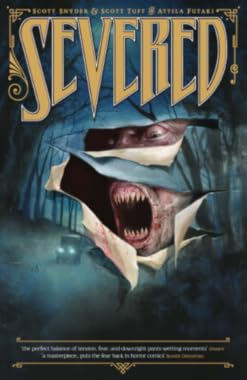
I very seldom read comic books as-such anymore, at least not by the issue, so I tend to only come across new things when published in book form.  Thus the new-ish book from Image Comics, Severed.  Everything about this one immediately appealed to my vestigial nine-year-old-boy: from the title to the design, even to the wonderfully familiar trick of the monster peeping through the shredded cover.  Yeah!

The book itself did not disappoint.  Written by two Scotts, Snyder & Tuft (sounds like a forgotten vaudeville "Dutch" act,) and handsomely drawn by one Attila Futaki, this is the best of what fidelity to form can do.  I was put in mind immediately of the best remembered monsters of my childhood.  What's different about this is the time clearly taken, and the care.  There is a visual lavishness, an attention to detail and pallet, and a more leisurely, or better, a more cinematic pace to the frights that tells of a labour undertaken from love, for the pure pleasure in making a thing well, rather than to a deadline or just as a job of work.

The monster here is likewise a familiar enough fellow; the friendly adult who actually means to eat you up -- think Hansel & Gretel, by way here of Hammer Studio.  There's a classic framing device and most of the story a remembered nightmare from childhood.  (I won't spoil the pleasure of the thing for anyone by noting too the absolutely correct and suggestively indefinite ending.)

A very professional job, this, and happily so, though improved, as I've said already by the entirely modern resources of enthusiastic young artists paying tribute to the horrors of a bygone time.  (Even the historical setting in a pre-electronic age, but in a time not so remote from modernity as to indicate the traditional, and safely remote fairytale was a perfect choice.)

I might cavil here or there with the unwelcome reminders of the original, serial  publication; the time taken by the monster with our protagonist feels a bit unjustified by his talents and charms, the necessity of stepping behind a curtain more than once to make what is pretty much the same shock as the last time, but this is quibbling  stuff.  The shocks are good ones and as satisfying as a familiar roller coaster.

What I like best here is the very avoidance of unnecessary and self-conscience explanation or fustian myth remaking, or sneaking parody.  (Fantasy as genre has much to answer for, and not the least of it, the grinding anthropology of begats and back-stories.)  I also hate winking.  This is the thing well done, and without irony, or embarrassment.

for all my enjoyment of variation and innovation, for genre-flipping and commentary, there is nothing better, when the night is coming on, and the window's open to let in the air and the dark, than a well-made monster before bedtime.