Showing posts with label Ira Gershwin. Show all posts

Saturday, August 21, 2010

Back to Heaven Again: Wesla Whitfield Sets the Standards

I have a coworker as fond as I am of making lists. These aren't "to do" lists. I make those too, though I've seldom managed to do much with such a list before I misplace the note. But I've always kept lists, in one form or another, of things like the books I've read or want to read, the movies I want to go see or rent, what cities I would visit if I could. Mostly though, I make lists of favorites. Making and keeping such a list, or just finding an old one in my files, can clarify, if just for the minute or two it takes to make one, or to read an old one, just where one stands or once stood on a given subject. (Finding a very old list among the childhood papers I recently brought back from storage at my parents' house, I I'm reminded that at twelve, for example, I listed, among the potential rewards of wealth and fame, "getting to kiss Leif Garrett," -- an ambition long since abandoned without regret. Tempus fugit.) But most lists I make; of favorite mystery novels, or out of print English lady novelists that may be reprinted on the bookstore's EBM*, I make for reference at work, and as a means to make recommendations to customers.
My coworker and I took to discussing this sort of thing now and then, when he passes on his security rounds by the used books buying desk. Most, not surprisingly, have been to do with books, but not all. Our favorite movie westerns, for example. We both put The Searchers at the top. We exchange these lists now and again, on a slow Saturday, just to amuse each other, get to know one another better, and also on the chance that one might find something on the other's list that will be new. I stumped him with one name on my list of favorite singers:
Wesla Whitfield.


I don't want to distract from the pleasure of listening to Wesla singing the Gershwins' "Our Love Is Here to Stay" by nattering while she does this so perfectly, so please, do watch the clip.

Lovely, isn't she? That's the Mike Greensill Trio she's singing with in this clip. There's quit a bit of information on Wesla and the Trio, on Wesla's website. Check it out for forthcoming gigs, recordings and the rest.

My friend at the bookstore had never heard of Wesla Whitfield. I never had either, fifteen years ago when I happened to pick up a CD called "Beautiful Love." I liked the look of her, and the playlist of standards. I didn't realize that I was going to fall in love.

Wesla's the kind of contemporary jazz singer that didn't used to be, back when jazz was the popular music of the day. She's a student of popular song, and now a master, of course. Someone like Rosemary Clooney came up as a girl singer with a band. Later in life, when Rosie made her comeback and started recording all those classic albums with Concord Jazz, there was a beautiful logic to the thing: Clooney came full circle, back to the music she'd grown up on, knew best, loved most. But for a later generation of great singers, singers like Susannah McCorckle, and later, Dawn Upshaw or Ian Shaw, and Wesla, the era of great popular jazz, of melodious ballads and swing, had already passed. For the great singers after rock & roll, after bebop, to sing these standards straight, as it were, was a very different challenge. For Clooney to sing what was after all the music of her generation was a kind of homecoming. For a singer like Wesla, a commitment to this music pretty much guaranteed a career in cabaret, little clubs, small recording labels, not being famous, study. It takes guts to sing this beautifully now.

There is a kind of studious, academic jazz, the kind of music that Wynton Marsalis has done so much to teach and preserve, that is more admirable, usually, than not. There are jazz singers, too, who obviously love this music and can sing it with a proficiency that would frankly startle many of the composers who, back in the day, were experimentalists after hours, as it were, and who, with few exceptions like Betty Carter, didn't really work all that often with truly great jazz singers who also happened to be great musicians themselves. As I said, all this is admirable, but not really my cup of tea.

The singers I love best, love the lyrics. Call them, narrative singers, for want of my knowing a better term. The Gershwin these singers love best, is Ira. Me too.

The greatest generation of jazz singers, from Billie and Ella to Sassy and Carmen McRae, however fast and loose they were prepared to be with the words they sang, when it came to the best lyrics, they respected the songs they sang. What did it really matter if Sarah Vaughan forgot the words to "Perdido," and said so, or rather sang so, in the middle of a performance? It was fun, that. But listen to her singing the Gershwins' "I've Got a Crush On You," or "Biddin' My Time," neither exactly deathless poetry, but both with clever, whimsical, sweetly sentimental lyrics, and one can hear the pleasure she took in the words. Listen to her sing one of my very favorite songs, Gershwin or otherwise, "Someone to Watch Over Me," listen to Billie or Ella or Carmen sing it for that matter, and one will hear just what could be done with a great lyric.

Listen to Wesla Whitfield sing "My Shining Hour," and see if it isn't exactly that same thrill. Like those great ladies, Wesla can sing seemingly anything from The Great American Songbook, as it's called, and make it either swing or cry, as she chooses, and sometimes do both, as only the greatest can.

Wesla understands the structure of these songs, musically and lyrically, and respects it. She can be playful, and like a true jazz singer, sing wherever she wants, behind or before the beat, in a run up or a slide down to the point in the score that she's so effortlessly working toward, but she never fails to tell the story, tell it well, and tell it right. That doesn't mean she acts. She's not an actor who sings, mind. There's an afflatus that swells into parody in a certain style of cabaret singer, an unchecked need to emote that makes every song not a story but autobiographical confession that can be embarrassing or just delightfully knowing depending on the performer -- say Liza Minnelli as opposed to Julie Wilson. These are the performers who sing, not singers as such, and certainly not jazz singers. Wesla's voice is too good for that sort of thing.

There are a few great singers, like Dawn Upshaw, who are classically trained but whose musical curiosity is such that they sing, among other things, standards. Unlike the great opera divas who have infrequently recorded the occasional stiff, grotesquely over-orchestrated tribute album to Irving Berlin or the like -- and don't get me wrong, I love me some Kiri Te Kanawa -- Upshaw has the taste and delicacy to record songs within the range of the composer's original intent; singing soft ballads softly, for instance, without threatening to blow them up. But Upshaw, though she can swing a little, has a musical reserve that can be frustrating for a jazz fan. There's always, in even her prettiest ballads, the suggestion of the recital hall, and never a hint of the tin pan, let alone the alley.

And then there's Wesla Whitfield. She's said in an interview that while she was classically trained and even sang in the opera for a bit, she found the chorus boring, and while her voice retains something of that classical purity, she's never been a prisoner of her training. As I said, she isn't really a classic cabaret artist either though. She doesn't need to have an act. She has the kind of voice she can trust, and the rhythm to back it up when she wants to swing. More than this though, she has the confidence to sing straight. She understands not just the music, but the words, and with that comes the bravery to just sit there by the piano and sing.

She's probably the nearest thing to perfect I know when it comes to doing just this. When someone suggested in an interview that she was America's greatest living jazz singer, she responded by saying that that was, not to put too fine a point to it, "bullshit." I understand and respect her dismissal of the idea. There are other singers now working within the tradition who do more; who work on the wire, as it were, and go higher, faster, or who can pull off the kind of astonishing tricks of balance and grace that can leave their listeners rather breathless with admiration. That kind of jazz singer is exciting exactly because of the risks they take. That isn't the only kind of jazz that's admirable though, or pure. There's also the music made in less likely places, little concert venues and clubs and festivals like the ones Wesla usually plays with her band, The Mike Greensill Trio. These are the quiet little spaces wherein the singer and the song are the whole reason to be there, within which one lovely voice, backed by a great pianist, a bass and drum, can remind one just what there is to love about listening to a great love song. Though sometimes she sings in bigger joints with an orchestra, and Wesla has the voice to do that superbly well too, for me, what she does best she does seemingly in conversation with only her Trio and with the great songs, and with me.

For my money, Wesla Whitfield is the best. Call what she does whatever you like. She sings. As Longfellow said of such, "God sent his Singers upon earth With songs of sadness and of mirth, That they might touch the hearts of men, And bring them back to heaven again." For me, Wesla Whitfield's singing is my idea of Heaven.

*EBM = Espresso Book Machine.

Sunday, March 7, 2010

Words Without Music

The more I read the papers,
The less I comprehend
The world and all its capers
And how it all will end
.

My preference, particularly in poetry, has always been for light books. I am grateful for every massy Oxford or Cambridge edition that can provide me with as near a complete collection of a poet's work as can be printed in one volume. When I want something from Blake or Byron, without quite remembering just what it is I want, such comprehensive volumes can be counted upon to have it, have it indexed at least two ways, and to have it whole. Hunting something online -- a misremembered title or a simple quote, a famous passage or poem -- even now can't provide quite the same opportunity to not only read but read around, rummage, read on. Questions addressed to even the most comprehensive database still require a specificity that books don't; one can't yet trust a website, even the best ones, as one still can a long dead Cambridge don, to anticipate only what may be relevant to the reader. One can get lost online in the web of connections. With a book, getting lost is still a happy accident. But even the slightest of the "Oxford Standard Authors" tends to be too weighty, with footnotes and endnotes, with indices and introductions, variants and alternate endings, with just the sheer volume of poems, to be comfortably carried on the bus.

It is widely accepted nowadays that poetry, at least such poetry as has survived the poet, is too cumbersome a thing to be carried. There is an obvious irony in this, but if only encountered in classrooms in the shape of fat Penguins or the brick-weight of a Norton Anthology, can anyone wonder that the great poets intimidate the student and the casual reader, if not by their style or themes, then by the sheer size of their "Collected Verse?" Few poets before or since Milton have assumed a reader willing to lug a whole oeuvre to lunch. The economic realities of publishing even Lovelock or Gray in anything less than a complete edition, likely to be used in a class, make most publishers shy of "selected verse." And with few exceptions such as Dover Publications, any hope of seeing a single book in the form in which the poet published it is slim.

The publishers of contemporary poetry tend to abide by the poet's wishes -- so long as the poet's alive -- and continue to produce books of a traditional length, though even these would seem to be, in a way, just the necessary preliminaries, if the poet is lucky and lives long and productively enough, to the "New & Collected" that seems to mark the true arrival of a poet as an established voice in today's diminishing marketplace. (Such collections tend to not always be all they might seem anyway, as even the slightest recycling, with additions, can be and all too often is so called. I'm sorry, but six new poems and two brief books bound together does not always a new book worth buying make.)

But there are some, admittedly often subsidized, presses still in the business of making handsome selections of poetry. If I'm going to read poetry at a bus-stop, or under a tree, or while eating a burrito, what's wanted is a book I can hold with one hand; a sturdy little thing in hardcovers, in a clear printing, that can in this way be kept out of the rain or free from splashes of hot sauce and slipped, while walking, into my pocket. I am too hard on paperbacks and don't like that sickening snap when one is held flat. I want my books to last me. I intend all my books to outlive me. The Everyman's Library Pocket Poets are ideal for my purpose. True, I've mentioned here before the frustration I've sometimes experienced in reading these when I might have need of the notes they never have, but bigger, better books can be consulted at home. For a walk on campus to see the cherry blossoms -- come too early this year and so all the more precious for being in constant danger of ruin by a return of winter -- a small book of poems is required.

For me, one of the real pleasures of the American Poets Project has been the eagerness with which the editors have embraced this principle of mobility. Unlike the editors of their more substantial sister publications in The Library of America, the makers of the more modest series have made no claim to preserving the American canon. Instead, the American Poets Project has consistently produced affordable, attractive, slim volumes of selected verse, none running beyond two hundred pages, and all of them suitable for reading on a walk or in a hammock.

In addition, each volume to date has been as likely to introduce me to poems and poets I do not know as to afford me a portable copy of them as I do. In what is their best feature, each volume is judiciously selected and edited by a writer, more often than not a poet, but as likely a biographer, not only well acquainted with the poet memorialized, but eager to find new readers for the work. The results have been consistently good; with short, clear introductions, representative, but sometimes surprising selections, and always good reading. What better way to appreciate Whittier than with Brenda Wineapple or Amy Lowell with Honor Moore? Some editors have been as surprising as their poets: Richard Wilbur choosing Poe, or McClatchy doing the selection of Edna St. Vincent Millay, happy meetings both. In at least two instances that come immediately to mind, this series has also introduced me to poetry I may never otherwise have known, and the introductions were made by trusted writers, both of whom have subsequently died. What a precious thing it seems now, to have had Thom Gunn introduce me to Yvor Winters, and the late Louis Auchincloss to show me the unsuspected poems of Edith Wharton!

I can't say that I've responded to every volume with equal enthusiasm, of course. I have a friend better-lettered in poetry who never could induce me to take up one of his favorite, Louis Zukofsky. Being a completest though, I had to buy the volume of Zukofsky published in the series and my friend may yet be shocked to learn that, yes, I even read a poem or two. Editor John Hollander's selection for his American Wits: An Anthology of Light Verse baffled me a bit, as I've never read such a book and smiled less. (Though I am still indebted to Mr. Hollander for his Emma Lazarus.)

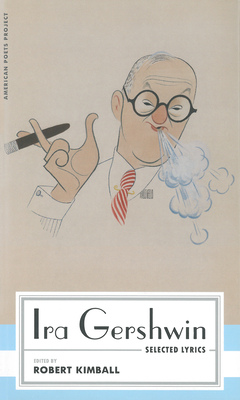
And one specially brilliant idea in this series has been to invite Robert Kimball to make a volume each of the selected lyrics of first Cole Porter, and now Ira Gershwin. Kimball is a scholar of the American musical songbook,with volumes of the complete lyrics of Gershwin, Hart, Berlin and Loesser to his credit, among other books. Such things are by their very nature unreadable as books, designed for reference, formatted to sit on a table or a music stand, to be flipped through happily, at home. But in his two little volumes to date for this series, Kimball has been given the impossible task of selecting just a few dozen of each lyricist's best. Of course there are missing favorites, and some songs included, presumably, for historic rather than artistic interest, which is a damned shame in such a narrow space, but this does not much matter as both books are full of such sparkling light verse, such wonderfully American beauties that it seems churlish to complain.

I stand more than a little amazed that so little notice has been taken, even in the bookish world, of the publication just last year of Ira Gershwin: Selected Lyrics. Think of the excuse provided for familiar quotation! (See above.) Unlike Cole Porter, who did what he did all but on his own entirely, or even who I hope will be the subject for Mr. Kimball's next contribution to the series, Lorenz Hart, Ira Gershwin tends to be remembered less well than the composer for whom he wrote some, though by no means all, of his best lyrics, his brother George. When the average person hears the name Gershwin, it is probably music that comes to mind. I don't know, from the very good joint biography of the brothers Robert Kimball cowrote, but that Ira Gershwin would himself approve that this is still so. But whatever George Gershwin's place in the pantheon of American composers, this little book of Ira's selected lyrics may be said to go some way toward recognizing an admittedly, at least in comparison, minor, but no less joyous genius in the lyrics of "the other brother."

Great song lyrics are rightly inseparable from their tunes, and I make no claim, reading Ira Gershwin's, that in some corner of my skull there is not at least a familiar, rhythmic hum. But I do not know the tunes for every piece included here, and even in the many that I know nearly by heart, there are often surprises, often in the little sung verses, that can not but make me marvel anew at Ira Gershwin's facility for deflationary wit. Witness this bit from the end of the too little sung verse from the much recorded song, "But Not For Me:"

"I never want to hear
From any cheer-
Ful Pollyannas,
Who tell you Fate
Supplies a mate --
It's all bananas!"

Or even in the second refrain of the equally famous "Let's Call the Whole Thing Off," written for Fred Astaire, there is this final twist which I find I never fully appreciated until I read it:

"For we know we
Need each other, so we
Better call the calling off off.
Let's call the whole thing off!"

Beyond the ingenious syncopation of that last, there is a a verbal sophistication that while never dependent on sophisticated vocabulary, turns with all the speed and grace of a vintage Lincoln.

That is what this little volume of selected lyrics I've been carrying around with me has made me appreciate about Ira Gershwin's, and by extension all the great American lyricists of the first half of the last century, unique contribution to American light verse; not just swing, and wit, but a very elegant democracy, an accessible yet intricate use of commonalities to express complex ideas and emotions as well as rhythms. If American popular music lost anything in the years between Ira Gershwin and Hip Hop, it was that sophistication.

I could keep on quoting, but I won't. The American Poets Project, and Richard Kimball, have made such efforts unnecessary. You've only to buy the book, and maybe Ella's Songbook, to appreciate the pleasures I've suggested briefly here.

I can't resist closing though, as I began, with one last bit from Ira, just to remind us that he wrote verses, not so much verse, though clearly, he did this better than many a more respectably literary man in something of the same line. So here, from "Words Without Music:"

"I'll hear words without music
All my life long --
Hoping, praying
That what he's saying
Will turn to song."