Showing posts with label Augustine Birrell. Show all posts

Tuesday, January 4, 2022

My Best Boswell


"It is strange that there should be so little reading in the world, and so much writing."

-- from The Life of Samuel Johnson, Volume IV, pg. 513, by James Boswell


I own four editions of James Boswell's Life of Samuel Johnson. Just the other day I put the number at three. I was off by one. Then I remembered that somewhere here I still have what can only be described as the remains of a two volume Everyman's Library from I think the 1950s. There are bits of the dust wrappers for each but the books themselves even when I bought them were in a sorry state and volume one -- it's always just volume one, isn't it? -- was defaced by the usual idiot notes and underlinings. (People who write in books! Pencil may just be forgivable I suppose, but ink? And even the smell of a "highlighter" makes me nauseous. This is the used bookseller in me, yes, but also as a reader of books largely owned by other people before me I feel I must say this flat out: I can count on just my two hands every interesting annotation I've ever read. If you write in your books then yes I am talking to you. You've done no one any favors, my dear, including you. Buy a pack of Post-It and a sturdy notebook, you animal. If you must, buy cheap paperbacks and throw them away when you are done. Corrections to the text can be useful, even amusing, if rare. I should very much, however painful, like to see Johnson's annotations in the books he mangled to make his dictionary. Otherwise? I've owned books owned before me by professors, journalists, actors, and even a respectable writer or two, and do you know what? What wasn't obvious was insipid or mean or pompous or illegible, and sometimes all at the same time. Nearly no one looks good in just their notes, folks. Once went to value the books of a reputable Shakespearean scholar, a much respected teacher of literature. Know what he wrote next to Ophelia's mad speech? "Flower image," and then he underlined that and the individual flowers! Didn't know where to look for blushing. Spare us all the embarrassment; if this is you, please see to it now that when you die your books are burned. It'll be a kindness really, to your memory and to your heirs. In short, if you cannot read without ink or remember without painting the pages of a book, you've no business owning any book worth keeping.)

It is the practice of many readers to note, in the margin of their books, the most important passages, the strongest arguments, or the brightest sentiments. Thus they load their minds with superfluous attention, repress the vehemence of curiosity by useless deliberation, and by frequent interruption break the current of narration or the chain of reason, and at last close the volume, and forget the passages and marks together." -- Samuel Johnson, Idler #74, September 15th, 1759

The three versions of Boswell that I remembered better are an Oxford Standard Authors in one bulky volume, a really beautiful big three volume club edition from the thirties, with sparse illustration and lovely wide white margins, and my favorite: Boswell's Life of Johnson, in six small volumes, edited by Augustine Birrell, from Archibald Constable and Co., LTD., published in 1904. Each volume is about four and a half inches by seven and no more than three hundred pages. Just the right size for carrying around. The print, particularly in the notes is painfully small, but clear. This set is my favorite and among my favorites generally, one of the books I most love. 

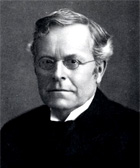
I was working as a buyer in a used bookshop when I found it. I hadn't bought the box of books it was in. It was lost in a jumble of other old and largely useless things. It was a dirty, ugly little lump, broken and battered and foul smelling. A previous owner had cut some thick plastic for covers to each volume. This had decayed and become sticky, and stinky with age. In fact all six books were stuck together when I found them. Most of the hinges were broken or breaking, and some were repaired with cellophane tape, now so dry that when the books were opened the strips crumbled and fluttered out like dragonfly-wings. I would never have paid a penny for the set, but the bookstore's owner had already marked it at $20.00 and I paid that and bought it for the editor's sake. Augustine Birrell (1850 - 1933), author of Obiter Dicta and other charming essays, was a largely unlucky politician -- Chief Secretary for Ireland -- and a gentleman of letters in the very best sense. For his sake, I decided to try to save these books. 

I managed to detach the volumes from one another and discarded the plastic jackets. I cleaned each volume as best I could. I erased the unreadable pencil notes and underlining. I pulled and picked out all of the tape. I unbent the dog-ears and I glued the broken hinges and I pressed each bowed volume as flat as I could make them under a considerable weight for a considerable time. I glued down the loose labels, even though they can't really be read, and I aired the lot in a dark dry room for some days before I even tried to read them. When I had done the best I could by them, these six little books, though far from handsome, looked about as respectable as they could be made to look. This then was the edition I read first in my thirties, then again in my forties, and read now in my fifties. It feels right in my hand and easier to read than any of my others, despite the small print. These books were made when even cheap books were better made than most new books are now. And I like Birrell's notes, and the letters he occasionally elbowed into the text, such as Johnson's last little letters to his dying mother. (An example I wish had been followed since.)

Edwardians being dreadful snobs almost to the man, they always seem to assume that the reader has at least "small Latin and less Greek," as well as French and Italian (!) but that isn't such an issue in the age of the Internet. True, more modern editions have uniformly better notes, but often too many. Birrell's introduction is all of eighteen short pages long and nearly as delightful as his longer essay on Johnson in his Selected Essays. More, Birrell is neither a bore nor a man with any point to prove. His only intent is to share his enthusiasm. (Imagine that from a professor, and who else writes introductions to books like Boswell's, nowadays!) He may not have been the most garrulous editor -- his own notes are few, fun, and far between -- but best of all he is no fool. He trusts his reader and the value of his text. In this he is not unlike the biographer himself, or his subject.

                                                                        ***

In Lichfield, Staffordshire there is a statue* of James Boswell with what, from certain angles looks to be a cabbage on his head. It's not. It's just a hat. Still, this would not have been the first suggestion that the 9th Laird of Auchinleck was himself a bit of a cabbage. His contemporaries seem to have found the little Scot more than a little absurd; nosey, pretentious, touchy, and even a bit dim. Subsequent generations of critics were not much kinder. An exception was critic Walter Raleigh (Victorian professor not Elizabethan pirate) who stated plainly that "the idle paradox that presents him in the likeness of a lucky dunce was never tenable by serious criticism..." In this estimation though Raleigh was singularly rare. Until the middle of the 20th Century and the publication of his rediscovered journals and papers, Boswell's achievement mystified most critics. How could such a little man have written such a great book? In his famous essay on Johnson, Thomas Babington Macaulay offered the following description of this pre-eminent biographer, Boswell: "That he was a coxcomb and a bore, weak, vain, pushing, curious, garrulous, was obvious to all who were acquainted with him." A generation later, critic Leslie Stephen was not much kinder: "His absurd vanity, and the greedy craving for notoriety at any cost, would have made Boswell the most offensive of mortals, had not his unfeigned good-humour disarmed enmity. Nobody could help laughing, or be inclined to take offence at his harmless absurdities." To give both their due, Stephen is also quick to point out that Boswell was always just as quick to laugh at himself, surely among the highest virtues in a man, a writer, and a friend?

Boswell's archives, including extensive journals and hundreds of letters were actually discovered packed away in trunks by his descendants and left in a hayloft in an Irish castle, of all places. Eventually donated by an American millionaire to Yale University, the publication of Boswell journals and manuscripts transformed his critical reputation. Turns out he was a far more thoughtful writer and a far greater artist than was previously assumed. He was both more flawed and more lovable than perhaps anyone but his friend Johnson ever understood.  His journals have in fact now been declared classics of English literature in their own right.

There is a frankness in Boswell that can still be startling to modern readers. Both his sex life and his ambition were revealed in new and naked detail in the journals, but so was the hard work he put into books, his real affection for his  friends, and his genuine if sometimes neglectful love of family. His Life of Samuel Johnson is in it's own way a surprisingly frank document, as well as a remarkable exercise in wholesale preservation -- Boswell never met with a scrap of paper from his subject's hand that he didn't treasure -- and justly celebrated as the supreme record of Johnson's conversation. But the biography can also sometimes be a most unflattering, hence very modern portrait. (See Johnson eating.) More though, in his great work, Boswell records nearly his own every idiocy, dumb question and many of his personal embarrassments. If in his journals this honesty rises to another level, what with all the whoring and climbing, etc., in even his Life of Samuel Johnson it is meant to feel like he's held little back. (Actually, Boswell was very careful of Johnson's innumerable vulnerabilities, and quick to find fault in Johnson's critics, and his own rivals, chief among whom Boswell numbers Johnson's much beloved Mrs. Thrale and Sir John Hawkins, Johnson's earlier friend, literary executor, and first biographer.) It would seem the very thing his contemporaries found most annoying in Boswell, his pushing personality and his persistence, proved his greatest virtue as a biographer. His style, which they could not see at all, is in his all but ever presence on the page -- a choice made much in advance of his time and still imitated down to at least the "New Journalism" of writers like Didion and Tom Wolfe, and many a nonfiction writer since. Boswell's story, his education, is the frame of his portrait of Johnson. It is Boswell who makes Johnson modern.

Hugh Kingsmill, himself biographer, journalist, and something of a wit, in 1940 produced Johnson Without Boswell. It is The Life basically with all the Boswell out of it. No harsher criticism than that, one would think. And yet Kingsmill admits himself there would hardly be enough Johnson to make such a book without Boswell. In some ways, all the modern scholarship and the publication of Boswell's papers have nearly and neatly reversed the earlier critical opinion, and now for many if not most readers, Johnson only exists to the extent that Boswell keeps him alive. Neither man deserves this. It is one of the least attractive undertakings of modern criticism, this business of knocking down and building up and then knocking down in turn. Boswell himself had no doubt of who was the greater man and writer. We needn't take him at his word, anymore than we must accept Johnson's gloomy spiritual inventories as the best estimate of his own character. Johnson did a great thing in his dictionary, as Boswell did with his biography. Johnson also wrote more and better than almost any man in his time, encouraged the best from his friends, valued the best of his predecessors, and promoted what he hoped would last in his own and other's languages. Would we now know Johnson without his Boswell? Not nearly so well if at all, and more, we might not know how to love him. As to Boswell, Johnson loved him and now we can too as few enough did before us, and as I do best in six shabby little, much repaired volumes from more than a century ago.

Call it all a rescue, a record of admiration, conversation, and the preservation of a friendship. Call it a reclamation, if not from obscurity then from old boxes and dim shelves and the dusty studies of dusty old men, and from the exclusive attentions of scholars and antiquarians. Call it an old friend in a rusty, brown suit, well met.

Boswell met Johnson in a bookstore, you know. Best way, really.


*The sculptor, Percy Hetherington Fitzgerald (1834-1925), was actually quite the fellow: a painter, biographer, journalist and regular contributor to Dickens' magazine Household Words. Fitzgerald's bust of his editor and friend can be seen in the Pump Room, Bath, and his delightfully curvy statue of Samuel Johnson in the Strand, London.

Thursday, November 28, 2019

Daily Dose


From Things Past Redress, by Augustine Birrell

BEING

"Being a ruddy, healthy child, a young Bacchus among the Baptists, and coming at the fag-end of a large family when all theories of education and of tremendous parental responsibility were either exploded or forgotten, I had an easy, perhaps too easy time."

From Chapter Two, Boyhood

Wednesday, November 6, 2019

Clerihew For a Gent. o' Lettres


AUGUSTINE BIRRELL

Augustine Birrell,
When the ministry fell,
Returned to the presses
With Essays and Addresses.

A Caricature


Monday, March 14, 2016

Daily Dose


From Obiter Dicta: Second Series, by Augustine Birrell

BOSWELL'S BOOK

"Boswell's book is an arch of triumph, through which, as we read, we see his hero passing into eternal fame, to take up his place with those --

'Dead but sceptered sovereigns who still rule
Our spirits from their urns.'"

From Dr. Johnson

Tuesday, October 15, 2013

Augustine Birrell's Essay on William Cowper

WILLIAM COWPER


The large and weighty family of Gradgrinds may, from their various
well-cushioned coigns of advantage, give forcible utterance to their
opinions as to what are the really important things in this life; but
the fact remains, distasteful as it may be to those of us who accomplish
the disciplinary end of vexing our fathers' souls by other means than
'penning stanzas,' that the lives of poets, even of people who have
passed for poets, eclipse in general and permanent interest the lives of
other men. Whilst above the sod, these poets were often miserable
enough. But charm hangs over their graves. The sternest pedestrian, even
he who is most bent on making his inn by the precise path he has, with
much study of the map, previously prescribed for himself, will yet often
veer to the right or to the left, to visit the lonely churchyard where,
as he hears by the way, lie the ashes of some brother of the tuneful
quill. It may well be that this brother's verses are not frequently on
our lips. It is not the lot of every bard to make quotations. It may
sometimes happen to you, as you stand mournfully surveying the little
heap, to rack your brains unavailingly for so much as a single couplet;
nay, so treacherous is memory, the very title of his best-known poem
may, for the moment, have slipped you. But your heart is melted all the
same, and you feel it would indeed have been a churlish thing to go on
your original way, unmindful of the fact that

    'In yonder grave a Druid lies!'

And you have your reward. When you have reached your desired haven, and
are sitting alone after dinner in the coffee-room, neat-handed Phyllis
(were you not fresh from a poet's grave, a homelier name might have
served her turn) having administered to your final wants, and
disappeared with a pretty flounce, the ruby-coloured wine the dead poet
loved, the bottled sunshine of a bygone summer, glows the warmer in
your cup as you muse over minstrels now no more, whether

    'Of mighty poets in their misery dead,'

or of such a one as he whose neglected grave you have just visited.

It was a pious act, you feel, to visit that grave. You commend yourself
for doing so. As the night draws on, this very simple excursion down a
rutty lane and across a meadow, begins to wear the hues of devotion and
of love; and unless you are very stern with yourself, the chances are
that by the time you light your farthing dip, and are proceeding on your
dim and perilous way to your bedroom at the end of a creaking passage,
you will more than half believe you were that poet's only unselfish
friend, and that he died saying so.

All this is due to the charm of poetry. Port has nothing to do with it.
Indeed, as a plain matter of fact, who would drink port at a village
inn? Nobody feels a bit like this after visiting the tombs of soldiers,
lawyers, statesmen, or divines. These pompous places, viewed through the
haze of one's recollections of the 'careers' of the men whose names
they vainly try to perpetuate, seem but, if I may slightly alter some
words of old Cowley's, 'An ill show after a sorry sight.'

It would be quite impossible, to enumerate one half of the reasons which
make poets so interesting. I will mention one, and then pass on to the
subject-matter. They often serve to tell you the age of men and books.
This is most interesting. There is Mr. Matthew Arnold. How impossible it
would be to hazard even a wide solution of the problem of his age, but
for the way he has of writing about Lord Byron! Then we know

    'The thought of Byron, of his cry
    Stormily, sweet, his Titan agony.'

And again:

    'What boots it now that Byron bore,
      With haughty scorn which mocked the smart,
    Through Europe to the Ætolian shore,
      The pageant of his bleeding heart?'

Ask any man born in the fifties, or even the later forties, what he
thinks of Byron's Titan agony, and his features will probably wear a
smile. Insist upon his giving his opinion about the pageant of the
Childe's bleeding heart, and more likely than not he will laugh
outright. But, I repeat, how interesting to be able to tell the age of
one distinguished poet from his way of writing of another!

So, too, with books. Miss Austen's novels are dateless things. Nobody in
his senses would speak of them as 'old novels.' _John Inglesant_ is an
old novel, so is _Ginx's Baby_. But _Emma_ is quite new, and, like a
wise woman, affords few clues as to her age. But when, taking up _Sense
and Sensibility_, we read Marianne Dashwood's account of her sister's
lover--

'And besides all this, I am afraid, mamma, he has no real taste. Music
seems scarcely to attract him, and though he admires Elinor's drawings
very much, it is not the admiration of a person who can understand their
worth. He admires as a lover, and not as a connoisseur. Oh, mamma! how
spiritless, how tame was Edward's manner in reading last night! I felt
for my sister most severely. I could hardly keep my seat to hear those
beautiful lines which have frequently almost driven me wild, pronounced
with such impenetrable calmness, such dreadful indifference!' 'He would
certainly [says Mrs. Dashwood] have done more justice to simple and
elegant prose. I thought so, at the time, but you _would_ give him
Cowper.' 'Nay, mamma, if he is not to be animated by Cowper!'--when we
read this, we know pretty well when Miss Austen was born. It is surely
pleasant to be reminded of a time when sentimental girls used Cowper as
a test of a lover's sensibility. One of our modern swains is no more
likely to be condemned as a Philistine for not reading _The Task_ with
unction, than he is to be hung for sheep-stealing, or whipped at the
cart's tail for speaking evil of constituted authorities; but the
position probably still has its perils, and the Marianne Dashwoods of
the hour are quite capable of putting their admirers on to _Rose Mary_,
or _The Blessed Damosel_, and then flouting their insensibility. The
fact, of course, is, that each generation has a way of its own, and
poets are interesting because they are the mirrors in which their
generation saw its own face; and what is more, they are magic mirrors,
since they retain the power of reflecting the image long after what was
pleased to call itself the substance has disappeared into thin air.

There is no more interesting poet than Cowper, and hardly one the area
of whose influence was greater. No man, it is unnecessary to say,
courted popularity less, yet he threw a very wide net, and caught a
great shoal of readers. For twenty years after the publication of _The
Task_ in 1785, his general popularity never flagged, and even when in
the eyes of the world it was eclipsed, when Cowper became in the opinion
of fierce Byronians and moss-trooping Northerners, 'a coddled Pope' and
a milksop, our great, sober, Puritan middle-class took him to their warm
firesides for two generations more. Some amongst these were not, it must
be owned, lovers of poetry at all; they liked Cowper because he is full
of a peculiar kind of religious phraseology, just as some of Burns'
countrymen love Burns because he is full of a peculiar kind of strong
drink called whisky. This was bad taste; but it made Cowper all the more
interesting, since he thus became, by a kind of compulsion, the
favourite because the only poet, of all these people's children; and the
children of the righteous do not wither like the green herb, neither do
they beg their bread from door to door, but they live in slated houses
and are known to read at times. No doubt, by the time it came to these
children's children the spell was broken, and Cowper went out of fashion
when Sunday travelling and play-going came in again. But his was a long
run, and under peculiar conditions. Signs and tokens are now abroad,
whereby the judicious are beginning to infer that there is a renewed
disposition to read Cowper, and to love him, not for his faults, but for
his great merits, his observing eye, his playful wit, his personal
charm.

Hayley's _Life of Cowper_ is now obsolete, though since it is adorned
with vignettes by Blake it is prized by the curious. Hayley was a kind
friend to Cowper, but he possessed, in a highly developed state, that
aversion to the actual facts of a case which is unhappily so
characteristic of the British biographer. Southey's _Life_ is horribly
long-winded and stuffed out; still, like Homer's _Iliad_, it remains
the best. It was long excluded from strict circles because of its
worldly tone, and also because it more than hinted that the Rev. John
Newton was to blame for his mode of treating the poet's delusions. Its
place was filled by the Rev. Mr. Grimshaw's _Life_ of the poet, which is
not a nice book. Mr. Benham's recent _Life_, prefixed to the cheap Globe
edition of _Cowper's Poems_, is marvellously good and compressed. Mr.
Goldwin Smith's account of the poet in Mr. Morley's series could not
fail to be interesting, though it created in the minds of some readers a
curious sensation of immense distance from the object described. Mr.
Smith seemed to discern Cowper clearly enough, but as somebody very far
off. This, however, may be fancy.

The wise man will not trouble the biographers. He will make for himself
a short list of dates, so that he may know where he is at any particular
time, and then, poking the fire and (his author notwithstanding)
lighting his pipe--

    'Oh, pernicious weed, whose scent the fair annoys--'

he will read Cowper's letters. There are five volumes of them in
Southey's edition. It would be to exaggerate to say you wish there were
fifty, but you are, at all events, well content there should be five. In
the course of them Cowper will tell you the story of his own life, as it
ought to be told, as it alone can be told, in the purest of English and
with the sweetest of smiles. For a combination of delightful qualities,
Cowper's letters have no rivals. They are playful, witty, loving,
sensible, ironical, and, above all, as easy as an old shoe. So easy,
indeed, that after you have read half a volume or so, you begin to think
their merits have been exaggerated, and that anybody could write letters
as good as Cowper's. Even so the man who never played billiards, and who
sees Mr. Roberts play that game, might hastily opine that he, too, could
go and do likewise.

To form anything like a fair estimate of Cowper, it is wise to ignore as
much as possible his mental disease, and always to bear in mind the
manner of man he naturally was. He belonged essentially to the order of
wags. He was, it is easy to see, a lover of trifling things, elegantly
finished. He hated noise, contention, and the public gaze, but society
he ever insisted upon.

    'I praise the Frenchman, his remark was shrewd,
    How sweet, how passing sweet, is solitude!
    But grant me still a friend in my retreat,
    Whom I may whisper--"solitude is sweet."'

He loved a jest, a barrel of oysters, and a bottle of wine. His
well-known riddle on a kiss is Cowper from top to toe:

    'I am just two and two; I am warm, I am cold,
    And the parent of numbers that cannot be told.
    I am lawful, unlawful, a duty, a fault,
    I am often sold dear, good for nothing when bought,
    An extraordinary boon, and a matter of course,
    And yielded with pleasure when taken by force.'

Why, it is a perfect dictionary of kisses in six lines!

Had Cowper not gone mad in his thirty-second year, and been frightened
out of the world of trifles, we should have had another Prior, a wittier
Gay, an earlier Praed, an English La Fontaine. We do better with _The
Task_ and the _Lines to Mary_, but he had a light touch.

    ''Tis not that I design to rob
    Thee of thy birthright, gentle Bob,
    For thou art born sole heir and single
    Of dear Mat Prior's easy jingle.
    Not that I mean while thus I knit
    My threadbare sentiments together,
    To show my genius or my wit,
    When God and you know I have neither,
    Or such as might be better shown
    By letting poetry alone.'

This lightness of touch, this love of trifling, never deserted Cowper,
not even when the pains of hell got hold of him, and he believed himself
the especially accursed of God. In 1791, when things were very black, we
find him writing to his good Dissenting friend, the Rev. William Bull
('Charissime Taurorum'), as follows:

'Homer, I say, has all my time, except a little that I give every day to
no very cheering prospects of futurity. I would I were a Hottentot, or
even a Dissenter, so that my views of an hereafter were more
comfortable. But such as I am, Hope, if it please God, may visit even
me. Should we ever meet again, possibly we may part no more. Then, if
Presbyterians ever find their way to heaven, you and I may know each
other in that better world, and rejoice in the recital of the terrible
things that we endured in this. I will wager sixpence with you now, that
when that day comes you shall acknowledge my story a more wonderful one
than yours; only order your executors to put sixpence in your mouth when
they bury you, that you may have wherewithal to pay me.'

Whilst living in the Temple, which he did for twelve years, chiefly it
would appear on his capital, he associated with a race of men, of whom
report has reached us, called 'wits.' He belonged to the Nonsense Club;
he wrote articles for magazines. He went to balls, to Brighton, to the
play. He went once, at all events, to the gallery of the House of
Commons, where he witnessed an altercation between a placeman and an
alderman--two well-known types still in our midst. The placeman had
misquoted Terence, and the alderman had corrected him; whereupon the
ready placeman thanked the worthy alderman for teaching him Latin, and
volunteered in exchange to teach the alderman English. Cowper must at
this time have been a considerable reader, for all through life he is
to be found quoting his authors, poets, and playwrights, with an easy
appositeness, all the more obviously genuine because he had no books in
the country to refer to. 'I have no English History,' he writes, 'except
Baker's _Chronicle_, and that I borrowed three years ago from Mr.
Throckmorton.' This was wrong, but Baker's _Chronicle_ (Sir Roger de
Coverley's favourite Sunday reading) is not a book to be returned in a
month.

After this easy fashion Cowper acquired what never left him--the style
and manner of an accomplished worldling.

The story of the poet's life does not need telling; but as Owen Meredith
says, probably not even for the second time, 'after all, old things are
best.' Cowper was born in the rectory at Great Berkhampstead, in 1735.
His mother dying when he was six years old, he was despatched to a
country academy, where he was horribly bullied by one of the boys, the
reality of whose persecution is proved by one terrible touch in his
victim's account of it: 'I had such a dread of him, that I did not dare
lift my eyes to his face. I knew him best by his shoe-buckle.' The
odious brute! Cowper goes on to say he had forgiven him, which I can
believe, but when he proceeds to ejaculate a wish to meet his persecutor
again in heaven, doubt creeps in. When ten years old he was sent to
Westminster, where there is nothing to show that he was otherwise than
fairly happy; he took to his classics very kindly, and (so he says)
excelled in cricket and football. This is evidence, but as Dr. Johnson
once confessed about the evidence for the immortality of the soul, 'one
would like more.' He was for some time in the class of Vincent Bourne,
who, though born in 1695, and a Fellow of Trinity College, Cambridge,
ranks high amongst the Latin poets. Whether Cowper was bullied at
Westminster is a matter of controversy. Bourne was bullied. About that
there can be no doubt. Cowper loved him, and relates with delight how on
one occasion the Duke of Richmond (Burke's Duke, I suppose) set fire to
the greasy locks of this latter-day Catullus, and then, alarmed at the
spread of the conflagration, boxed his master's ears to put it out. At
eighteen Cowper left Westminster, and after doing nothing (at which he
greatly excelled) for nine months in the country, returned to town, and
was articled to an attorney in Ely Place, Holborn, for three years. At
the same time, being intended for the Bar, he was entered at the Middle,
though he subsequently migrated to the Inner Temple. These three years
in Ely Place Cowper fribbled away agreeably enough. He had as his
desk-companion Edward Thurlow, the most tremendous of men. Hard by Ely
Place is Southampton Row, and in Southampton Row lived Ashley Cowper,
the poet's uncle, with a trio of affable daughters, Theodora Jane,
Harriet, afterwards Lady Hesketh, and a third, who became the wife of
Sir Archer Croft. According to Cowper, a great deal of giggling went on
in Southampton Row. He fell in love with Theodora, and Theodora fell in
love with him. He wrote her verses enough to fill a volume. She was
called Delia in his lays. In 1752, his articles having expired, he took
chambers in the Temple, and in 1754 was called to the Bar.

Ashley Cowper, a very little man, who used to wear a white hat lined
with yellow silk, and was on that account likened by his nephew to a
mushroom, would not hear of his daughter marrying her cousin; and being
a determined little man, he had his own way, and the lovers were parted
and saw one another no more. Theodora Cowper wore the willow all the
rest of her long life. Her interest in her cousin never abated. Through
her sister, Lady Hesketh, she contributed in later years generously to
his support. He took the money and knew where it came from, but they
never wrote to one another, nor does her name ever appear in Cowper's
correspondence. She became, so it is said, morbid on the subject during
her latter days, and dying twenty-four years after her lover, she
bequeathed to a nephew a mysterious packet she was known to cherish. It
was found to contain Cowper's love-verses.

In 1756 Cowper's father died, and the poet's patrimony proved to be a
very small one. He was made a Commissioner of Bankrupts. The salary was
£60 a year. He knew one solicitor, but whether he ever had a brief is
not known. He lived alone in his chambers till 1763, when, under
well-known circumstances, he went raving mad, and attempted to hang
himself in his bedroom, and very nearly succeeded. He was removed to Dr.
Cotton's asylum, where he remained a year. This madness, which in its
origin had no more to do with religion than it had with the Binomial
Theorem, ultimately took the turn of believing that it was the will of
God that he should kill himself, and that as he had failed to do so he
was damned everlastingly. In this faith, diversified by doubt, Cowper
must be said henceforth to have lived and died.

On leaving St. Albans, the poet, in order to be near his only brother,
the Rev. John Cowper, Fellow of Corpus, Cambridge, and a most delightful
man, had lodgings in Huntingdon; and there, one eventful Tuesday in
1765, he made the acquaintance of Mary Unwin. Mrs. Unwin's husband, a
most scandalously non-resident clergyman--whom, however, Cowper
composedly calls a veritable Parson Adams--was living at this time, not
in his Norfolk rectory of Grimston, but contentedly enough in
Huntingdon, where he took pupils. Cowper became a lodger in the family,
which consisted of the rector and his wife, a son at Cambridge, and a
daughter, also one or two pupils. In 1767 Mr. Unwin was thrown from his
horse and fractured his skull. Church-reformers pointed out, at the
time, that had the Rector of Grimston been resident, this accident could
not have occurred in Huntingdon. They then went on to say, but less
convincingly, that Mr. Unwin's death was the judgment of Heaven upon
him. Mr. Unwin dead, the poet and the widow moved to Olney, where they
lived together for nineteen years in a tumble-down house, and on very
slender means. Their attraction to Olney was in the fact that John
Newton was curate-in-charge. Olney was not an ideal place by any means.
Cowper and Mrs. Unwin lived in no fools' paradise, for they visited the
poor and knew the manner of their lives. The inhabitants were mostly
engaged in lace-making and straw-plaiting; they were miserably poor,
immoral, and drunken. There is no idyllic nonsense in Cowper's poetry.

In 1773 he had another most violent attack of suicidal mania, and
attempted his life more than once. Writing in 1786 to Lady Hesketh,
Cowper gives her an account of his illness, of which at the time she
knew nothing, as her acquaintance with her cousin was not renewed till
1785:

'Know then, that in the year '73, the same scene that was acted at St.
Albans opened upon me again at Olney, only covered with a still deeper
shade of melancholy, and ordained to be of much longer duration. I
believed that everybody hated me, and that Mrs. Unwin hated me most of
all; was convinced that all my food was poisoned, together with ten
thousand megrims of the same stamp. Dr. Cotton was consulted. He replied
that he could do no more for me than might be done at Olney, but
recommended particular vigilance, lest I should attempt my life; a
caution for which there was the greatest occasion. At the same time that
I was convinced of Mrs. Unwin's aversion to me, I could endure no other
companion. The whole management of me consequently devolved upon her,
and a terrible task she had; she performed it, however, with a
cheerfulness hardly ever equalled on such an occasion, and I have often
heard her say that if ever she praised God in her life, it was when she
found she was to have all the labour. She performed it accordingly, but
as I hinted once before, very much to the hurt of her own constitution.'

Just before this outbreak, Cowper and Mrs. Unwin had agreed to marry,
but after it they felt the subject was not to be approached, and so the
poor things spoke of it no more. Still, it was well they had spoken out.
'Love me, and tell me so,' is a wise maxim of behaviour.

Stupid people, themselves leading, one is glad to believe, far duller
lives than Cowper and Mary Unwin, have been known to make dull,
ponderous jokes about this _ménage_ at Olney--its country walks, its
hymn tunes, its religious exercises. But it is pleasant to note how
quick Sainte Beuve, whose three papers on Cowper are amongst the glories
of the _Causeries du Lundi_, is to recognise how much happiness and
pleasantness was to be got out of this semi-monastic life and close
social relation.

Cowper was indeed the very man for it. One can apply to him his own
well-known lines about the winter season, and crown him

              'The King of intimate delights,
    Fireside enjoyments, and homeborn happiness.'

No doubt he went mad at times. It was a terrible affliction. But how
many men have complaints of the liver, and are as cheerful to live with
as the Black Death, or Young's _Night Thoughts_. Cowper had a famous
constitution. Not even Dr. James's powder, or the murderous practices of
the faculty, could undermine it. Sadness is not dulness.

    'Dear saints, it is not sorrow, as I hear,
    Nor suffering that shuts up eye and ear
    To all which has delighted them before,
    And lets us be what we were once no more!
    No! we may suffer deeply, yet retain
    Power to be moved and soothed, for all our pain,
    By what of old pleased us, and will again.
    No! 'tis the gradual furnace of the world,
    In whose hot air our spirits are upcurled
    Until they crumble, or else grow like steel,
    Which kills in us the bloom, the youth, the spring,
    Which leaves the fierce necessity to feel,
    But takes away the power--this can avail
    By drying up our joy in everything,
    To make our former pleasures all seem stale.'

I can think of no one to whom these beautiful lines of Mr. Arnold's are
so exquisitely appropriate as to Cowper. Nothing could knock the
humanity out of him. Solitude, sorrow, madness, found him out, threw him
down and tore him, as did the devils their victims in the days of old;
but when they left him for a season, he rose from his misery as sweet
and as human, as interested and as interesting as ever. His descriptions
of natural scenery and country-side doings are amongst his best things.
He moralises enough, heaven knows! but he keeps his morality out of his
descriptions. This is rather a relief after overdoses of Wordsworth's
pantheism and Keats's paganism. Cowper's Nature is plain county Bucks.

              'The sheepfold here
    Pours out its fleecy tenants o'er the glebe.
    At first progressive as a stream, they seek
    The middle field; but scattered by degrees,
    Each to his choice, soon whiten all the land.'

The man who wrote that had his eye on the object; but lest the quotation
be thought too woolly by a generation which has a passion for fine
things, I will allow myself another:

    'Nor rural sights alone, but rural sounds,
    Exhilarate the spirit and restore
    The tone of languid nature, mighty winds
    That sweep the skirt of some far-spreading wood
    Of ancient growth, make music not unlike
    The dash of ocean on his winding shore
    . . . . . . . . . . . . . .
    . . . . . . . . . of rills that slip
    Through the cleft rock, and chiming as they fall
    Upon loose pebbles, lose themselves at length
    In matted grass, that with a livelier green
    Betrays the secret of their silent course.'

In 1781 began the episode of Lady Austen. That lady was doing some small
shopping in Olney, in company with her sister, the wife of a
neighbouring clergyman, when our poet first beheld her. She pleased his
eye. Whether in the words of one of his early poems he made free to
comment on her shape I cannot say; but he hurried home and made Mrs.
Unwin ask her to tea. She came. Cowper was seized with a fit of shyness,
and very nearly would not go into the room. He conquered the fit, went
in and swore eternal friendship. To the very end of her days Mrs. Unwin
addressed the poet, her true lover though he was, as 'Mr. Cowper.' In a
week, Lady Austen and he were 'Sister Ann' and 'William' one to another.
Sister Ann had a furnished house in London. She gave it up. She came to
live in Olney, next door. She was pretty, she was witty, she played, she
sang. She told Cowper the story of John Gilpin, she inspired his _Wreck
of the Royal George_. _The Task_ was written at her bidding. Day in and
day out, Cowper and Lady Austen and Mrs. Unwin were together. One turns
instinctively to see what Sainte Beuve has to say about Lady Austen.
'C'était Lady Austen, veuve d'un baronet. Cette rare personne était
douée des plus heureux dons; elle n'était plus très-jeune ni dans la
fleur de beauté; elle avait ce qui est mieux, une puissance d'attraction
et d'enchantement qui tenait à la transparence de l'âme, une faculté de
reconnaissance, de sensibilité émue jusqu'aux larmes pour toute marque
de bienveillance dont elle était l'objet. Tout en elle exprimait une
vivacité pure, innocente et tendre. C'était une créature _sympathique_,
et elle devait tout-à-fait justifier dans le cas présent ce mot de
Bernardin de Saint-Pierre: "Il y a dans la femme une gaieté légère qui
dissipe la tristesse de l'homme."'

That odd personage, Alexander Knox, who had what used to be called a
'primitive,' that is, a fourth-century mind, and on whom the Tractarian
movement has been plausibly grandfathered, and who was (incongruously)
employed by Lord Castlereagh to help through the Act of Union with
Ireland, of which we have lately heard, but who remained all the time
primitively unaware that any corruption was going on around him--this
odd person, I say, was exercised in his mind about Lady Austen, of whom
he had been reading in Hayley's _Life_. In October, 1806, he writes to
Bishop Jebb in a solemn strain: 'I have rather a severer idea of Lady A.
than I should wish to put into writing for publication. I almost suspect
she was a very artful woman. But I need not enlarge.' He puts it rather
differently from Sainte Beuve, but I dare say they both meant much the
same thing. If Knox meant more it would be necessary to get angry with
him. That Lady Austen fell in love with Cowper and would have liked to
marry him, but found Mrs. Unwin in the way, is probable enough; but
where was the artfulness? Poor Cowper was no catch. The grandfather of
Tractarianism would have been better employed in unmasking the
corruption amongst which he had lived, than in darkly suspecting a
lively lady of designs upon a penniless poet, living in the utmost
obscurity, on the charity of his relatives.

But this state of things at Olney did not last very long. 'Of course
not,' cackle a chorus of cynics. 'It could not!' The Historical Muse,
ever averse to theory, is content to say, 'It did not,' but as she
writes the words she smiles. The episode began in 1781, it ended in
1784. It became necessary to part. Cowper may have had his qualms, but
he concealed them manfully and remained faithful to Mrs. Unwin--

            'The patient flower
    Who possessed his darker hour.'

Lady Austen flew away, and afterwards, as if to prove her levity
incurable, married a Frenchman. She died in 1802. English literature
owes her a debt of gratitude. Her name is writ large over much that is
best in Cowper's poetry. Not indeed over the very best; _that_ bears the
inscription _To Mary_. And it was right that it should be so, for Mrs.
Unwin had to put up with a good deal.

_The Task_ and _John Gilpin_ were published together in 1785, and some
of Cowper's old friends (notably Lady Hesketh) rallied round the now
known poet once more. Lady Hesketh soon begins to fill the chair vacated
by Lady Austen, and Cowper's letters to her are amongst his most
delightful. Her visits to Olney were eagerly expected, and it was she
who persuaded the pair to leave the place for good and all, and move to
Weston, which they did in 1786. The following year Cowper went mad
again, and made another most desperate attempt upon his life. Again Mary
Unwin stood by the poor maniac's side, and again she stood alone. He got
better, and worked away at his translation of Homer as hard and wrote
letters as charming as ever. But Mrs. Unwin was pretty well done for.
Cowper published his Homer by subscription, and must be pronounced a
dab hand in the somewhat ignoble art of collecting subscribers. I am not
sure that he could not have given Pope points. Pope had a great
acquaintance, but he had barely six hundred subscribers. Cowper scraped
together upwards of five hundred. As a beggar he was unabashed. He
quotes in one of his letters, and applies to himself patly enough,
Ranger's observation in the _Suspicious Husband_, 'There is a degree of
assurance in you modest men, that we impudent fellows can never arrive
at!' The University of Oxford was, however, too much for him. He beat
her portals in vain. She had but one answer, 'We subscribe to nothing.'
Cowper was very angry, and called her 'a rich old vixen.' She did not
mind. The book appeared in 1791. It has many merits, and remains unread.

The clouds now gathered heavily over the biography of Cowper. Mrs. Unwin
had two paralytic strokes, the old friends began to torture one another.
She was silent save when she was irritable, indifferent except when
exacting. At last, not a day too soon, Lady Hesketh came to Weston.
They were moved into Norfolk--but why prolong the tale? Mrs. Unwin died
at East Dereham on the 17th of December, 1796. Thirty-one years had gone
since the poet and she first met by chance in Huntingdon. Cowper himself
died in April, 1800. His last days were made physically comfortable by
the kindness of some Norfolk cousins, and the devotion of a Miss
Perowne. But he died in wretchedness and gloom.

The _Castaway_ was his last original poem:

    'I therefore purpose not or dream
      Descanting on his fate,
    To give the melancholy theme
      A more enduring date;
    But misery still delights to trace
    Its semblance in another's case.'

Everybody interested in Cowper has of course to make out, as best he
may, a picture of the poet for his own use. It is curious how sometimes
little scraps of things serve to do this better than deliberate efforts.
In 1800, the year of Cowper's death, his relative, a Dr. Johnson, wrote
a letter to John Newton, sending good wishes to the old gentleman, and
to his niece, Miss Catlett; and added: 'Poor dear Mr. Cowper, oh that he
were as tolerable as he was, even in those days when, dining at his
house in Buckinghamshire with you and that lady, I could not help
smiling to see his pleasant face when he said, "Miss Catlett, shall I
give you a piece of cutlet?"' It was a very small joke indeed, and it is
a very humble little quotation, but for me it has long served, in the
mind's eye, for a vignette of the poet, doomed yet _debonnaire_.
Romney's picture, with that frightful nightcap and eyes gleaming with
madness, is a pestilent thing one would forget if one could. Cowper's
pleasant face when he said, 'Miss Catlett, shall I give you a piece of
cutlet?' is a much more agreeable picture to find a small corner for in
one's memory.

Saturday, January 12, 2013

Daily Dose

From Et Cetera, by Augustine Birrell

THE ONE

"The one drawback to the invention of the moveable types is that it circulates human folly and vulgarity as readily as it does wisdom and common sense, and, as the momentary demand for the former commodities is always greater than for the latter, injury to men's mentality is done."

From John Bunyan

Monday, September 17, 2012

Daily Dose

From Et Cetera, by Augustine Birrell

NO NEED

"There is no need here to discuss the general achievements of Hawthorne in literature."

From Nathaniel Hawthorne

Friday, April 22, 2011

Daily Dose

From Res Judicatae, by Augustine Birrell

DE QUINCEY

"Can any man turned fifty truthfully declare that he wishes De Quincey had left thirty volumes behind him instead of fifteen?"

From Sainte-Beuve

Sunday, January 2, 2011

Daily Dose

From Boswell's Life of Johnson, in Six Volumes, Volume I, edited by Augustine Birrell

ENDEAVOURED

"I have thus endeavoured to sum up the evidence upon the case as fairly as I can; and the result seems to be that the world must vibrate in a state of uncertainty as to what was the truth."

Boswell's conclusion on the parentage of Richard Savage

Friday, December 31, 2010

Nothing Novel, Nothing Strange


My Samuel Johnson is not handsome. I might say my Boswell's Life of Samuel Johnson, LL.D., to be clearer. Six homely little volumes, rescued from the oblivion to which they were well on their way when I found them, I bought them for myself and decided to see if I couldn't repair them just enough to be read. I'd meant to read the book again anyway, thinking that what I'd read before had either been incomplete or an abridgment, anyway something I'd never got through, for all that. Couldn't say why. I owned some monstrous Modern Library thing, the print so small and the book so big as to make reading it anywhere but in bed under a strong light impractical. When I met with this set, I was working in a different bookstore, a rather quiet used shop, and these sad little books came across the desk, scattered through a few boxes from some dear old soul's estate. I put them aside as I found them, each little book looking worse than the last, thinking the set might be worth something, even in such disgraceful shape, if complete. (It's not, by the way, even in good condition.) Eventually, I found all six. Four of the six were cracked and at least two were completely gone at the hinges. All six were filthy with dust and damage. The owner, at some point, looking I like to think to save an old favorite, had wrapped each one in a hard cellophane that had gone tacky with age, so that the stray volumes were stuck either to each other or to some other unfortunate book. Having paid just a few dollars for the set, I made a project of restoring the books as best I could.

The edition appealed to me because of it's editor, Augustine Birrell, an Edwardian essayist I like, and because of the perfect proportions of the books; neither too small to be read, nor too big to be put in a coat pocket. Took me a few hours, working on them in just my spare time at the store, to see what I had. The tops of the books were black with soot, though this came away easily enough with a thorough dusting. The worst of the work was when I had to carefully disengaged each book from it's sticky homemade wrapper, first by slitting the cellophane along the spine with a knife, and then peeling away the dry bits down to the pasted edges folded inside the books. Here and there the cellophane had stuck to the covers and had to be shaved off using a razor and some lighter-fluid. Only when the last bits of ancient amber tape and primitive plastic came away, could I assess the real damage. The labels on the spines were all more or less intact, but had faded to a near nullity, and the spines themselves had all gone brown with age. The green cloth covers were all discolored and dimpled to varying degrees, the worst this way being the third volume, which had bowed from the moisture slowly collecting under the wrapper. One of two had flecks of white paint, and at least one volume had a circle of candle-wax on the back cover. I took off whatever dirt would come away. I glued the hinges with plain white glue. I stacked all six under some heavy dictionaries and let them heal for a day or two. The glue made the hinges stiff, but, as I'd already observed, the stitching inside the spines was sound, so if I open each book quite carefully, I'm alright after the first few pages. Well worth doing, as I've found in the years, and readings, since. The result of my twenty dollar investment, and my entirely amateur efforts at restoration could ultimately not have better pleased me. This, I now think, is my favorite book, just as it is, ugly as it is, and all six, precious volumes, more mine in a way, than any others I own.

I am tonight reading this best of books, in this, my favorite edition, yet again. As the old year dies, and the New Year rises, I find myself unusually restless, and in need of good, boisterous company. I know no better among my books. I can fall into good company in any of the six volumes, at almost any page. Even in the first number, so often criticized, and justly no doubt, for what James Boswell did not know of his friend's life before they met, there is Boswell himself, and him I like. Not everyone does, but I do. I like his nervousness, and his rush, I like his chattering recitation of fact, his sympathy and his antiquated tact. For a man much criticized first for his indiscretion and intrusiveness, and then by later scholars for his prudish recasting of quotation and events, I still like his charming belief in every anecdote of the infant, intellectual Hercules, and his sincere devotion to the reputation of his mentor and friend. Some of Boswell's contemporaries, and rivals for his subject's affections, found him annoying and obsequious, and not a few considered him unworthy of the task he undertook well before his great friend died, to preserve Johnson's conversation and character for future generations, yet none proved Boswell's equal in this, just as no one since, scholar or not, has written a better book about Johnson, or a book better kept next to those that Johnson wrote. The Victorians, and none more influential than Macaulay, dismissed Boswell as a species of idiot savant, lucky in the company he kept, but no kind of writer and of a character no gentleman might like. (I love Macaulay, even in his essay on Boswell and Johnson, as Macaulay was great critic, and in his way a stylist near the equal of any critic after Johnson, excepting Hazlitt. I'm not really bothered then that Macaulay was wrong about Boswell, or anything else, much.) Later still, when Boswell's journals finally saw the light, his reputation seemed to triumph, even at the expense of the person who made his name. In the past few decades, Johnson has come up again, the Yale Edition, and the tercentenary of his birth restoring much of the luster that might otherwise have dimmed in the modern era, with scholars like Donald Greene correcting long-standing misinterpretations of his politics, and biographers like Peter Martin writing excellent and well informed new books.

But it's Boswell I go back to.

This New Year's Eve, the husband has a head-cold. I gave it him, no doubt, and have kept some symptoms for myself, by way of keeping him company. We don't go out to parties anyway, but this year we saw the New Year in watching the celebrations in New York. One of the great advantages of living on the West Coast of the United States, we've discovered, is that we may have a kiss at midnight, by EST, watch the fireworks go off nearly everywhere but here, and then be about our business for the night. In the case of dear A., just tonight, this meant taking his dose of cough-syrup like a good man by nine-thirty and then settling into his pillows without a murmur, and for me, yet another night curled in the guest-room with my books. I'd vowed, most solemnly, to read the night and the year away in quiet contentment; reading something new, and edifying, for the New Year. But what I read in this way did not satisfy. I did not need new ideas, or gentle music. What I wanted was a bit of excitement it seemed, though even the murders I had waiting for me seemed surprisingly dull. I tried book after book, each, it seemed, further and further from my original intention. I could not settle, even with so many good options already at my elbow, until I was up and standing on a foot-stool to fetch my Boswell down from the top of the case. I was not really happy then until I'd stepped into a conversation and heard the familiar roar:

"JOHNSON (much agitated) : 'What! a vow? -- O no, sir, a vow is a horrible thing, it is a snare for sin. The man who cannot go to heaven without a vow, may go --'"

And Boswell aside right after, "Here standing erect, in the middle of his library, and rolling grand, his pause was a truly curious compound of the solemn with the ludicrous; he half whistled in his usual way, when pleasant, and he paused as if checked by religious awe. Methought he would have added -- to Hell -- but was restrained. I humoured the dilemma."

That was what was wanted; "nothing novel, nothing strange," but good old friends, conversation, and company, after all. And so, another year begun in the same old way, and all the better for that.

These old friends of mine, all six ugly little books of them, will simply have to last me another year.

Sunday, October 31, 2010

Thrilling Tales! David Wright: Not to Be Missed

In the course of our October reading series, Creepy Tales!, we had one rather special evening, made so by the participation of a visitor from that other backwater of bookish souls, the public library. He was wonderful, as I knew he would be. I confess, I'd never actually seen him read before. I knew his reputation, and I've listened to him on the radio many times. I was thrilled when he consented to read for us. We had a Bradbury story from him, perfect for the occasion, read by a man who really knows how to do this sort of thing, and does it all the time. Made me want more.

There is a slight problem though, entirely to do with me, nothing to do with him.

He's a librarian. This means that he does most of his reading aloud at the public library. I hate public libraries.

Now, some of my best friends are librarians. I'm obliged to say that because my personal dislike of the institution is well established, and my experience of public libraries nearly all bad. I always vote "yes" for funding, on principle, and I regularly encourage customers to go to the library when the bookstore in which I work is unable to meet their needs. Hell, I've even urged bright young people to consider pursuing degrees in what is called -- for reasons that can never adequately be explained to me -- "library science." There are so many reasons to support our public libraries that I need hardly review them here. Libraries are great. Public libraries are necessary to a healthy democracy. Librarians, at least the ones I know, are all marvelous individuals; dedicated professionals, champions of literature and literacy, devoted public servants.

The library our guest-reader works and reads in is an architectural jewel, one of the beauty spots in Seattle. Honestly, it is a pleasure just to walk around inside that building. I've insisted that visitors here go check it out. If you're ever in Seattle, or if you live here and have never been, you owe it to yourself to go. You won't be disappointed.

As for me, I can't think of a reason I would ever go there again, unless it was to hear David Wright read aloud. That's the problem.

The Seattle Public Library system is a national model. Their website is a marvelous thing; well made, accessible, cross-referenced to a fair-thee-well. Use it all the time. Check it out. I've met and liked at least a dozen people that work at the library, and I wasn't just making a joke when I described not a few as being friends. True, my local branch library is an empty shell of a thing and just too sad to think about let alone ever visit again, but the inter-library-loan system in Seattle is excellent, as I understand it, and any number of my coworkers are regular patrons of their closest branches, as well as the central library, and have nothing but praise to sing for the institution. (I know people who work in bookstores all over the city who read most, if not all of their books, by preference, from the library. I know even more people, mostly with small children, but by no means all, who wouldn't have seen a movie in years if it weren't for the DVD selection available from the library.)

If then there is anything bad to say about the Seattle Public Library, I'm hardly the person with any right to say it. I don't go there. Just can't.

For me, as a used bookseller and a bibliophile, there are few things sadder and less appealing than an ex-library book. I own a few myself, discarded years ago from obscure institutions in remote places, books so neglected by readers for so long as to be hardly library books at all; perhaps a discreet, and rather charming old pocket and card -- nearly blank with disinterest -- a stamp or two inside, perhaps a hand-painted code discreetly, even elegantly numbered on the spine. Most former library books are such broken, battered, tatty old things as to make a book-collector cringe, if not weep. Most books with library markings that come across the Used Books buying desk go straight back into the box from which they came. Unsaleable wrecks. Even seeing certain books on a public library shelf can still break my heart. I can still remember, years ago, being in a public library -- a gorgeous place by the way, built with real money and taste, on beautifully maintained and expansive grounds in Southern California -- and coming across not one, but a dozen first British editions of Iris Murdoch, still in their original dustjackets. At the time, I was still busily reading my way through Murdoch for the first time, and as there were at least three of the titles in the library that I'd yet to find used, anywhere, in any edition or printing, at a price I could afford, I determined to borrow at least one from the library to read. It was Murdoch's second novel, The Flight from the Enchanter, 1956. The book looked like hell: stickers and bar-codes and stamps, inside and out, and no record of anyone having checked it out in a decade or more when I took it from the shelf. Still, I very much wanted to read that novel. Ten pages in -- half a page covered in ink underlining. Even this didn't completely discourage me. The three missing pages further in? That did it.

Barbarians.

That's the kind of thing that drove me from public libraries forever. That, and finding only three hideous copies of the same Austen title on the shelf at one local branch, not my own, mind, already maligned here, and nothing else. Or seeing the collected works of Maeve Binchy, in hardcover in another area library that boasted only two novels by Charles Dickens on the shelf. What else? Well, seeing a private library of exquisite nineteenth and early twentieth century art and music books dumped out with the trash on a loading dock of a public library. I had encouraged the lovely old lady who owned these to donate to them to that same library, just down the road from a bookstore where I was working at the time. While these books were not necessarily valuable books from a commercial standpoint, they were certainly of historical interest, and fabulously, privately bound, and in astonishingly great condition. If nothing else, I'd told the owner, they could go into a library book sale and find new readers to appreciate them. The owner stopped back in at the bookstore on her way home, beaming, to tell me she had handed the books personally to someone at the desk in the library, and they'd seemed quite pleased. (I road a bike to work in those days, so it took me three trips back and forth to rescue the books that weren't already ruined by coffee grounds, etc. These I eventually gave to a coworker, astonished at her good luck.)

I won't even mention all the fine bindings I've seen defaced on public library shelves, the rare books discarded, the inaccessible stacks, the shocking taste, the space wasted on gimcracks and conference rooms and junk...

Obviously, I am not meant for public libraries. I'm fine with that. I'm sure the nation's libraries, should they ever have reason to notice my absence, would be fine with it too. I can't bear to go into the joints anymore? Well, right back at ya, bub, no doubt. Who needs some chubby aesthete swanning through the stacks, moaning, and bitching sotto voce at the computer terminal because the only copy in the system of Augustine Birrell's second series of Obiter Dicta is marked "lost"? I don't want to be that public crank. Lord knows, the public library doesn't need another muttering up the place.

It's better so.

I have my own copies of Birrell now.


So now I'm in a fix. I want more of David Wright. In his reading series for the Seattle Public Library, Thrilling Tales, There are so many things I'd love to hear him read; old familiars, and things I know not at all, which is almost more exciting. It isn't just the selections on offer though, but the possibility of hearing this reader read again that tempts and torments me now. This guy is the man. He really is.

David has offered a brilliant explanation of reading aloud to grown-ups. I'd recommend it to anyone with an interest in giving reading aloud a try, in public, or even just for family and friends. He knows whereof he speaks, people.

More than that though, listening to him is a pure pleasure. I feel an idiot for not having been to hear him at the library before now. If you have the opportunity, you should. Trust me.

As for me and my ridiculous phobias and crochets, pay me no mind. Honestly, ignore all this. I only bring my problem with public libraries up again as an excuse, and because I owe Mr. Wright an apology for never having been to see him in his crib, specially after he was so generous with his time and talent in coming to ours. I hope he can forgive me.

I'll have to just try to be adult about all this nonsense. Just put my head down some fine Fall Monday, and just go.

I haven't been inside the Seattle Central Library for years now, I'm ashamed to say, and I've never been in the Microsoft Auditorium where David reads. I bet I could just walk right in and never even see a book until David takes one out to read from.

I can do this.

Thursday, October 8, 2009

Daily Dose

From William Hazlitt, by Augustine Birrell

HAZLITT

“It is necessary to keep on one’s guard against the sham raptures of men of literary genius. Great gifts of expression always seek employment; and if writers so endowed wish to describe themselves as basking in glorious sunshine, they will not be deterred from doing so by the fact that at the moment of writing the rain is falling heavily to the ground. It is Talfourd, I think, who advises Hazlitt’s readers ‘to allow for the wind.’”


From The English Men of Letters Series

Sunday, April 26, 2009

Reading A Book About Books Aloud to My Betters

Sometimes, one is volunteered without so much as notice. Just yesterday, I found myself up at six in the morning, dressing in the dark, trying not to wake my beloved -- though, in truth, a truck crashing into the bedroom couldn't quite do that unless dear A. decided for himself to get out of the way. I used my printed directions to find my way downtown, find the rather fabulous new hotel at which I was expected for breakfast, and then find myself seated on a dais. For once, my big mouth had not put me in this position. Or rather, if it did, it was only at second hand; because I am the resident "expert" at the bookstore on used books, and by way of my established reputation for being a ham. I was copied on an email by a very nice woman, organizing a panel discussion at a conference of college bookstores. In this email I learned that I was to be one of four featured speakers on the subject of increasing the sales of books other than textbooks. Having read of this for the first time, I consulted my boss. Meeting with a bewilderment equal to my own, I then consulted The Boss of Bosses, and learned I was, indeed, intended to talk, to "represent the bookstore."

I do not doubt for a minute that at some point well previous to the morning in question, I must have burbled, with my usual lack of reserve, how happy I would be to do anything that might help, in any small way, with the huge undertaking that was to be hosting such a conference here, in Seattle, with the bookstore where I work as the official representative of the local trade. I've heard and seen something of the enormous effort put forth in this undertaking by my betters and my coworkers. So far as I could see, everything came off, by the way, rather wonderfully well. All, I hasten to add, without so much as a finger lifted by me. The conference participants seemed, in my brief encounters with them, well pleased. In fact, before I rose to join the morning's first session on the last day of the conference, the organization's leaders, quite rightly, made a point of publicly recognizing the excellence of the efforts made by those among my employers who had worked so hard to make of things such a resounding success. I joined most sincerely in the applause. But then there was this business of my unexpected presence among all these executives, managers and the like. How to explain, let alone justify that? All I can think is, in the frantic hours of preparation for the conference, my name came up when Used Books did and, Used Books being something of a success story since it's introduction into the Trade Books Department a few short years ago, an understandable, if unnaturally leap of faith was made. Frankly, I would be hard pressed to imagine a less likely person to be set before such serious people of business, and at such an hour. Naturally, being as I've so often now admitted, so very easily flattered by the least notice being taken of me by my employers, I never thought of declining the invitation. Instead, I simply worried I'd make a dreadful mess of the thing.

I am not the least little bit businesslike. Oh, I work hard. I try very hard to be professional about my job. I am loyal. But I don't do well with numbers. I do not speak the language of business or management with any fluency at all, as any of my employers, past and present, and any who have worked for me when I've been a manager, could testify. Oh, I can talk, but seldom to the point. Perhaps the best assistant manger I was ever lucky enough to work with, used to tell the clerks after I'd finished yakking away at meetings, "He means you need to show up on time hereafter" or "He means you need finish what you start," or "He means you need stop talking so much at the cash register," that last always causing me exquisite embarrassment, as I was always by far the worst offender. That I am trusted with counting back change is a fact of which I am perhaps inordinately proud. I really ought never have been let near a budget, a schedule, or a business conference.

But however I came to be there Saturday morning, there I was. At eight in the morning, dressed better than I usually am at noon, let alone at such an hour of the day, I found myself seated next to actual business people, before a microphone, in a huge room full of other business people, including my own boss, our collective boss, and any number of company executives. In my somewhat slapdash preparation for this unlikely event, I had shaved carefully, worn black socks to an occasion other than a funeral for the first time in ages -- or so I hoped -- and packed a small bag with a small, old book, my phone in case I might need to call my partner to come and console me after, a short page of figures provided by my boss, and a small tackle-kit used for pricing books, in which were: a pencil, an eraser, a bottle of lighter fluid used for cleaning stickers off books, a few markers, a short strip of price tags, a box of yellow stickers used to mark the spines of books as used, a dollar bill, and my health insurance card. That last item, was a prop for the point in my presentation when I explained how one found and hired a used books buyer to work in a legitimate college bookstore. That was how the bookstore I work in now got me. (If you are in the market for an experienced used books buyer, trust me, there's nothing better. Just whisper, "401 K," and "dental coverage," to the first employee, over forty years of age, who looks likely, at any used bookstore. You'll have landed a candidate the minute you drop bait.)

My fellow panelists, professionals all, and managers the lot, each had not only prepared remarks, but powerpoint presentations. I came last. I had a shopping bag with props. As I listened to each of the speakers, my nervousness grew. To distract myself from unflattering comparison, I doodled on the pad of paper provided, the faces of bald men in the audience. I was pretending to make careful notes. (And by the way, when all was over, like an idiot I left those doodles behind. My apologies now to any who came after me to the dais and found themselves doodled.) Inevitably, my turn finally came.

I had decided, just that morning, to take a friend with me to the conference, the old book I mentioned. I thought I'd read it quietly at breakfast and so avoid conversation with legitimate conferees. Worked for awhile, until the dining area filled up. The book is Obiter Dicta: Second Series, by Augustine Birrell, published in 1887. The price marked in pencil, which for some reason I never erased, is one dollar. I bought it, years ago, from a bin of books put out to be got rid of at a used bookstore in Southern California. I didn't know Birrell from Adam, but the book was old and attractive, and one dollar. Now of course I am a collector, in a modest way, of Birrell's essays. All charming. I read again, from this book, Book Buying. Having read a bit of that with my eggs, I decided then and there to open my remarks from the dais by reading a bit of it aloud. Gave me courage, explained a little my own philosophy of books, got me a laugh or two I would not have earned otherwise. I introduced myself, and Birrell, showed the audience the book and told how I came to have it. I explained that, for Birell, William Gladstone was a contemporary figure, and that when the author quoted Gladstone's lament that there were always fewer bookstores than there had been in his youth, Gladstone might be speaking for all of us today. Here's the bit I read:

"Mr. Gladstone was, of course, referring to second-hand bookshops. Neither he nor any other sensible man puts himself out about new books. When a new book is published, read an old one, was the advice of a sound though surly critic. It is one of the boasts of letters to have glorified the term 'second-hand,' which other crafts have 'soiled to all ignoble use.' But why it has been able to do this is obvious. All the best books are necessarily second-hand. The writers of today need not grumble. Let them 'bide a wee.' If their books are worthy anything they too one day will be second-hand. If their books are not worth anything there are ancient trades still in full operation amongst us -- pastrycooks and trunk-makers -- who must have paper."

After that bit, I sailed on. I won't bother reproducing here my own comments on used books buying, except to say that my many props were brought out to show that, whatever pretensions to expertise we book dealers might assume to ourselves, all one needs to become a second-hand books dealer is: a box, and in that box, a pencil, an eraser, a bottle of lighter fluid used for cleaning the stickers off books, etc., etc.

Evidently, despite my unprofessional presentation, or perhaps because of the simple novelty of it, my audience was easily pleased. I will never quite understand the workings of business, conferences and the like. My bosses and a number of those in attendance at this conference were all surprisingly nice to me though, after I read a little something to them at that ungodly hour on a Saturday. Always trust writers better than one's self, that's my only contribution to the mysterious business of capitalism. Feel free to use that, the quote from Birrell's essay, I mean, if you likewise have the unexpected occasion for it.

Wednesday, January 28, 2009

Daily Dose


From Miscellanies, by Augustine Birrell

A NOTE ON WIT

"It is given but to half a dozen men in a century really to teach their grown-up contemporaries, whilst to inflame them by oratory is happily the province of a very few, but to bore them well nigh to extinction is within the scope of most men's powers."

From Is it Possible to Tell a Good Book from a Bad One?